QRZ Logbook


Tuesday, December 22, 2009

My Christmas present to you: How to renew your ham license for FREE! *

If you've been licensed for over 10 years, chances are you've received notices from companies offering to renew your license for a "minimal fee".

Well, I'm about to save you some money, because you don't have to pay a dime if you do it yourself*.

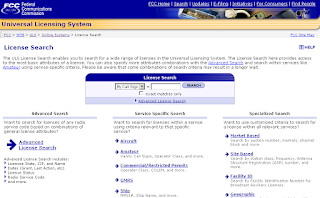
All you need to do is to go to the FCC's Universal License System (ULS) site and renew online.

A few "quick notes":
  • *If you have a vanity callsign (like I do) you will need to pay the vanity fee (currently $13.40 as of the posting of this article). This fee can also be paid online.
  • You cannot renew until it is 90 days before the date of expiration and up to 2 years after the expiry. If you wait to renew after the expiration date, you CANNOT transmit on amateur radio frequencies from the date of expiration until it appears in the ULS as renewed! If you wait until after the 2-year grace period, it cannot be renewed, you will need to take the Technician Class exam to get re-licensed.
  • This whole renewal process will NOT be instantaneous, it may take several days to process, so the sooner you fill out the renewal request during the 90-day window, the sooner it will get processed and you will not have to chance an interruption from using ham radio.
  • If filing online is still not for you, then you can still print and fill out the Form 605 and file via snail mail. That's free as well. Also, the ARRL will do it free for members, but Vanity calls are $13.40 + $5 for processing.
Find your FRN


You will need to know your FRN (FCC Registration Number) in order to renew. Don't know it? Don't worry, all you need to do is look it up on the ULS search page.

To search for your FRN:
  1. Go to the ULS main page.
  2. Under the "Search" area, click "Licenses".
  3. In the search page enter your callsign.
  4. Locate your callsign. Under the "FRN" column (in the center) is your FRN that you will need to log in and renew your license. Write it down!
If you already know your FRN and password, go to the login page, sign on, and wait for me down below. Otherwise, continue on...

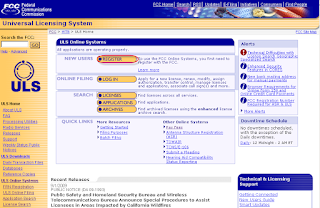
Chances are, you've never had to use ULS before, since either you've been a ham for less than 10 years, or renewed it before ULS online renewal was enacted, let someone else do it for you, or you got a new callsign (due to vanity request or license upgrade) and the 10-year term was reset upon the issuance of the new callsign. Therefore when you get back to the ULS sign-on page, click "Register".


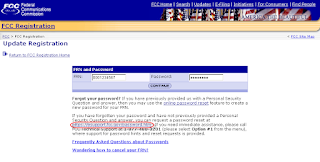
When you get there, you will have 3 options, click "Update" in the middle.


Personal Security Question

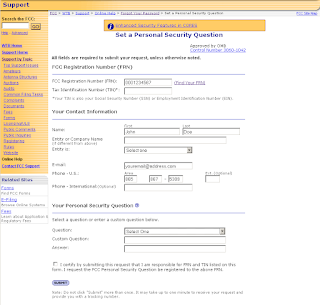
Now, if this is your first time using ULS, you probably have not set your Personal Security Question. If you have previously set up your Personal Security Question, skip to the next paragraph. If you have NOT set up a Personal Security Question, you will need to fill out an online request form and someone with the FCC will manually set this question and email you once complete. This may take a couple of days! To get to the request page, click the link that takes you to https://esupport.fcc.gov/password.htm.


On the next page, click "Set your Personal Security Question" and the next page is where you fill out the Personal Security Question you want to set.


You will need your FRN, enter your contact info, and provide a current email address, then set whatever you want for your Personal Security Question. You can either choose a preset question from the dropdown menu, or set one up that you alone will know.

Again, someone contracted with the FCC will set the question and answer you chose so once again write it down!

Reset your password

Once you have received your email from the FCC that the Personal Security Question has been set up (or you already know it and skipped the previous paragraph) you will need to set your FRN password.
  • From the ULS main page, click "Login", then go to the link to contact tech support, then click the link to reset your password.
  • Enter your FRN (you did write it down, didn't you?).
  • Answer the Personal Security Question you set up.
  • Enter your new password (minimum 6 characters, combination of letters, numbers, and special characters (I highly recommend you do NOT use your callsign (if it was a 2X3).
  • Once your password is reset you may get a notification from the FCC advising that your password was reset.
Time to Log in to the ULS

Hopefully you haven't given up hope and are not shilling out $5-10 for someone else to renew your license at this point. We're almost there, I promise!

You've gone through setting up your Personal Security Question and/or password, so now it's time to log in.
  • From the ULS main page, click "Login".
  • Enter your FRN (again, you did write it down somewhere?) and password.
  • You should now be viewing your information (callsign, address, etc.):
  • On the menu to the left, you will see a link to renew your license so click the link.
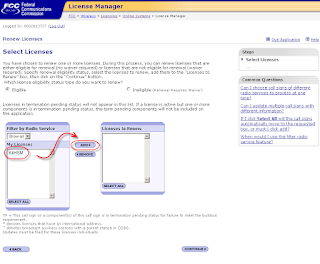
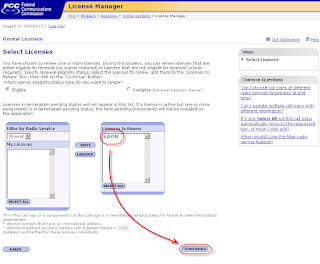
  • The next page will show your callsign in a box on the left (you should have "Eligible" selected above the box with your callsign). Click you callsign to highlight it, and the select the "Add" button in between. Scroll down to the bottom of the page and click "Continue".
  • Follow the remaining instructions to finish the registration and submit once you are ready.
If you have a Vanity call, you will be prompted to pay the fee associated with renewing a Vanity callsign once the renewal application has been successfully received. It will be in a "pending" mode until the Vanity fee is paid. I plan cover that process in a later posting.

And that, my friends, is what they're charging you for. So now, if all has gone through successfully, you will be placed in the queue for renewal. It shouldn't take more than a couple of business days to get updated in the ULS but give it up to 10 business days before attempting to contact the FCC for an update. Check the ULS for your callsign and note the expiration date should now read 10 years from now. You should also receive an email confirmation.

I admit for some this may be too much, but if you stuck with it this far, you hopefully saved a bit of money. If not, then you're not out an incredible amount of money if you let someone else do it for you. But still, why pay someone else to do a job that you should be able to do on your own for free?

I'd love to hear from anyone who followed these directions and get some feedback one way or the other. Also, if you could proved additional screenshots (especially if you have to renew your Vanity) I would appreciate it, as I never thought to grab screen captures while renewing mine, but then again, this idea didn't occur to me until after the fact. If you have a sequential callsign that's due for renewal, I can try to help if possible. My email is gregk4hsm at gmail dot com.

Wednesday, December 9, 2009

Morse Code keyer manufacturer moving to Knoxville

Today I found that Scott Robbins, W4PA was buying Vibroplex and moving the company here to Knoxville.

I met Scott at a RACK meeting several years back. He was working at Ten-Tec and was notorious as a contester (before retiring last year).

He was the guest speaker and gave an example recording showing how he can use two radios simultaneously to make contacts during contests. While tuning with one radio, he's making a contact on another. I don't know what he did for writing down the contacts...

It's good to know that there's some economic boost around here. Even if it's "ancient technology". Wonder if he's hiring?

Saturday, November 14, 2009

Meet my daughter, KJ4QNH!!!

Nearly a year ago, I posted that my daughter Lauren was studying to be a ham. Unfortunately, with school, life, girl scouts, and basically everything else getting in the way, we were limited to 1/2 hour Q&As once or twice a week on much of what she already studied, and a few sample tests on QRZ, most of which she missed passing by a couple of questions.

As summer approached, I was looking forward to sitting down with her and studying, but she would lose interest (or rather, she was wanting to play with her friends, watch TV, play her Nintendo DS, etc.) or I would not be able to help her due to household "honeydews" that were never-ending.

I was determined not to force her in to doing this. I didn't want to pressure her, and only wanted her to get her license because she wanted to do it, not because I (or my wife) wanted her to. I walked a fine line between encouraging her and making her. I figured if I forced her in to studying, it would only discourage and block her from wanting to get her license, but I would often remind her that she needed to study.

I would occasionally ask her "are you still interested in getting your license?", and she eagerly replied she was determined to get it.

We continued to study together whenever possible and even my wife (Jessie, K4RLJ) was occasionally helping. Her biggest stumbling blocks were the frequencies allocated to Technician class licensees, what bands belonged to what frequencies, and the questions relating to Ohm's Law.

Then I remembered that on occasion ham groups have all-day classes followed by exams that same day. I was listening to a local net and caught some guys talking about one that had just occurred the Saturday prior and decided to email some folks and ask if there was any more such groups that were going to take place anytime soon. I was met with 4 different groups conducting such classes, but none were here in town. One was 2 hours south in Chattanooga, another in Kingsport, and yet another in North Carolina.

I then got an email from a friend who was a VE for W5YI and was going to have a class in my wife's hometown of LaFollette (about an hour north of here) and checked with Lauren and we decided we would do that one.

I gathered that this would be the key to Lauren's passing her test. There wouldn't be any TV, internet, or other distractions and she could focus completely on the task at hand. Plus she had been studying off-and-on for over a year, so my wife and I were confident she would focus her efforts and possibly pass the test. We didn't expect her to pass, but we didn't expect her to fail, either.

I did this once before with my sister-in-law when she was about 13. That one was an all-day session, where one person read off all the questions, and the correct answer, and they moved on to the next question. They then took the exams the next morning. Unfortunately she failed her test.

She did eventually get her ticket after studying and my wife took her to an exam session in Lafollette scheduled just for her. She did not, however get much more involved and her license has expired. If she wanted to get her license, she'd have to re-take the test and get a new callsign.

This session was different from my sister-in-law's. We met at Paradigm Church, which was located at a small shopping center on the far end of town. There, they gave her the questions and correct answers on a study sheet and they let everyone study at their own pace, without reading the pool aloud.

There was one person who was blind, and while Lauren was studying, several of us who were sitting around with nothing to do decided to help him and went into another room and read the questions and answers to him. His father who wasn't licensed either helped out as well.

They would study for 45 minutes and then take a 15 minute break. There was a 90 minute lunch in between.

The guys there were very nice about providing pizza for everyone and a few drinks to pass around. It was small, but quiet, and Lauren was concentrating like I've never seen before.

The study session was scheduled to last until 4PM, but Lauren had already gone through the pool by 11AM. She wanted to take the test right then, but there wasn't enough VEs to administer the examination. I quizzed her on several parts and she would miss one or two, and I would have her go back and re-study those portions. Finally, as the afternoon went on, the VEs arrived and started to fill out the Form 605's for her to get her exam when they asked for her picture ID...and guess who forgot to pick up her picture ID...

I suddenly entered a panic mode. I called Jes and proceeded to freak out asking for anything with her picture on it. Her school had picture IDs produced for those times when they might (god forbid) get lost or missing and I fortunately had one in my wallet. They asked for a photocopy. And guess who didn't have a copier in his back pocket...

I then scoured the town for someone...ANYONE...with a copier handy. The local pharmacies didn't have them anymore. For once, Walmart didn't have what I needed. All the check cashing places with copiers and faxes were all closed. Fortunately there was a rental place open at the local mall and I was able to coax the person behind the counter to photocopy the ID.

By the time I got back (30 minutes later) the other two who were studying alongside Lauren were in the middle of their tests, and Lauren was waiting on me with the photocopy.

We filled out the paperwork, handed over her $14 application fee, and away she went. It was hard not to stare at her while she was taking the test, but I fought the urge as best I could.

20 minutes later, she turned everything in. And we waited.

And waited...

Aaaaaaand waited...

I couldn't get any kind of yea/nay from the VEs one way or the other. We sat there patiently while they graded the other tests and hers. I would see them mark the test and pray it wasn't hers they were bleeding red ink all over.

They told one of the others that she had passed, but hadn't told us if Lauren passed. The longer it went on, the less confident we felt that she had passed.

Finally, the VEs called her up to sign her name on the CSCE. "So she passed?" I asked. "Well heck yeah she did!" was the reply, and Lauren smiled as bright as she possibly could.

We called Jes, her grandmother, some friends, and I posted her success on Twitter and Facebook and the kudos came in from hams the world over.

She missed 7 of 9 questions she could miss and still pass the exam. It took 11 days to get her callsign as the FCC was slow to process the paperwork and Veteran's Day also had an effect on the delay.

Earlier this evening, she had her first QSO with Jim, KQ4AB, who was the man who was overseeing the test session. At first I thought I would be her first QSO, or maybe Jes, or a couple of friends of ours who have kids that are hams, but I thought that she should check in to his net and have a quick QSO with him. He got a kick out of it and I recorded it on my cell phone. Here's the video.

So now, I have a wife and daughter who are hams. Just one more daughter to go. And she's cracked open the book and begun her journey. It may be a couple of years (she just turned 8) but she's determined to be like her sister.

I couldn't be happier.

Monday, October 19, 2009

Hey "balloon boy", you're doing it wrong!

Like many of you, last Thursday I was glued to the TV watching this "UFO" over Colorado with what was believed to be a kid inside the lower compartment. Thousands of feet over land, thoughts were the obvious for me: Was Falcon Heene cold? Did he have adequate oxygen at whatever altitude he was located? Was the helium mixing with the lower compartment? Was he even on board?

I was relieved when he wasn't on the balloon and then began to wonder where he was. I was out of the house shopping for clothes for a funeral when I got word he was found at home.

I've dabbled with high-altitude balloons over the last 3-4 years, most notably trying to get one across the Atlantic. I have a little bit of knowledge about helium and zero-pressure balloons like what we used for the attempts. I'd like to think I, though not the expert, had a little more than the average bear about what was going on. So when I saw the balloon in the sky with only helicopter cameras and high-def zoom for reference, I couldn't judge just how large this balloon was. It could have been 30' in diameter, 50', 100' maybe? It wasn't easy to determine.

Then, when I saw it coming down to the ground, only when I saw the rescue person chasing after it did I see how big it truly was. I gathered it to be 10-15' in diameter after using the chaser for reference (see below).

When I saw the balloon's true size, it couldn't possibly lift off the ground with a 6-yr-old, much less carry him 50 miles.

I had my doubts based on what I did with launching balloons for Spirit of Knoxville back a couple years ago. I've emptied large tanks of helium into a 1500kg latex balloon and it would have maybe 15 lbs of lift.

How, then could a 50 lb boy (rough guess) reside in a roughly 20 lb "UFO" (another rough guess) with that much helium? It didn't seem possible, at least to me.

My suspicions were validated when the balloon turned up no boy inside. Only after the drama did we see the actual launch of the balloon, and even there I was stumped at how people might think a child was in there, as flimsy as it was slowly climbing into the sky.

I am on a couple of ARHAB mailing lists, and this was a hot topic for those who are more adept at calculating lift, volume, and the specs of what size balloon would be needed for lifting large payloads (like children). However, the debate was somewhat divided, several thought the balloon might be able to lift 60+ lbs of human into the great beyond, and others (like me) felt it was not possible. Of course, I weighed in more of the stability of the craft as opposed to just lift vs load.

In the image to the right, this was SNOX II, our 2nd attempt to send a payload up and out over the Atlantic. The balloon is what's called "zero-pressure". There is an opening at the bottom to vent excess helium as the balloon climbs to a higher altitude and the balloon expands. The venting of helium balances out the lift/load ratio, and once it has reached an equilibrium, will cruise at altitude for several hours. If you look carefully, the bubble at the top of the balloon is filled with about 13 lbs of "positive lift" helium. Below it is an anchor, but the payload was just under 12 lbs, the maximum legal size payload we could use for FAR 101 exemption of balloon flight rules. I'm holding the payload and ballast to the right of the balloon, by the way...

Now, compare the bubble in the SNOX balloon to the helium that filled the "UFO" in the picture above. Even with one side of the "UFO" deflated, I'm speculating that the helium in the SNOX balloon is roughly a third the capacity of the Heene balloon. 13 X 3 = 39 lbs of positive lift. Give or take 10 lbs, is it possible the "UFO" balloon could haul a 6-year-old boy?

I am certainly not an expert mathematician. I did well in math until we started subtraction in Kindergarten, and it was downhill from there. However, even looking at my past experience I certainly think there's no way that the Heene balloon could have ever gotten off the ground.

Now, it looks more like the whole incident was an elaborate hoax by Richard Heene and his wife and kids, who were also in on it. You have to ask what kind of deranged mind would concoct such an elaborate hoax as this, but then again, I've never watched Wife Swap to see just how insane he is.

I'm not one who would do some of the things he's done, such as taking my kids tornado chasing or hurricane chasing. The closest I've come is taking my oldest (Lauren) with me to Foothills Parkway to watch an approaching thunderstorm system, and that frightened her to where I decided not to do that again anytime soon.

Who knows what Heene was thinking when he came up with this scheme. I'm just glad he's not a ham operator. Who knows what kind of trouble he would cause then...

I do think, though, a "reality show" about a balloon autonomously crossing the Atlantic would sell much better to TV execs than whatever he had going on.

Tuesday, October 6, 2009

Congrats to George's daughter

TWIAR's producer George Bowen, W2XBS left the following on TWIAR's web site:
My apologies for not having TWIAR edition #860 available on the web site. This weekend, my daughter and Bill Barans son Zachary successfully passed their technician exams and should have their call signs this week. This endeavor to have yet another ham in my family has taken up considerable time, which resulted in edition 860 not being available. Please look for a brand new This Week in Amateur Radio and TWIARhn (Edition #861) this coming weekend October 10th. This weeks Edition #245 of TWIARi International is now up and available.
73 George - Executive Producer

This Week in Amateur Radio
Looks like George has a decent excuse this week.

I've been trying to get my daughter Lauren (age 9) motivated into getting her ticket before next June, when the question pool will change. We got started late in the summer, and she was very motivated. But, as time went on, she started to get distracted with her friends, TV, etc. My quagmire is that I will not push her because I don't want her to get licensed because I want her to, but because she wants to get her license.

It's tough to keep her motivated and not seem pushy. She hasn't looked at the book for a couple of weeks now. But, my other daughter Amber (who turned 8 last Sunday) has now expressed an interest in ham radio as well. Perhaps a little competition is good for motivating them. They tend to be competitive in many things (as sisters tend to be) so maybe I need to light a fire under Lauren by teaching Amber.

I also can try to find an all-day class where they spend about 8 hours learning the question pool, and then they take the exam the following day. Problem is, where to find one around here?

I took my sister-in-law to one of these classes when she was 13 and very much interested in getting a license. Unfortunately she didn't pass the exam (missed by 3 questions) but she kept at it and got her license about a month later. She ended up letting her license expire, but she spoke to me recently about wanting to get it again.

Maybe I ought to conduct my own session with all three of them. Although my patience threshold would be equivalent to that of Lewis Black.

Thanks but no. I'd better find someone else to lead the classes.

Sunday, October 4, 2009

Autopatch...who uses THAT anymore?

Back when I got my license in 1993, cell phones were nowhere near the "state of the art" they are these days. In fact, 7.6 million had them in 1991. Now, 203 million of us in the U.S. alone have them.

They were large, bulky, and heavy (look at the monstrosity to the right), they lasted for all of a few hours on a charge (without talk time), and if you did use them, you were either charged a ridiculous amount of money per minute, or you had limited talk times per month. And don't even get me started on roaming charges...

Because only doctors and celebrities could afford these miracles of modern technology, the "poor man's cell phone" was the autopatch, or a phone patch hooked up to a repeater. Back in 1993, we had 3 repeaters in Knoxville with autopatch capability, and all were open for use. I was fascinated to listen on a scanner to hams using the patch to call home, find out what they needed to pick up from the grocery store or the fast-food joint, or just to see if little Johnny got home from school okay. Every so often a 911 call would roll in and usually it was a car wreck where people were banged up but okay.

There were those who used it daily for the same thing over and over. One in particular would call his mom and ask her what she needed, and every time he called, she said the same thing: "Pick me up some 'see-grets'," or "cigarettes" as we would say.

Some hams would never have a QSO with anyone other than the autopatch. I can recall many hams who would make their patch call then leave, never to be heard from again until the next time an autopatch was needed.

My first autopatch call was to my mom, if I remember correct. She wasn't too thrilled. She didn't like the "one-way" aspect of it where I couldn't hear her unless I un-keyed the mic. Still, it was great to have the ability of calling home while on the from work to see if I needed to stop and get something along the way, or call my then-girlfriend (now the wife) to check on things.

Knoxville must be the exception to the rule, because just about any other city I've been to, from Des Moines to Destin, not one phone patch outside of Knoxville was "open". They were off the air, toned with an unpublished tone, or a code was needed to be entered that the repeater owner needed to provide (and who were they to do such a thing?). I can recall one repeater trustee in Florida who said flat out he wouldn't give out the patch code to "foreigners" like myself. That ended the otherwise pleasant QSO immediately and swearing off of "his" machine.

One repeater here in Knoxville had its user base centered around the autopatch, and it was not unusual to see 50-60 patch calls made per day. Along with funny IDs, weather info, and an occasional TWIAR or Newsline airing, it was a happening repeater.

Then came the modern era of telecommunications. Phones got smaller, smarter, and most importantly, cheaper. My first cell phone was circa 1996. I got a whopping 60 minutes per month to use, at $49.99/month. My first cell phone was the popular Nokia phones with that "Snake" cell phone game that was so addictive. Text messaging? Wasn't that what beepers were for?

Over the years, as cell phones gained popularity, autopatch use was inversely proportional, and nowadays one autopatch call a day is above average. I myself have not used an autopatch for several years. Until today.

Today is my younger daughter's birthday. So one of her requests was to have a sleepover with her friends. And my other daughter's friends. And their sisters. 9 kids (including my two) camped out in the living room overnight last night. All girls. Then there's my wife, and our two dogs and a cat, all girls. I was drowning in an Ocean of estrogen.

This morning I get (rudely) awakened to the sounds of kids hollering about how hungry they were (similar to birds when the mom brings a worm to the nest) and my wife dispatched me on a mission to get doughnuts from the nearby Krispy Kreme. The task was simple: One dozen plain glazed and one dozen with rainbow sprinkles. I arrive at the doughnut shop and discover the rainbow sprinkles have been substituted with brown and orange Halloween Sprinkles since it's October. To make sure I don't scar my daughter for life I decide to call my wife to ensure I can get these sprinkles. Alas, I discover I have left my cell phone back at home, because I was still in a stupor heading out the door and forgot to take it with me.

So I go back to the Trailblazer and get on my ham radio, trying to remember how to use the autopatch. Back "in the day" one repeater had the simple "* up, # down" method, where you keyed the mic, announced your call, punched in the * key followed by the 7-digit number, then listened for the repeater to acknowledge the connection and read back the phone number. Another repeater (Tim Berry's WB4GBI on 147.075) was slightly different. You had to key the mic and push *, listen for the dial tone, then key up again and punch in the phone number. An extra step, but nothing like the one used by the local radio club. I can't even remember the sequence, but it was like a 3-digit code to get the patch up, then the 7 digits.

It had been so long since I needed the autopatch, things changed a bit. One repeater's autopatch I couldn't access, so it may be offline (the repeater trustee sold the machine when the club running the repeater dissolved) and the other machine (147.075) changed its format to *up, # down without the need for listening for the dialtone.

Attempt #1 succeeded, but no one answered the phone and I left a message begging for someone, anyone to pick up. Strange, since there's 9 kids and my wife, someone SHOULD have heard it. I call again, and again, I get the answering machine. Since the machine is working, I know my house hasn't burned to the ground, so I try my wife's cell phone. For some reason, it didn't want to connect all 7 digits on that attempt. I try again and this time it connects, but I get her voicemail.

I then decide to make the executive decision to get the doughnuts with sprinkles. In the end, I made the right choice. My wife claims she was not near the phone and it was in the bedroom out of earshot (apparently the 100 decibel level of kids drowns out a phone/answering machine) and the cell phone was on vibrate and she didn't have it on her.

It never ceases to amaze me how the best technology built into a cell phone is useless when you don't take it with you. But it's nice to know that the autopatch is still there "when all else fails".

Saturday, September 5, 2009

My "QSO" with Wayne Green, W2NSD

September 5 marks an anniversary of sorts.

Recently I was cleaning out the shack and came across a bunch of old magazines (Monitoring Times, QST, CQ, SERA Repeater Journal) and found one issue of a magazine I regretted buying; the August 1998 edition of 73 magazine.

I'd seen it at the newsstands and caught an issue or two as I was perusing the magazine racks at Books-A-Million. I'd see them at a radio club gathering sometimes, but otherwise paid it no mind.

I bought this magazine and had it on the kitchen table for a few days, until I finally had some free time and cracked open the magazine that would expose me to the ever-infamous (if not shameless) Wayne Green.

The articles were not that interesting, to be quite honest. How to build a FET probe, updating old linears, and a review of the Kachina 505DSP computer transceiver (on the 133 Mhz Pentium processor) were the big stories. Then, as I was finishing up the magazine I caught the "Never Say Die" editorial (and I use that term lightly) that started on pages 4-5, continued on page 37, then to page 71, and then from pages 80 to 86.

A full 11 pages of commentary. How much of it was about ham radio? The first four paragraphs where he eulogized the late Sen. Barry Goldwater, and he couldn't even complete that section without going into some diatribe about preventing strokes and how Barry would have kicked ass as President (one thing Wayne and I actually agree on).

He then went on to discussing about a "performance" (why can't he just call it a speech?) he was giving in Peoria and how he wanted to talk about a variety of topics. And then he started hocking his literature.

Page after page after page was spent on some of the most unreal subjects one could possibly imagine being in a ham radio magazine. I can understand if someone wanted to put this kind of stuff in After Dark magazine, but in a ham radio publication??? I ended up referring to the magazine as "Seventy-turds".

Here is a copy of that "editorial". He and I had an exchange on that archaic form of communication called snail mail. Even though I was on the internet in 1998, apparently he wasn't. Yahoo, Infoseek and AOL Webcrawler (how's that for old school) yielded no results for pages he might have, and Google? What was that?!?!?!

Even though the internet was relatively young, a lot of businesses were already getting online. 73 wasn't one of them. So I hunkered down and wrote him a letter, which is below. He responded to me in a letter dated 8 days later. It's below my letter.

Just as an FYI: I had only been in ham radio for 5 years that year (callsign KE4HSM before I dropped the "E" through the vanity call system), and Wayne Green was not someone I was familiar with. I brought him up one night soon after on a net and the reaction from the locals was one of "you mean you've never heard of him?" While I was not familiar with him, I had heard of him and knew he was a publisher. That was all I gathered from him. Little did I know...

This would be the only time he and I corresponded. There was no need for anything more after those letters and you'll see why. Basically we spoke our peace and moved on with our lives. You can read the letters here or continue below.

First, my letter to Wayne, dated September 5, 1998:
Dear Mr. Green:
Recently I went into a bookstore to pick up some publications and decided to "test drive" some of the Amateur Radio magazines on the newsstand. I came across the August issue of 73 magazine and bought it along with a couple of others.
I began to read your magazine and found the articles inside somewhat mediocre. I then came across your editorial. Is is of your editorial that I write to you today.
The first think I noted was that your editorial took up a large chunk of the magazine, seeing as to how it was 10 pages long and spread out over 80 plus pages of your magazine. I figured you must have either had a lot on your mind or it was a slow news month.
It started out with a brief remark about the late Senator Barry Goldwater, K7UGA, then a minor blurb about the Dayton Hamvention. Then the rest of the editorial I found to be absolutely ludicrous a total waste of my time reading it [sic].
Mr. Green, your journalistic integrity (or lack thereof) makes me wonder how you maintain any subscribers other than those who use it for a good laugh. What in hell does your "conspiracy theories" about the moon landings, Mozart's music, the educational system, capitalism vs. socialism, refined sugar, Russia's nuclear missiles, and smoking causing impotence (among a host of other ridiculous topics), have to do with the Amateur Radio community or HAM radio in general?
What makes me even more outraged is the fact that you shamelessly promote your "fine line of products" and hock others' as well throughout your "editorial". What do I care about your wife's $15 video of how NASA could have faked the moon landings, and your subsequent $5 booklet on the same asinine topic? What does your $5 book on El Niño and volcanoes have to do with HAM radio? Where does HAM radio play into this load of BS? I found that this indeed was not an editorial, but rather a long-winded infomercial in print form.
I read it through in case there was a grander scheme that you might be leading as to how some or all of the aforementioned topics related to HAM radio, but I could not find any. Would someone pick up a copy of an outdoors magazine to find out how to attract aliens from faraway worlds? Would someone read a computer magazine to find out how to clean a gun? I think not, and just as well I would not expect to pick up a HAM radio magazine to read how I could feel better drinking ozone-ated water.
This was not journalism, but rather cheap self-promotion and shameless selling out. I cannot believe I wasted my $4 on this "magazine". You can bet it will not happen again.
Regretfully
Gregory S. Williams
KE4HSM
Now granted, I was a tad coarse in my delivery, but I was honestly pissed off. I didn't regret writing it. I wondered if it would appear in a future edition of his magazine (I never found out). Yes I did capitalize HAM back then, only because I believed the story of "station HAM" which looks to be an urban legend. And yes, those topics were all covered in the editorial.

His reply was September 13. It was a Sunday, so I suspect I received it the following Tuesday or Wednesday. Just the letterhead of his reply was practically a letter in and of itself.

Here now, is his reply:
Dr. Wayne Green W2NSD/1, Ph.D., Editor-Publisher
Assoc. Professor of Energy, Institute of Basic Research
And a bunch of other even more impressive credentials which my legendary modesty prohibits me from listing
Gregory .........
My editorials must be an acquired taste. I've been writing long editorials like that about anything I have found interesting for 47 years so far - and in all of the 25 successful magazines I've published. Clearly, I've failed to get you to think, which I regret.
Oh, we tried not running my editorials in 73 for a while - and watched in horror as the circulation dropped in half. The reader feedback cards almost invariably rate my editorials as the best part of the magazine. Are they all out of step, or you? You do come across as a negative person - which, if true, ell substantially shorten your life, plus make life a lot less fun for those around you. You didn't say what business you are in, but I recommend you don't get into publishing.
With amateur radio rapidly dying as a hobby I'm hoping to at least keep what hams we have alive for 30-60 years more than they would if they continued to live as they have. I'm also doing my best to show them how they can make all the money they want by getting off the treadmill.
Most hams seem to have an interest in new ideas, though there are, of course, some who are monomaniacal. QST probably fits their mind-set better.
Oh yes, if you were actually interested in news ideas, what magazine would you buy to find them? Since John Campbell, W2ZGU, the editor of Analog died (he smoked), I don't know of any other than 73 and Nexus (an Australian magazine).
73...
Wayne
And there you have it. I never got an answer to any of the questions I asked, but instead got a dressing down for being so "close-minded". If I was so negative, who was the one claiming ham radio was a "dying hobby"?

Maybe he should have taken my correspondence a bit more seriously, for 73 abruptly ceased publication 5 years later in October of 2003.

One would think that someone with all those credentials too numerous to mention would have a little money stashed for those times when his multitudes of subscribers and fans don't pay for their subscriptions...

I don't have a problem with his opinions, but his method of ramming those opinions down our throat and taking $4 in the process left a lot to be desired.

Happy Anniversary, Wayne. 73 for now.

Monday, August 31, 2009

Sam Brown, WA4IUM, SK

For those outside of East Tennessee, and perhaps Pittsburgh and Chicago, you may not know a lot about Sam Brown, WA4IUM. He was an TV and radio journalist for many years, an anchorman most notably for Knoxville stations WATE and WVLT (then WKXT) before heading into the private sector and teaching at the University of Tennessee.

If you're a ham, especially a ham living outside of the US, you might be familiar with him, as he was a perpetual notch at the top of the DXCC tree. I remember reading many issues of QST and seeing his name at the top of the list, occasionally 1 or 2 from the top. At last check he worked 346 of 394 countries (mixed).

I first heard of the death of Elvis Presley from Sam Brown on August 16, 1977. He was a nightly fixture for getting local, state, and national news. He delivered it the way journalists should, unbiased, unabated, and as professional as you could get. He won four national Edward R. Murrow awards for his work at radio station WNOX.

Last week, Sam died unexpectedly at 59 years of age. It came as a shock to me to hear this. Sam was a pillar in the East Tennessee community. He was active in many amateur radio clubs and was instrumental in getting UT's radio club their tower on top of Neyland Stadium.

I only met him two times on the radio. Early one evening I was driving home with my wife and I heard him key up a local repeater and no one came back. I recognized his call instantly and decided to reply. We ended up chatting for 20 minutes (10 of which were in the driveway at my house, with my wife listening) about our attempt to contact Norm Thagard on the Mir (our first meeting) back in 1995 and my writeup in the local radio club's newsletter about how I attempted to contact Norm's replacement Shannon Lucid and eventually succeeded.

He said he remembered reading my story in the newsletter and complimented me on my writing of the article. To hear someone who's as accomplished as Sam was tell me he liked my writing was nothing short of phenomenal. That's like being told by Tiger Woods, "Hey, nice tee shot!".

That QSO was one of the most memorable ones I've ever recalled, and I will cherish that moment as one for the record books. Unfortunately most hams won't know of his accomplishments and contributions to ham radio. The ARRL hasn't posted a story on him. I guess you have to be damned near a celebrity, world leader, or ARRL cheerleader. Then again, he practically was a celebrity. At least here he was. I'm not going to say that the ARRL should post every ham's obituary on their front page. But for Sam, he was truly a remarkable person and one I think many hams around the world (at least one person in 346 countries) would recognize.

Saturday, August 15, 2009

Adventures in Zero-land

There are some things I wanted to do before I left this world, and traveling to the midwest was one of them. Given, I was intending to go storm-chasing, and considering that it was just visiting my sister-in-law's home, and still "tornado season" in the midwest, the chance to go to Iowa was too good to pass up.

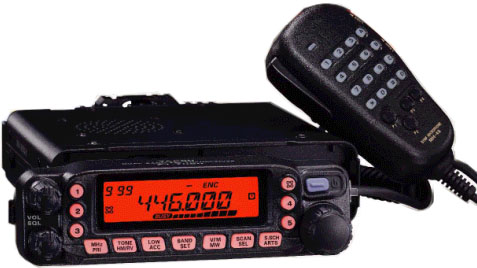
My sister bought and flipped a 120-year-old home in a little town south of Des Moines called Truro. It would take us 16 hours to get out to the house in question. I spent 4+ days getting a dual-band radio installed so that I would have some radio time while on the way to and from Iowa. The big question I had was, would anyone want to talk to me?

I must admit, getting a contact on a repeater has been a bit of a challenge in recent treks around the southeast. When the mobile was installed in the minivan, I often spent countless hours looking for contacts on repeaters and simplex to no avail. Trips to Myrtle Beach, Winston-Salem, Huntsville, Ft. Walton Beach, and Nashville were often met with silence, no matter if it were the middle of the day or the dead of night. I even took my FT-530 to San Diego last year and wasn't able to make any repeaters anyplace. The ones I were able to hit, no one would answer. I wondered if I was even making it in to the repeaters but I guess I'll never know.

So we embarked upon our journey around midnight on a Thursday night/Friday morning. We picked up my sister-in-laws friend who lives in Iowa and we all rode up I-75 towards Lexington, KY.

I spent most of the first couple of hours talking with my friend Jason, KF4VDX on his repeater, then we moved to a repeater in Petros (NW of Knoxville) and linked to a repeater in Williamsburg, KY. He came in on one repeater, and I talked with him on the other. About an hour north of the TN/KY line, the repeater faded in the distance and we had to end our QSO. At one point in time some years ago, we probably could have continued on using the FARA linked repeater system, linking KY, OH, IN, and MI. There was a repeater in Knoxville that was installed to the linked system, but it only lasted a few short months before a storm took out the link from Knoxville to Kentucky. We decided we would try Echolink if possible while in Iowa.

Overnight, the drive was lonely, broken up by conversation in the car of ghosts and ghouls, and it was conveniently told to me that this house we were going to be staying was reportedly HAUNTED! So we passed the time telling one ghost story after another, and sure enough I wasn't going to sleep at the wheel...

The night was quiet, and I tried several repeaters in the Lexington and Louisville areas as we trudged north and west. We stopped a couple of times, between Louisville and Indianapolis. And about an hour before Indy, I tried 146.700 and struck up a conversation with K9NQW. We chatted for a while, discussing the usual banter new contacts tend to discuss. I would later get a QSL card from him after I returned home, and it was a very pleasant surprise. I just replied back to him this week with my own QSL card, something I haven't done in a couple of years.

After we by-passed Indy and its Friday morning rush-hour bedlam, (we arrived around 7AM Eastern time) we got on I-74 going towards Illinois. My wife drove as I dozed off and on (I don't sleep very well in the car) so the radio was quiet as she and my sister-in-law's friend chatted.

At one point on the drive near Peoria, I was tempted to head a bit further west towards Macomb, IL. Some friends were down there, but it was unannounced, and I hadn't heard from them in some time, so I wouldn't know where they lived. Still, it was tempting to take a trip and see if their LPFM radio station was still on the air. However, time was getting the better of us, and we continued onwards towards Davenport, IA.

Between Champaign and Peoria, I stuck up a QSO with three hams (their callsigns escape me, and the notepad I wrote them down on went MIA) in the area. They were very helpful, telling us about traffic issues, talking about other hobbies (one was into bicycle riding and spoke of wanting to bike the Smoky Mountains) and recounting war stories of QSOs long past. It was also the first storms we encountered in this area. It was unique to be able to watch the storms from several miles away, as opposed to having the horizon obstructed by mountains and rough terrain as we would in Tennessee. These storms were not severe, however, so no storm chasing for me to embark upon as a detour to the monotony.

The showers were brief, and we continued on towards Iowa. We passed Knoxville, IL on the way to Davenport, but couldn't stop to take a picture due to construction in the area.

Along the way, I sent messagea to my Twitter account to see if any hams would try to contact me while I was on the way to Iowa. I'd send my location and repeater(s) I was monitoring. Unfortunately, this experiment was all for naught. No one mentioned my Twitter page when talking to them. But considering that I was having many QSOs as it was, Twitter probably wasn't necessary anyways.

When we crossed the Mississippi River into Iowa and interstate 80, I found another ham on a repeater in the area. As we talked we passed an airport, and I instantly recognized "Fat Albert", the Blue Angels flight team's support plane. I was told there was an airshow that weekend, and the Blue Angels were the main event. We discussed returning on Sunday for the airshow. Unfortunately we were not able to make it.

During the trip, my wife would thumb through the Repeater Directory and read off whatever repeaters were on 2m and 440 in whatever cities showed up on the signs along the way. I was surprised that a great majority used tone access. Back in Knoxville (Tennessee, that is), tone access was almost unheard of. So few repeaters employ tone access in the area. (NOTE: As I wrote this, I checked and found that Iowa repeaters were mandated to have tone access in 2007). At one point in 2004 SERA (the South Eastern Repeater Association) attempted to mandate tone access, and I was one of many who cried foul. My biggest complaint was that in times of emergency we may not have the luxury of trying to figure out the tone of a repeater as we're trying to access it for any emergency traffic. I was aware many areas were using tone access to curb interference (intentional or otherwise) but I guess back home we're just a tad different. In fact, one group of folks tried to get East Tennessee repeater owners to secede from SERA and start their own repeater coordination body. While I sympathized with the breakaway repeater owners, I didn't necessarily support the idea of a new coordination group, but I wasn't a repeater owner, just an avid user. Eventually, SERA backed away and decided to wait until a later time to "re-evaluate" the policy with more input from repeater owners, and not just a few coordinators trying to speak on their behalf. The storm eventually died down, but I think a lot of damage was done and interest in SERA waned for a time. I have yet to renew my subscription to their journal, though I need to get another issue soon.

Back to the story, though. After we had a late afternoon lunch/dinner in Newton, near a new Iowa Speedway, we started to get excited as we were finally closing in on our destination. I didn't expect the drive through Iowa to be so long. It's much bigger than I expected. The radio was quiet through Iowa City and Williamsburg.

When we got near Des Moines, we hit a severe thunderstorm and an absolute torrent of rain, the likes of which I have not encountered in years, both in duration and intensity. It made me thankful for putting on new tires just a couple of months prior (at $700 no less!) as we hit some of the worst storms I've driven through ever. One of the repeaters in Des Moines (146.820) was designated as a SKYWARN repeater, and as we tuned in, I heard the National Weather Service liaison chime in with weather warnings and bulletins. I didn't dare key up, fearing I'd get a major ass-chewing by someone thinking I was a rookie, despite my having been SKYWARN net control and conducted hundreds of nets in the past. But, after a lengthy period of quiet, I keyed up and requested info from NWS on the path of the storm in relation to my destination. Silence. No one, not even NWS would come back to me. And I know I had the right tone set in, and was 50w into the machine. But whatever the reason, no one was willing to talk to me. As it turned out, I attempted to use this repeater 3-4 more times the week we were in Iowa, and not once did anyone answer me back. This was the only open repeater that I encountered where the locals were not talking.

We arrived in Truro and the rain had been pouring in this little town. The streets were flooded, and the homes on both sides of our place was flooded and running past our house's driveway to the nearby runoff creek. To make matters more interesting, after the rain eventually died down, as I'm trying to unpack the Trailblazer, the nearby tornado siren begins wailing! I joked with my mother that I would chase tornadoes while out here, but now I'm thinking I'm the hunted one!

As it turned out, the siren was signaling the local volunteer fire department into action. Apparently something caught fire from a downed powerline or something. Still, it took me a few hours to reclaim my wits about me.

The next evening I took the family to Knoxville (Iowa, that is) Raceway about an hour east (taking the highways and even a gravel road or two). I'd never been to a sprint car race before, and figured we'd take in the best one in the country. On the way there, we hit up a 440 machine and I had a 10 minute QSO with a guy on his way to working security/bouncer duties downtown in Des Moines. It was a nice way to pass the time as we travelled the highway towards Knoxville.

When we neared Knoxville, my wife looked up the one repeater in Knoxville and found it to be closed. I tried to key it up and it did not reply with a carrier. I decided to do a little snooping and found the tone for it. I know, I probably shouldn't have, but what would it hurt? I'm just some hick from Knoxville (Tennessee, that is) who doesn't know any better, right? The worst I figure is I'd be shooed off the machine. Well, not even THAT happened. I keyed up 2-3 times and gave my call ("K-4-H-S-M, mobile Zero") and got no response. Either no one really was listening (closed repeaters back home tend to be vacant) or they weren't caring to talk to me. Not even on the return trip back to Truro would I get an answer.

On Sunday, I got into another repeater on 2m and struck up a QSO with another ham as we made our way to a museum some hour NE of Des Moines. He was pleasant to talk to, though again his call and name escape me.

I began to realize that the area was chock full of enthusiastic hams who were very friendly and helpful to this 4-lander. I often wonder if I just wasn't hitting the right repeaters back in the southeast when trying to bring on a QSO to pass the miles.

The next day, I went to 6.52 simplex on 2m as we made our way towards Winterset, IA (home of the famous bridges of Madison County and birthplace to John Wayne) and I was stunned when I got an answer from Mark, W0ISF. We talked on simplex, then he invited me to his repeater. If his callsign rings a bell, it's used every year for the Iowa State Fair special event station (going on now as this is published). I would end up talking to Mark 2 more times, including our leaving to return home the following Friday morning. I thanked him for his hospitality and hoped I could talk to him during the fair. As of now I haven't heard them (listening to 20 meters mainly) but I will continue to try.

On Tuesday, I traveled to Western Iowa to see my friend Dale, N0WKF (file guy for TWIAR) for our first eyeball QSO. On the way, again, a couple of good hams talked to me. I tried to reach Dale on his repeaters but he wasn't on the air listening for me. It was great to finally meet him. We stayed for about 3 hours and then visited Council Bluffs before heading back to Truro for the evening. The trip was spent off the air, though, as we were drenched from a sudden shower while on a pedestrian bridge over the Missouri River separating Iowa from Nebraska. I was partly pissed from being soaked, and partly afraid I'd short something while talking.

The journey back to Knoxville, TN was made going south through St. Louis and unfortunately I wasn't able to make any contacts on the way back home. As I approached Wentzville, MO, outside of St. Louis, I tried to find a repeater to raise Vern Jackson, WA0RCR, another TWIAR contributor with the Gateway 160 meter net report. Unfortunately no repeaters were in Wentzville, and I didn't have 160 meters in the car to try. Although that would be a great trick...

Traveling through St. Louis (with a visit to the arch) was a first for me, and traffic was certainly not going to give me any breaks this Friday afternoon. I endured heavy traffic, and although I heard a few QSOs as I scanned the 2m band, I had to drive first, talk later.

After we left St. Louis, we got stuck in traffic, and no real way to pass the time for the 90 mins other than drive/stop/drive/stop. I tried a couple of repeaters on 2m and 440, but no one was there. My concentration was spent on trying to find a way back the other way for a detour anyways, but the two spots where I could turn were Government vehicles use only, and the cops were watching them. I saw people pulled over after making the U-turn, and figured I'd be a sitting duck with TN tags.

After the jam let up (construction that either never occurred or completed for the day while we were stuck) and we had dinner, Jes drove from Illinois down thru Paducah and into Tennessee, but I didn't use the radio. I'm not a good passenger. That's all I care to say about that part of the trip...

Back into Tennessee, I hit the Cumberland Plateau past Crossville and called to Jason, KF4VDX, and sure enough, he was there, almost like he was waiting for me to return. Although I had a great trip out west, it was nice to hear a familiar voice again. He talked me back to the house and my trip officially ended around 2am (Eastern Time) Saturday morning. In just 12 hours, Field Day would be underway, and he and I would try to work it both from his home and from a club outing in Maryville.

Overall, I was pleasantly surprised at the warmth and hospitality both on the air and in person from people all over Iowa. My sister-in-law's house was officially sold 2 weeks after we left, so we won't be able to go back there for "free room and board" next time we go out there. But it made such a great impression upon us, we know there will be a next time.

BTW: No ghosts bothered us while we stayed there. And if I find that sheet of paper with the names of everyone I talked to while out there, I'll add them to this post. If you're one of them, email me.

Monday, August 10, 2009

The great radio install odyssey

Every once in a while it's good to challenge yourself, to think out the processes of how to execute the procedure, and to adapt to changes brought on by obstacles in your way. Such was the case in early June getting a radio installed in my SUV...

I own a 2002 Chevy Trailblazer. It's nice, got it used almost 2 years ago, and with few exceptions have enjoyed the vehicle. I had not installed a ham radio in it as I did not have all the right equipment, the money to invest in said equipment, and I didn't want to drill holes anywhere that were visible or otherwise.

I'm not the most mechanically inclined person out there, and I am the last person you'd want to talk shop with on auto body and repair. So I met this challenge with great trepidation. Given my track record in the past, if I screwed something up, I was going to FUBAR the entire electrical system, spring a leak in the oil pan, or somehow generate a wormhole to Alpha Centauri.

This started about a year ago. See, my initial plan was to place the antenna in much the same configuration as what is on our Windstar minivan, which was to have a mount on the rear tailgate and off to the side. Unfortunately, the Trailblazer's tailgate is set so that the windows and the metal are seamless and it's impossible to mount the Comet CP-5 in the rear. So I decided I would mount it on the hood of the Trailblazer. This has become a subject of debate for a couple of my friends and I. One thinks I'm going to cook my brain every time I key the microphone at 50w. I, on the other hand, feel less conservative when it comes to that. I've been using my cell phone for several years, and haven't felt any side effects...yet...

Next, what kind of antenna will I purchase? I have several mobile radios, the Alinco DR-135 2m with TNC, the Kenwood TM-742 tribander (2m/220/440), the Yaesu FT-1802 2m, and a beat-up but functioning Yaesu FT-5100 dual-band mobile. I also have the Yaesu FT-100D I could take mobile, and my wife's FT-7800 dual band which is in her minivan.

I purchased the Comet mount and a tri-band antenna (2m/220/440) at the Knoxville hamfest last June (as in 2008). I figured if I was going to invest, I might as well get one for all three bands on my mobile radio collection. Somewhere in this house (I think) is the ATAS-100 antenna for the Yaesu FT-100D. I misplaced it after a Field Day some years ago and unless someone swiped it (which in my world is possible) I just have yet to find it.

I started initially by asking questions on both ham radio forums and on forums for Trailblazer owners. I wanted to get as much info as possible. I had people who were TB owners, Chevy mechanics, and even a pro installer helping me out as much as possible. Through it all, I kept putting it off because I just didn't want to drill a hole in the firewall or, as mentioned before, tear something up that would end up being a $4000 repair job. I even began calling around to see what estimates the pro installers would want to put it in, I was that intimidated by the project.

Every so often I would glance into the engine or under the carpeting to see where I could poke a hole if need be. However, I never quite made the connections between where the grommet was that would go into the engine compartment. Again, my naiveté in all things mechanical prevented me from connecting the dots. In April my wife decided we needed to go visit her sister's home in Iowa. The trip would be in the Trailblazer. When the plans were finalized, I decided to buckle down and get the radio installed. So, I concentrated on the antenna first, and would worry about the radio later.

Day 1: Questions, questions

For months off and on, I probed the forums and asked about where the plugs/grommets/holes were supposed to be. As things ramped up on getting the trip planned, so too, did I re-visit the issues on the forums. I studied the forums for signs of where to install the radio (didn't want it on top of the dashboard, and couldn't fit in between the seats). I finally found a forum thread where a user had installed a ham radio in his TB and he mentioned the location of a rubber grommet, and I went outside (at 11 at night) and found it. Okay, so part of the mystery was solved. Now, how to either widen the hole in the center (which was tight due to the wires already occupying the center of the grommet) or to loosen it and fish the wires through. Again, my reservations crept up as I once again did not want to poke a hole, and have it hit the wiring and shock the hell out of me or short the entire dashboard to oblivion.

Once I was assured I was not going to electrocute myself, or go broke fixing a screwup, I bought an awl just for the purpose of poking through the grommet. Then I embarked on a search for the infernal T-connectors that no one seems to carry, yet every damned one of my radios (sans the FT-100D) has them out of the box. Go ahead and try to find them at your local shops. I dare you. I twittered my contacts, which spilled onto my Facebook page (my "tweets" also simulcast to Facebook) and no one could help except for a link to Powerwerx.com. I tried hardware stores, Radio Shack, and even a CB shop, to which I was met with the somewhat-unsurprising, "Sir, I have NO idea what in hell yer talkin' bout" response. Nevertheless, imagine my surprise when I remembered there was a spare cable at home in the FT-1802's box, freeing me the agony of having to go through the ordeal I just embarked. I'm a glutton, I suppose. But now I have the two things I need to get the party started, along with the antenna mount and antenna.

Day 2: Shock and awl

After work the next day, I come home and start to gather all my items for the install. I've got most every tool I can imagine, most others I can't, and the assortment of implements of destruction to carry out the deed. I get the awl ready to go and aim at the target, the grommet. I gingerly work the awl in, and to my surprise, no sparks, smell of ozone, and no electrocution!

So now I go find out where the grommet exited:

The grommet going into the engine was basically staring me in the face all this time. I never realized the grommet set so high into the engine area. I thought it was much lower. So much for my depth perception...

So I then start to wiggle the awl around and try to widen the hole. As I'm reaching for my pocket knife, the grommet pops off one side. "Great", I thought, but as I checked, it seemed like it would be the optimal place to fish the wire and antenna coax through, so I decided to simply route the wires through the side. The result is below:

Not the greatest job, I'll admit, but for what I needed, it works. I'm going to re-work it later on to where the grommet has a better seal overall.

So I get the power cable in, then the antenna is next. It, too, easily goes in with little convincing. The antenna was mounted to the hood in little time (pic to the left), and I feel like I'm making great progress. I install split flex tubing around the antenna and power cables, then have to stop everything and make a quick run to pick up one of my kids from a friend's house.

Upon returning home, I work on getting the power cable into the battery. Boy was that a riot! Without boring you, I'll just say it took 2 hours, yelling at the connector, cursing deities for smiting me, shaving off some of the rubber insulation around the battery connector to fit the wire into the bolt so it would have a firm connection, and divorce lawyers on standby.

After that odyssey, night fell, and it was time to call it a night. 7 days to Iowa, and I started to feel pressure. Just how easy would the install be?

Day 3: A mobile conundrum

Again, I am working, and I spent part of the day (and my lunch hour) scouring for ideas on where to put whatever radio I was going to use. I got home and the weather was getting stormy, so I decided I'd work on my Yaesu FT-5100 and try to blow the cobwebs off and see if I could make it mobile-ready. My wife was at work, and the kids were antsy due to the storms and lightning in the area, and I took my radio, old Radio Shack (errr...sorry..."The Shack") magnet mount antenna, and a power supply upstairs to work on programming it while the rain came down.

I stuck the mag-mount sideways onto my tower, and fed the coax in from the back door to the dining room table. I hook everything up and start to try and sort out the radio's startup issues (apparently it was modified, and a very complicated process had to be done to just get the radio to get into the proper bands for starting up, as well as discovering the battery in the radio for memory was apparently long-dead) and the rain outside turns to a monsoon. My tower is located next to the gutter, and the gutter became clogged. Niagara Falls is now right outside my door, so I venture out to unclog the gutter. As I grab a clump of...something leafy, brownish, and soggy, I toss it over the opposite side of the tower, but it hits the mag-mount and takes it down. The mag-mount falls, and the attached coax yanks the radio off the table.

At first, it appears that everything is fine, and I pick up the radio and reconnect it. But when I power the radio back on and push the "Function" button (F/W) it's stuck. As are two other buttons on the face plate. It appearently landed on the VFO knob and jammed the front good and solid. I didn't pay a lot for the radio, and apparently I got what I paid for. Karma is not shining well on me.

So I look at my other multi-band radios. The Kenwood 742 tri-bander (which I do not have a mount for), my FT-100 (wrong power connector), and my monoband FT-1802. My wife tells me to take the 7800 out of her minivan and use it for the trip, since she seldom uses it when she drives the minivan (unless I'm driving in a caravan or using it while driving her car). I decide it's the best option since it did have 440 capability. So after the monsoon, I went out at 11PM-ish and took the radio and mount out of the minivan and took it back to the Trailblazer. The 7800 was set up with the radio's chassis in the back of the van, and the faceplate (separated) in the front of the minivan. So imagine my surprise when I can't find the cable to connect the faceplate back to the chassis, just the 20' long cable from the back to the front...

So I have a couple of options, find a place to mount the chassis SOMEWHERE up front, and put the face up on the dash, or try to get a new cable made for mounting the radio to the chassis. Ant this is not just any cable. It's RJ-12. Picture normal telephone cable (RJ-11). It has 4 wires. RJ-12 fits a plug the size of RJ-11, but it has 6 wires. This is not going to be easy to find, it appears. So, I leave the radio in the car and go back inside, feeling modestly defeated. Another day, another setback.

Day 4: CABLE GUY!!!!

I get to work the next morning, the radio riding shotgun since I hadn't mounted it yet. I get to work and ask a co-worker if he had crimpers at his house (he used to be a cable installer). Unfortunately he didn't have any equipment anymore as he sold it all years ago. I take one of my breaks and run out to a wiring supply store located across from the place I work, and ask for RJ-12 cable. They said they didn't carry any there, that it was special order (and in 1000' rolls) and that I would need a lot of luck finding some in Oak Ridge. I thought it funny, because, well, Oak Ridge did have a little technological history here and there...

I go back to work and talk more with my co-worker, and he suggested buying crimpers and checking Home Depot for the plugs, and take the 20' cable I had and cut off and end and cut it for the 3" piece I needed for the direct connection between the chassis and faceplate. So I run to the Home Depot during lunch, and I buy crimpers that were cheap, but were "designed for RJ-11/12 connectors". And by good fortune, they did indeed carry RJ-12 plugs! I do love that place sometimes...

I ran back to work, wolfed down my lunch, and worked on the cable. I cut one end, hooked up the cable in the proper orientation (based on how the original cable was set, you have to flip the connector's wires) and crimped.
It was then I made another ill-fated discovery. The crimpers were "RJ-11/12 compatible" but they only crimped RJ-11's 4 wires, with NO CRIMPS ON THE OUTER 2 for RJ-12!!!

I found a couple of guys installing network cable in the building and begged for crimpers, and they said they didn't have any that day (they were finishing a project which didn't involve crimping anything, apparently) and once again I'm out of luck. Thinking fast, I replaced the crimpers in its packaging, taped up the package, and after work ran back to Home Depot and exchanged it for REAL crimpers...the kind that were indeed made for RJ-11, 12, 45, 92, 85, 55, BINGO!

I get out to the car, remove the crimpers, and with a quick bit of careful pressure, had me a connector cable for the radio! I placed the faceplate to the chassis (a bit of a struggle because the cable was 1/4" too long) and plugged in the radio and antenna. Life was good! I might get this thing installed after all.

I get home and get to work on the mounting of the radio. I snake all the excess wiring under every crevice I can think of, under the carpeting, behind the center console, under the console, etc. I decide that the best place for the radio is below and to the right of the steering column, where I had seen another person on the Trailblazer forum mount his radio.

I mount the bracket, putting two small holes "conveniently" out of view. It was here that I faced yet ANOTHER issue. I put the bracket so close to the center console I had little room for the screws with which to mount the damned radio!

BUT...I refused to be set back anymore. I was able to use a magnet screwdriver to hold one screw in place while getting the radio mounted in the bracket. I used what little space I had and needle-nosed pliers to put the final twists on this odyssey. A couple of zip ties later, I finally have my radio installed!

The finished product is below:


So, if you've made it this far, you have (hopefully) gone through the best/worst of times, just as I did (I have a habit of wanting to make the reader emotionally involved in my stories).

I learned a lot about this install. Mainly I learned I could actually do it. Most other times I've had someone install it with me or for me. It built up confidence I needed, and hopefully will not be so intimidated on my next install.

My next post will be what happened on the way to (and in) Iowa on the radio. Was it worth the trouble getting a radio installed? Stay tuned. I'll have it posted in the next week.