QRZ Logbook

        
Showing posts with label ham radio. Show all posts

Saturday, July 20, 2019

Where have I been?

Sometimes life just gets in the way and you forget that you have websites to keep up with.

So where to start? 

Well one of my recent hobbies has been drone flying. I received a DJI Phantom 3 Standard (P3S) as a Christmas gift in 2017 and have been flying it whenever I can. I'll post some videos below.


I've flown it mainly over family property or over my house. I went to Cove Lake State Park and got chewed out royally by a Park Ranger (turns out State Parks were off-limits). I am hoping to fly it over a few places in the future but getting permission seems to be very much an act of Congress these days...

Ham radio has been somewhat on hold as we've installed new flooring over the winter and with my mother moving in, space has been very cramped and so setting my HF equipment back up has been secondary to everything else. I've still been running SKYWARN nets along with several great friends and ham radio aficionados. Fortunately the weather has not been as severe in this area as it has been in years past, so I can focus on other priorities.

Regarding work, my company's changed in the last couple of years. I was working for Scripps Networks, Interactive, now I work for Discovery, inc. Scripps was acquired by Discovery starting in October 2017, and finalized the following March.

Really, other than that, not much groundbreaking news. But hopefully that will change. I plan to be updating this page more often now that I have some things to focus on.

Stay tuned!

Thursday, May 21, 2015

Hamvention 2015 - A trip 16 years in the making

Yeah, it's a selfie!
In May of 1999, my wife and I were celebrating the news that we were expecting our first child (soon-to-be Lauren, K4LRN), and we broke the news to several of our friends as we trekked to Dayton, Ohio for our 3rd trip to Hamvention. For those who are not hams, or for the 2 or 3 hams who haven't heard, Hamvention is THE hamfest to end all hamfests. It is a bucket list item every ham radio enthusiast should endeavor to do at least once in their lifetime.

It's been 16 years since my wife and I made our fourth trip, along with our 2 kids. Quite simply, life got in the way. There were times I was ready to make another pilgrimage to Hara Arena for Hamvention, but something would always get in the way. Most recently in 2010, I was ready to go, but my gall bladder had other plans.

Fortunately this year, the stars were properly aligned and I was able to go, along with my family. I wanted my kids to experience what it was like to be in one of the largest gatherings of geeks, technophiles, and gadgets in the world at one time. Usually, school is coming to an end around this time, so they have finals to study for, or some other end-of-year commitments that they need to attend that supersede a sojourn to Hamvention. This year was no different, so the plan was for us to go up on Friday after school. Jes then suggested for me to go up with a friend (Jim, N4UHZ) on Friday and enjoy Hamvention by myself, and they'd come up Friday night and we'd go Saturday and possibly Sunday.

Cincinnati, on the road to Dayton
My journey started, as does all journeys anymore, with tension and drama. My wife and little'n Amber both came down with a stomach flu that sidelined them from Mother's Day until Friday. There was talk that they'd stay home, which I didn't want to hear. There was a lot of uncertainty about where exactly I was going to stay, when I would go up, when I would head back, who I was heading back with, etc. 

I had flashbacks to last Labor Day weekend, when I was preparing to go to Shelby, only to be awakened 4 hours before I was to leave by my wife who informs me of an engine "noise" (but "not to be worried because the Service Engine Soon light hadn't come on") and long story short, the money I had set aside for Shelby went into replacing the alternator on her car.

Fast forward to last Thursday night, and my wife tells me (as I'm asleep, preparing to get up at 3 for my trip up) that she may not go because her stomach is still sour from enduring a week of this stomach bug. Let's just say it created tense "discussion" prior to me leaving.

Eventually, Friday morning came and they felt better, Amber going back to school after being out all week, and I headed up to Dayton with Jim. It had been a long time since Jim or I made the Dayton Hamvention trek. In fact, his last trip was in 1999, same as me. We had been to the Dalton, GA hamfest last February and have always had fun driving together. We catch up on lost time, yak on his TS-480 Kenwood, talk about life, the universe, towels, the usual things...

Inside Hara Arena
He showed me his ICOM D-Star radio, the ID-5100A. It was my first exposure to D-Star (every time I tried to look at a demo at a hamfest, someone always had to hog the space and REFUSE to allow me in to check it out) so I got to see it in use for part of the trip up.

I'm trying to decide if I want to get involved in D-Star, or perhaps Yaesu's System Fusion, both, neither, or something else entirely. Both have their advantages/disadvantages.  It was impressive to see in action (finally!) but I've got more research to do.

We did have a "hiccup" on the way up, as we got sidetracked somehow and ended up on I-64 heading towards Louisville, KY as we were driving into Lexington. I'm still not sure how it happened. I just happened to be checking my smartphone for traffic conditions through Cincinnati when we made the discovery, as if the signs for Louisville weren't enough of a giveaway. It ended up being a 30-minute detour. Maybe we needed more sleep than we thought...

When we did make it up there, it was approaching 10AM. At last we finally arrived to our mecca. He went to the flea market, I went to the indoor areas to check out some of the displays, new toys, gadgets, and gizmos. Some of the indoor vendors had stuff I was looking for, so I quickly filled up my backpack with goodies.

I also checked out a forum on contacting satellites with HTs and purchased a replacement battery and charger for my aging FT-530 2m/440 HT. This will be important later on. Around 1PM, I finally made the rounds through the indoor areas and headed out to the 'boneyard" and went about 100 feet in, quickly passed through a tent that had nothing to do with ham radio (but had everything to do with junk) and was checking out another vendor when suddenly I hear "drip...drip...drip..." and look and see dozens of people running for cover. 

Dark skies loom overhead of the flea market
And just as quick as I saw/heard the popping of raindrops, the most torrential downpour of rain that was practically biblical came down upon the masses. There was no buildup, it just happened.

I was already under a tent when the cloudburst happened, so I waited it out for 10-15 minutes. I slowly pulled out my rainsuit and put it on as the rain began to subside, and braved the last of the rain, and surveyed the aftermath. So much merchandise was abandoned to the elements. Printers, computers, RC copters, and radios all damp or outright soaked with rainwater. It was amusing and disheartening all at the same time.

Gordon West, WB6NOA
I considered Friday a good day for indoor activity but a complete bust for being outdoors. Had I gone out to the boneyard first thing when I arrived, things probably would be different.

That night, Jes and the kids (and my mother, but I'm not allowed to talk about her on the internet, shhhh!) arrived and we got settled in after a long day for everyone. We get up and going and by 10AM we're back at Hara, and my kids get their first taste of what it's all about.

Aaaaand they're ready to go by noon.

It was hot and muggy, both indoors and out. Amber's stomach was still sour from her stomach bug, and so she was not in the best of shape. But if there's one thing that two girls have that I'll never have, is that the vendors and salespeople LOVE kids, and they got a lot of free stuff, inside the Arena and out in the flea market! From pins, to buttons, to phone chargers, to selfie sticks (yes, Kenwood gave them each a selfie stick!) it seems that the appearance of kids really brings out the charity. That alone was enough to encourage them to stick around for much of the afternoon.

And I was going to make them stick around until at least 3:45PM. The reason was because of a raffle that I wanted to attend. Remember that battery and charger I bought for my Yaesu FT-530? Well, that purchase got me a raffle ticket entry for a brand new Yaesu FT-60R dual-band handheld radio that W&W Manufacturing was giving away. The catch was that you had to be present to win. So I had a good feeling that if I showed up, I was in good shape to at least have a better shot than most others to win. 

Prize winner!
So I head over there (and casually try to encourage my family to stick around for the drawing, but send them off to sit in the lounge to wait) and there's about 2 dozen or so others sticking around for the drawing. I see the number of tickets they have and there's quite a few, so I figure that the number of tickets-to-number of people showing up ratio was in my favor.

The first ticket was read off, and everyone anxiously looked around to see if someone was going to holler they were the winner. Silence...at least the kind of silence you'd expect from a semi-crowded assembly hall. Going once...twice...onto the next ticket.  Again, anxious glances from those all around looking to see if their ticket matched the new winning number. Fortunately I memorized mine just before the drawing began (I've since forgotten, I've slept since then! The last 3 were 328...I think...). Ticket #3 is drawn.

As the ticket is read off I go through the ticket number in my head and they match up. I look down and confirm it and yell out "YO!" and show my matching number, to the collective groan of the rest of the folks who dared to challenge the odds.

Most of the items I picked up at Hamvention
I parade my new radio goodie to the family, much to their surprise and after a couple of pics with W&W we head out to the parking lot, and back to our hotel. We are all exhausted, but accomplished.

We decided to head home early on Sunday, and not go back to Hara. I'd purchased/won/was given all the goodies I needed to get (an 80-6 meter Carolina Windom dipole, Signalink USB for PSK31, and a 3-position antenna switch among other things) and the kids had school work to finish up when they got home.

Overall it was a wonderful experience despite the weather. The kids had fun, despite their issues with the humidity and their stomachs. I'm glad they got to take it in while they are young, so that they might be able to appreciate it before they grow up too fast on me.

Sunday, September 8, 2013

CB is now ham radio?

Velveeta made a commercial for their Shells N' Cheese product and it features "that guy that's got a ham radio in his basement", except the radios it features are CB radios! See for yourself:


At the end of the 15-second spot there's a radio to the lower left that looks like a Yaesu / Vertex radio (maybe an 857-D) but it's too obscure and out of focus to be sure.

Nevertheless, it's nice to see the radio hobby/art/pasttime get a bit of publicity, even if it is 11 meters...

And the record, I had my fill of Mac and Cheese growing up, and I'll be damned if I eat another bowl of it. My kids on the other hand...

Friday, August 9, 2013

Could you pass the 1965 Ham License exam?

1965 ARRL FCC
License Manual
I was at an estate sale a couple of weeks back and came across a couple of books that got my attention, The Radio Amateur's License Manual and How to Become a Radio Amateur. Unfortunately I didn't get to find out the callsign of whoever it was that had the books.

The license manual covered all of the classes of licenses available at the time: Novice, Technician, General, Conditional (same as General but test taken by mail), Advanced (not available to new applicants), and Extra.


As I scoped out the book, I found some interesting rules that the FCC enforced at the time:
  • If you wanted to take the test or renew, you paid $4, and it was good for 5 years. If you changed your address, it was $2.
  • Callsigns must be transmitted at the beginning of each transmission, every 10 minutes, and at the end of each transmission (currently hams don't need to identify at the beginning).
  • Novices retained their callsigns for a year and must upgrade.
  • Hams violating FCC rules faced a $500 fine per day during which the offense occurs.
  • Logs were kept of each QSO and must show:
    •  Date & time of transmission  
    •  Signature of each operator
    •  Call of the station contacted
    • Power
    • Frequency
    • Emission type
    • Location
    • Message traffic handled
  • Hams had to notify the FCC Engineer-in-Charge if they intended to operate mobile longer than 48 hours.
  • If an applicant failed an exam, they had to wait 30 days to re-take the exam.
  • The book cost 50 cents, and included the FCC Part 97 rules and regulations.
The other manual
I bought
Some rules have obviously changed. 

What struck me even more was that many of the questions from the Novice/General/Extra questions were pretty tough. Even with my electronics education and background, it was amazing how intricate many of the questions were. Unlike today's question pools, the 1965 pool did not include multiple choice answers with the wrong answers included, but the exams were multiple choice. It also wanted the reader to draw out certain circuits.

So here are some sample questions in the Novice, General, and Extra class exam pool. See how many you can answer. I'll post the correct answers in 24 hours:

Novice:
  1. Question #9: What method of frequency control is required to be used in the transmitter of a station licensed to the holder of a Novice Class License?
  2. Question #13: What is the maximum permissible percentage of modulation of an amateur radiotelephone station?
  3. Question #17: What is the relationship between a fundamental frequency and its second harmonic; its third harmonic, etc.?
  4. Question #23: How is the actual power input to the tube or tubes supplying energy to the antenna of an amateur transmitter determined?
  5. Question #27: What is meant by a "parasitic" oscillation?
General:
  1. Question #1: Name the basic units of:
    • electrical resistance
    • inductance
    • capacitance
    • current
    • electromotive force or potential difference
    • power
    • energy
    • quantity
    • magneto-motive force
    • frequency
     
  2. Question #10: What is the principal reason for using a filter in a plate power-supply system?
  3. Question #19: What undesirable effects may result from operation of an unneutralized triode r.f. amplifier in a transmitter?
  4. Question #69: What is meant by a "doubler" stage?
  5. Question #71: What is the reciprocal of resistance?
  6. Question #106: What precaution should be taken to protect filter capacitors connected in series?
Extra:
  1. Question #4: What factors determine the core losses in a transformer?
  2. Question #7: In a Class-C r.f. amplifier, what ratio of load impedance to dynamic plate impedance will give the greatest plate efficiency?
  3. Question #12: During 100 percent sinusoidal amplitude modulation, what percentage of the average output power is in the sidebands?
  4. Question #25: What are synchronizing pulses as used in television transmitters and receivers?
  5. Question #34: What determines the operating frequency of a magnetron oscillator?
  6. Question #46: If the conductors in a 2-wire r.f. transmission line are replaced by larger conductors, how is the surge impedance affected, assuming no change in the center-to-center spacing of the conductor?
  7. Question #63: What is the purpose of the mosaic plate in a television camera? To what item of photographic equipment is it similar in function?
  8. Question #92: What are the "Baudot" and "Seven Unit" codes? How are they used?
  9. Question #120: What is the meaning of the term "frequency swing" in reference to frequency-modulation transmitters?
  10. Question #136: What is the ohms per volt of a voltmeter constructed of a 0-1 d.c. milliammeter and a suitable resistor which makes the full-scale reading of the meter 500 volts?
  11. Question #181: What is meant by low-level modulation?
  12. Question #204: State where antenna impedance is usually measured.
  13. Question #219: Define a "back-wave" and explain what causes it.

Monday, December 3, 2012

Tom Ogle, KE4WFJ, SK

It's with great sadness I report that one of my closest friends, Tom Ogle, KE4WFJ passed away this morning after a brief fight with cancer. He was 52.

He is known to many in the Knoxville ham community, from APRS, chasing high-altitude balloons, DFing QRMers on some repeaters, bike tours, Field Days, and as an NCS for SKYWARN.

Tom (right) with me at Field Day in 2010
I hadn't been in touch with him for a few weeks but invited him to come up this past Friday for SKYWARN Recognition Day but had not heard back from him. I didn't think it was anything serious, but he apparently kept his illness a secret from even his closest friends.
He only found out last Saturday (Dec. 1) that he had Stage 4 cancer that had spread rapidly in his body, and was given just 6-8 weeks. It ravaged him so fast I don't know if it could have been caught early enough, because he claimed he didn't feel any symptoms until a few weeks ago. I was contacted at 7:30 this morning with the terrible news.

He loved ham radio and he was always wanting to help whenever possible. He was also a great friend. A few years ago when I had a falling out with another ham, he was one of a handful who stood by me from the beginning and reminded me what a true friend could be.

Here is his obituary.

RIP Tom. I miss you already.  ..._._


Monday, November 5, 2012

433 MHz Tape Measure Antenna

Stan. Swan (ZL2APS) has an instructional project for building a UHF tape measure antenna (and yours truly makes a special appearance with my VHF-designed antenna) based on the design by Joe Leggio (WB2HOL).


Here are the opening paragraphs of his Instructables project:
This Instructable relates to the design & evaluation of a simple tape measure based 433 MHz 3 element Yagi antenna.  An effective receiver was made by  "persuading" a ~US$4 Dorji 433 MHz ASK (Amplitude Shift Keying) data module into analogue signal reception,perhaps from a companion PICAXE driven tone transmitter.

When used with the tape measure Yagi antenna, DF (Direction Finding) performance over line of sight ranges to 1km was quite remarkable,with a DMM (Digital Multi Meter) RSSI signal strength display allowing extremely fine bearing resolution.

The project, photos, and downloadable PDF can be found here.

Sunday, June 3, 2012

Where are they now?

My first QSO on ham radio should be hitting Altair riiiight about............NOW!

Where the signals are...
(click to embiggen!!!)
And just think, the first Marconi signals are even farther out than these!

Friday, June 1, 2012

Trip to Clingman's Dome, discovering SOTA

The view from Clingman's Dome at sunset
I hope everyone had a happy Memorial Day weekend. It's good to take pause and remember that many brave men and women paid the ultimate price for all of us Americans to freely express ourselves and enjoy the lives we live day in and day out.

I decided to take the family up into the mountains and watch a sunset from Clingman's Dome in the Great Smoky Mountains National Park Monday. We were supposed to go on Sunday but plans didn't work out (as they never do with me!). 

When we got I pulled out my trusty Wouxun 2m/220 radio and attempted to make some contacts on 6.52 simplex but, unlike 2 weeks ago when I went up to "the Dome", there was no one willing to talk. 

As I trekked up the steep path to the overlook I made a couple of quick QSOs with locals on a repeater, and stowed my radio for use from the observation tower. As we got to the base of the ramp leading up to the tower, I looked up and saw a rotatable dipole jutting out from the side of the dome. I quickly realized someone else on the tower had a ham ticket and was tearing it up on HF!

W3FF Buddipole
I got to the top and met up with Lynn, KJ4ERJ who was visiting from Florida. I asked about his operation and he told me he was working "SOTA", or "Summits on the Air". It was the first I've heard of such a program (even though I've been a ham for 18-1/2 years) but sounded very interesting.

I was offered a chance to operate but declined. I was having enough fun enjoying listening to the contacts coming in from New Mexico, New York, Florida, Arizona, and New Jersey on his Yaesu FT-817.

I tried simplex again and wasn't successful. I made a couple more repeater contacts and stayed long enough to realize that the sunset I had hoped to view was lost to the clouds off to the west.

Lynn and his son Paul, KJ4DXK were hammering out contact after contact on the rotatable dipole (set up for 20m meters) and I had to find out more about the antenna. I discovered it was a "buddipole" and watching it in action showed its value, as Paul and Lynn continued to rack up contact after contact on 2.5W, getting 5/9 reports from almost everyone.

KJ4ERJ working a contact on 20m
I tried to drum up a few contacts for them by sending a message to my Twitter account, but I forgot, I'm on TOP OF A MOUNTAIN, and cell phone coverage didn't exist. Unfortunately I couldn't raise anyone on the repeaters in order to spread the word about their operation. Talk about bad timing!

Summits on the Air (according to their web site) is "an award scheme for radio amateurs and shortwave listeners that encourages portable operation in mountainous areas. SOTA has been carefully designed to make participation possible for everyone...There are awards for activators (those who ascend to the summits) and chasers." It sounds like something I need to investigate at some point. This may soon become another pet project!


The weather atop Clingman's Dome is some of the most hostile and unpredictable I've ever encountered. I've been up to the Dome numerous times, typically to stargaze after dark and on occasion to take my ham gear up and work some contacts, though it's typically on VHF. I've been up to watch meteor showers, join an astronomy party, and of course, enjoy the view. But you do need to dress warm for the trip. Memorial Day it was 95 degrees at my house, but when we got to the Dome, it was 60. And as the sun went behind the clouds to the west, the constant wind at the tower added a chill to the air that made us beat a hasty retreat back to the car.

One evening my wife and I ventured up to the Dome's parking area to watch a meteor shower, and it was one of the clearest views I've ever had of the stars. Then we go back a week later, and the weather in Knoxville is clear and dry, but high up on the mountain, when we arrived at Newfound Gap, just before getting onto the 7-mile road to the Dome, a thunderstorm brewed up from nowhere and made for a treacherous retreat from the mountain...back to a clear and dry Knoxville. More often than not, it's clear everywhere BUT the Dome, and when I arrive in the parking area, it's nothing but fog.

Still, going up to Clingman's Dome is well worth the trip. Whether it's to stargaze, enjoy the view, or work a few radio contacts, it's guaranteed to be an adventure.

Thursday, December 1, 2011

I'm still around

Yeah, I know, it's been awhile. Fact is, I haven't been on the radio but a handful of times in the last few months. In fact, the most I talked on the radio was this past Thanksgiving while on the way to my in-laws for dinner.

I got on the radio a couple of days prior to that while driving home from work, but one ham whose name I won't mention seemed to think I was intruding on *his* QSO and basically snubbed me. This was after I'd stepped out of my vehicle to get gas and in the middle of a QSO with others that he apparently butted into the conversation on.

It really annoys the hell out of me when people just treat me with no respect when I've done nothing wrong to them. If I have, at least have the balls to man up and tell me to my face what it is you don't like about me...what, did I insult your mother? Take your money? Rob your life savings? B.O.?

Oh well, no sense dwelling on it...in other news, SKYWARN Recognition Day is set for this coming Friday/Saturday and once again I plan to do some overnight operating at the Morristown NWS. So if you plan to operate Friday night/Saturday morning, listen for WX4MRX on the air, chances are you might be talking to me!

Sunday, September 11, 2011

Hearing Voices: 9/11 and the Ham Radio Renaissance

As the world remembers and pays tribute to the nearly 3000 victims of the September 11 terrorists attacks a decade ago, I thought I would reference this article from 2003 on how 9/11 brought a "renaissance" to ham radio:
...Sept. 11, 2001, marked a quiet renaissance in the world of amateur radio, after years of declining membership and relative obscurity. Over the past couple of decades, amateur radio operators have witnessed their beloved pastime lose much of its luster. In the early part of the 20th century, hams, as amateur radio operators are also known, were a rogue band of technology buffs who were quick to pick up on Guglielmo Marconi's experiments with then-new wireless technology. They for the most part defied government regulation of the airwaves until World War I, when the U.S. Navy shut down all non-military radio operations.
The full article can be found here.

Saturday, August 13, 2011

Oklahoma ham loses radio equipment, home to wildfire

Harold Lazear (K5KLM) of Terlton, OK saw the flames coming and hopped on the roof of his home with a hose to try and do whatever he could to fight the inferno from taking his home and its treasure trove of ham equipment he'd collected over the years.

In the end, the fire won the battle.

The flames approached so fast that when Lazear realized he was not going to be able to hold off the fire, he only had time to jump in his pickup and leave without collecting any radio equipment. It all burned to the ground in 10 minutes.

After building up a collection over the years as a storm spotter and Red Cross volunteer, he now finds himself a recipient of aid from the agency he dedicated his volunteer time towards.

People who wish to donate may do so with a credit card at the Red Cross website, tulsaworld.com/okredcross, or by calling 918-831-1170. Checks can be mailed to American Red Cross-Tulsa Area Chapter, Dept. 995, Tulsa, OK 74182. Make checks payable to American Red Cross-Tulsa Area Chapter.

Tuesday, July 12, 2011

Leo Laporte to get his ham license?

According to some friends of mine on Twitter, Leo Laporte is shooting for his ham ticket. He told Bob Heil during the HamNation broadcast on Tuesday.

Leo has often reported on ham radio news and when TWIAR was active we featured Leo's TWiT segments on the podcast.

I've always liked Leo since the days of ZDTV and the Screen Savers. Back then, that was the place to go for real geek news.

Hopefully he'll be active on the radio and not just have it for a resume enhancement.

Sunday, November 14, 2010

IL neighbors up in arms over ham radio towers

A ham radio operator in Peoria County has some residents outraged.

Craig Thompson is building several towers on his property and his neighbors are apparently concerned with the view once they have been erected:


Furthermore in the comments section, one neighbor has threatened to install an electric dog fence or resort to other means to impede the use of the towers.

The funny thing is, everything Mr. Thompson has done to this point has been legal, cleared by the county, and it's on his personal property. The county trustee even cited amateur radio's federal guidelines (PRB-1) that allow ham radio to supercede tower restrictions.

Friday, October 8, 2010

Speaking of 220 MHz...

Continuing on from my previous post, while I'm on the subject of 220 MHz (1.25 meters), I welcome more 220 radios into ham radio. It seems like the 220 MHz market is thin, but there's an obvious reason. Very few countries have privileges on the 1.25 meter band; the US, Canada, and Mexico primarily here in Region 2, and no other countries in regions 1 or 3, except Somalia in Region 1. Because of this limitation, the big companies (Yaesu/Vertex, ICOM, Alinco, and Kenwood) don't deal much in the way of 220 simply because they cannot readily modify the equipment for other countries in order to sell the same model radios.

It's basic economics, really. Take a Kenwood TS-2000 HF/All-mode transceiver. This radio can be modified slightly (mainly in the power plug) in order for it to be sold in other countries like Japan, the UK, and Australia. Most of these countries have the same privileges for most of the bands that radio can transmit. Since they can sell these radios to several countries, they can manufacture more of them. Because they can manufacture more, they can buy parts in greater bulk, lowering the price of producing, thus lowering the price they can sell for a profit.

Radios with 220 capability will not be manufactured in larger quantities, so the parts cost more to order in less bulk, and increase the costs to manufacture. The higher the cost to produce, the higher the price in order to turn a profit.

It's a double-edged sword of sorts. There is a demand for more 220 radios, but the prices are higher than desired for many on a budget like myself. The prices are high because the manufacturing costs are higher for 220 than for 2m/440 dual-band radios. Unfortunately the threshold for the demand does not exceed the incentive to lower the prices to more competitive levels and invite more hams onto the band.

Yet, the band's inactivity results in a constant threat to that band being sold off to other services. It partially happened around 1988 when a portion of the band from 220-222 MHz was sold to UPS (though never used).

That's why I welcome the Wouxun radios. They offer use of the 220 MHz band at a great price and they hopefully will re-ignite interest in the band. 2 meters is already overcrowded in many parts of the country, and the 70cm band (440 MHz) is used, but has more limitations, namely in distance.

I'm hoping Wouxun will make a 220 MHz mono-band radio (HT and mobile). The prices they offer should be completely affordable and it might spark other companies to not only manufacture more 220 equipment, but also at an affordable price, same as 2 meters.

220 is a great band, with good propagation, signal quality, and the ability to continue use inside a building. Hopefully Wouxun will get the market for 1.25 meters in a renaissance of sorts, and we'll be able to drop the argument that no one is on that band.

Thursday, October 7, 2010

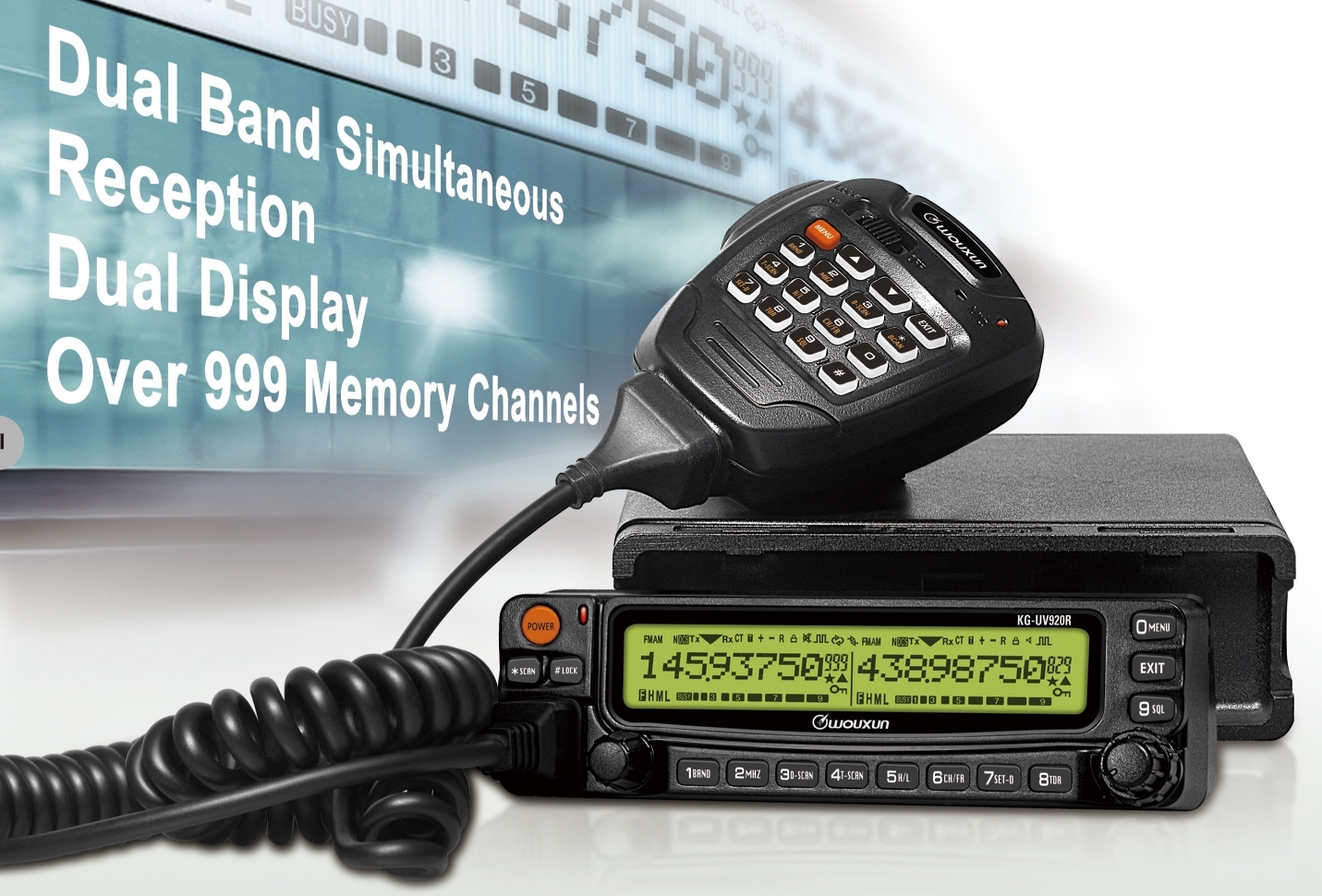
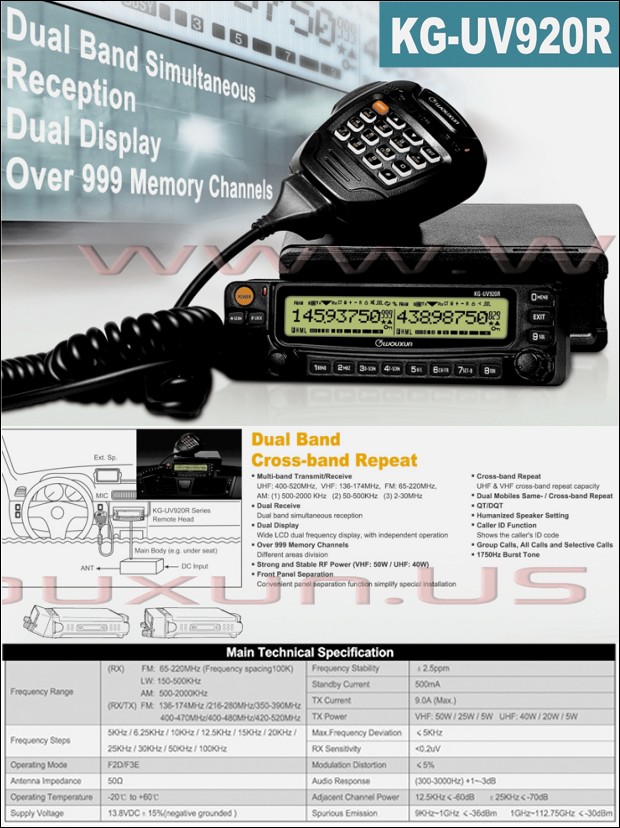
Wouxun to make a dual-band mobile?

It looks like the folks over at Wouxun are trying to get a dual-band mobile type-accepted by the FCC.

The 2m/440 KG-UV920R is not in production (yet) but a photo appears on the Wouxun homepage labeled "Coming Soon" and a note on the side of the image says that the company's head of US distribution (Ed Griffin) is in China until the end of the month (maybe to finalize the deal with this radio?).

A promotional flyer of the new rig with some preliminary specs can be found here.

Along with 2m/440, it looks like they may try to build a 2m/220 mobile radio as well!

I don't (yet) own one of these radios, but I'm saving my pennies to get one. Two radios, in fact. Maybe three. One for me, my wife, and daughter, the 2m/220 HTs.

I've been very interested in these radios since they debuted a few years ago. The low price is obviously very attractive, but my initial skepticism was that it was priced too low (as in, "you-get-what-you-pay-for") but the overall reviews have been for the most part positive regarding these radios, and the price is very hard to pass up, considering that the cost of a dual-band radio is the same (if not lower) than most single-band radios (especially 220MHz radios).

Keep your eyes on this company, folks. They may change the market on ham radios in a very good way.

Tuesday, August 31, 2010

Not the best title for a ham radio article...

The Daily O'Collegian of Oklahoma State University has a nice write-up about ham radio in their recent issue.

Not too thrilled about the title, tho...

10-4 Good Buddy

Oklahoma State University’s Amateur Radio Club is making a comeback.

Having been around since the 1920s, Amateur Radio Club is one of the oldest clubs on campus.

But just two years ago, the club’s outlook was bleak.

With only one member, who was a senior and about to graduate, the club was seemingly coming to an end.

But Seth Charles, now ARC president, Patrick Huber and Logan Cabori helped start it back up.


More on this article here.

I would hope someone would have corrected the writer prior to publication, but I guess you can't win them all.

Tuesday, August 3, 2010

German ham detained in Lebanon

Several international news agencies and blogs are reporting that Manfred Haug (OD5/DL6SN) was arrested last Monday and charged with spying by Lebanese authorities who questioned him over his "sophisticated transmitting equipment".

He was later released and no charges were filed after "intense questioning" by counterintelligence officials.

Manfred works at a cheese factory as an engineer and has lived in the country since 1999.

Lebanese officials have ramped up their security efforts in recent months, arresting dozens of individuals and accusing them of spying for Israel.

When in a country with potential security issues and hostilities, stow the radios!

Tuesday, June 15, 2010

Doppler-gangers

Due to the nature of the subject, I've omitted names and callsigns.

Over the last few weeks we've had several individuals causing malicious interference across several repeaters here in East Tennessee. One was caught a few weeks ago, and turned out to be a non-ham. Of the few others that have appeared, one has been very clever in hiding his (or her) signal quite well, but a few have been able to pick them up. While we have a few leads as to who the suspects are, we haven't singled any people out (yet!).

So, last night on my way home, I checked in to the local SKYWARN net and listened in to the gang wrapping up the net as the weather abated. However, as I was checking on some weather approaching from Nashville, we suddenly heard a dear carrier, covering up all signals.

My immediate reaction was that the NWS station had left the mic stuck in the "transmit" position. However, the NWS station chimed in on another repeater that they were not the cause. So the next natural suggestion was that we had a QRMer.

However, something told me it wasn't intentional. The normal interference we had heard was someone scratching a mic, retransmitting signals from HF, or the occasional bodily function. This was just silence. However, a couple of other hams were convinced it was intentional, because they'd been getting QRM recently.

I stepped up my drive home and arrived and put my home station into action. I swung the beams south and immediately got a spike in my signal strength (about S-7) to the southeast, towards Pigeon Forge. We'd had a couple of leads of QRMers from that area, so I started to think we had a bead on the signal from that general direction. However, another ham advised they had a strong signal near McGee-Tyson Airport, directly south of me. I swung my beams due south, and the signal shot to S-9, almost full quieting! Now, all I needed was another ham with a beam to triangulate a general location.

Unfortunately, no one else with a beam was listening, or wasn't hearing the signal.

I got on the repeater's output frequency and sent out a simplex transmission that we were actively searching for the signal. The repeater owner was listening and managed to shut the repeater off through a control link on another band, preventing damage to his repeater.

A DFer with a doppler unit was in the area, so I advised he head towards the airport. While the DFers were doing their manhunt, I got on the repeater's output frequency again and advised that I had the signal to the south and requested input from users who could hear the signal and give a direction or bearing. Unfortunately, no one was giving beam headings or any signal report. I gave out my phone number and a couple of hams called and gave me some signal strength reports, but again, not from a beam, just what they picked up on their HTs.

About 30 minutes into the situation, we new this was not intentional. No one with common sense would risk their equipment just to harass other hams, especially during a SKYWARN net. 3-4 DFers got in on the hunt, and they had bearings near the airport, but further south. As they got closer to the transmitter, I began looking up hams in the QRZ database who might be in the area. I would ask for street names to try and see if there was any hams who lived on particular streets. After they gave information on one street, I called out a ham's callsign and address, and they sped towards that position. Another ham knew they person and called him on the phone. It turned out he was not the QRMer. The DFer's briefly stayed, using the time to get another bearing before continuing on.

Suddenly, the signal developed noise. it had now been transmitting for over an hour and I figured the radio was beginning to overheat. It went from S-9 to S-7 on my radio's signal strength meter. Some thought the drop in signal was an indication it was mobile, but I didn't hear "picket fencing", indicative of a mobile station on the move.

As the DFers moved in closer, the signal suddenly dropped out. Was the radio dead? The hunters made comments that the radio must've died, but suddenly it reappeared, then cut out again! Suspicion arose. Was this intentional, and the guy was messing with us? Was he monitoring us and shutting off the transmitter the closer the hunters were getting?

Suddenly, it came on again. Then off, and on...it appeared to me that the transmitter was shutting itself off due to thermal protection. We knew we had to find it before the radio was permanently damaged, or worse, started a fire!

We were approaching 2 hours, when suddenly one of the DFers picked up a strong signal near the house of a well-known ham. We finally had our culprit.

The ham had gone out to tend to some business and had just plugged in an ICOM radio he had just acquired. His wife was home and allowed one of the DFers in to check the equipment, and the radio was finally turned off. It turned out the mic had a short in the wiring, and was shorted to transmit.

The radio itself was warm, but not terribly hot. The power supply, however, was able to fry an egg, from what I was told.

It was a successful "hunt" and with the terrain and occasional "kerchunk" from hams trying to figure out why the repeater wasn't on, the DFers were able to resolve the situation in good time.

It was a great exercise in direction finding. Hopefully the lessons learned will make the hunters better when it comes time to locate the actual QRMers on the repeaters.

Sunday, June 13, 2010

You think YOU have a strong opinion about ham radio...

Check this guy out:


The "Truth Revealed About Ham Radio" by Bert Fisher K1OIK – that gives his humble opinion about what he views is wrong with our hobby and some hams within it.

I'd treat this like I treat other hams who have strong opinions (like, oh, I dunno...me!) and just remember what they say about opinions...

Still, it's a very entertaining 10-minute diatribe. I find truth in much of it. And yeah, I've done several of the things he rails on (HIHI!).

By the way, Google Blogs rolled out this new template, and I decided to give it a try. Give me feedback on it. Like? Dislike? Better or worse than the previous template I used?

Monday, June 7, 2010

South African ham/amateur satellite chaser deemed "threat to US national Security"

Well it seems like ham operators, when they're NOT breaking the law, are apparently threats to national security here in the US. Even when they're not American!

Greg Roberts (ZS1BI) is a ham operator in South Africa. When he's not on the air, he's looking into the air. More specifically, into the night sky, chasing "birds", or satellites.

6 weeks ago NASA launched the super-secret X-37B space plane in cooperation with the Air Force. The launch was not announced ahead of time and the orbit of the space plane was kept quiet.

However, Greg and some other observers were able to determine it's orbit based on a chance encounter by one observer, and then reviewing past launches of top secret spacecraft and theorizing when the plane would pass over his location. Sure enough, he was able to not only confirm it's orbit, but he was able to determine it's altitude and orbital inclination, and published his calculated orbital elements online. Satellite observers around the world were able to confirm these predictions as the space plane circled over their locations.

Within days, publications around the world, from the New York Times and others all were agog over how an "amateur" (Greg is actually a retired professional astronomer) was able to accurately predict NASA's new toy.

Well apparently Sector 7 isn't too thrilled with Greg's "amateurish" antics. An article in the South African Times informs us that Greg is now labeled as a "threat to U.S. National Security".

I find it amazing how the US is so concerned with how an amateur from South Africa found the super-secret X-37B, yet they didn't seem too concerned that perhaps the Chinese, or North Koreans, or even our modern-day ally Russians might have found the satellite using the exact same methods employed by Greg, albeit more sophisticated (expensive).

And yet HE is the problem.

Perhaps the CIA and whatever other national security agencies should focus on real threats to US national security, and not worry about the petty observations of people like Greg who are just providing a service to people who might not get access to such information.

I mean, I am a taxpayer after all, so this is my space plane too, is it not?