Ever since Pluto was demoted to a "dwarf planet" in 2006, I've been disgruntled about it. Back in my day, there were NINE planets, and to me, it will always be a planet.
New Horizons' flyby of the PLANET PLUTO supports a lot of astronomers' feelings about its status. And now, NASA Administrator Jim Bridenstine agrees that it should be re-promoted to planet status.
"Just so you know, in my view, Pluto is a planet. You can write that the NASA Administrator declared Pluto a planet once again. I'm sticking by that, it's the way I learnt it, and I'm committed to it."
And there you have it!
Of course the IAU has to get on board with it as well. However, after the controversial way that Pluto was demoted, it's still a long shot. On the last day of the IAU's conference in Prague in 2006, a vote was cast with approximately 10% of the 2700 attendees present regarding the criteria for how a planet is defined:
#3 has been the sticking point, and some claim that planets such as Earth and even Jupiter are not planets by definition as they regularly encounter asteroids that are orbits near theirs.
Some scientists are championing the cause to keep Pluto relegated to "dwarf planet" while others are in the opposite side. It's a battle debate that's bound to last for many years to come.
Whichever side you're on, you still have to admit, Pluto is a fascinating body in our Solar System.
Off and on I've been trying to find a way to listen to the meteor showers that frequently hit the Earth. The idea is that as a meteor hits the ionosphere, it scatters said ions and radio frequency signals that normally would just radiate into space are instead reflected back towards earth. Hams frequently use this method when making contacts via meteor scatter.
There are web sites set up for people to listen to the NAVSPASUR (Air Force Space Surveillance System) transmitters on 216 MHz. I've not been able to hear the transmitters even though I live close to the facility in Alabama.
I've tried to listen to the meteors using a "poor man's" method of listening to TV signals from stations in other cities like Chattanooga and Bristol, TN. That idea went out the window when the FCC kicked TV stations off the analog frequencies in 2009. I've tried listening to FM radio stations using this method, but the dilemma I have is that, with Knoxville being such a big radio market, practically every available frequency from 88-108 MHz is taken locally.
So now I'm left trying to find any good radio frequency that would work for me to listen to meteors "pinging" the atmosphere. It needs to be outside the Knoxville area, constantly transmitting, and with a high enough power to be heard distinctly when the meteors pass overhead.
If anyone can assist with this quagmire, I'd be most appreciative.
After a 4-hour delay due to issues with a missing UHF antenna, Sergei Volkov, RU3DIS, and Alexander Samokutyaev deployed ARISSat-1 from the Pirs module of the ISS last Wednesday.
While preparing to deploy ARISSat-1, the spacewalking cosmonauts noticed only one antenna protruding from the bird when there should have been 2, one for 2 meters (VHF), the other for 70cm (UHF).
Controllers in Moscow and Houston decided to postpone the deployment to evaluate the issue as the cosmonauts continued with their remaining scheduled spacewalk duties.
Later in the spacewalk, controllers gave the go-ahead for Sergei and Alexander to send ARISSat-1 into space, gently nudging it aft and nadir of the station in order to eliminate the possibility of collision with the station later.
The images posted are actual screen captures taken by ground stations listening for ARISSat-1's SSTV signal. You can see the helmet of Sergei Volkov and a pre-loaded image of the ARISSat-1 logo. Live cam images are captured at various times which will allow for stations on the ground to get a near-real-time static image of what ARISSat-1 is seeing over 200 miles high. If the satellite goes into darkness, the logo images are transmitted.
In addition to SSTV, voice and BPSK at various times. While in the sunlight, it will transmit on high power and near-continuous transmission. While in eclipse, it will go into power-saving mode, transmitting intermittently.
It's not yet known the full extent of the damage to the UHF system (designed to be a linear transponder), however, hams are reporting they are making successful contacts with it.
For now, here are the modes of operation:
145.950 MHz FM Downlink: FM transmissions will cycle between a voice ID as RS01S, select telemetry values, 24 international greeting messages in 15 languages, as well as SSTV images.
435 MHz - 145 MHz Linear Transponder: The linear transponder will operate in Mode U/V (70 cm up, 2 meters down). It is a 16 kHz wide inverting passband and the convention will be to transmit LSB on the 435 MHz uplink and receive USB on the 145 MHz downlink.
145.919 MHz/145.939 MHz CW Beacons: The CW transmissions will be call sign ID RS01S, select telemetry and call signs of people actively involved with the ARISS program.
145.920 MHz SSB BPSK-1000 Telemetry: When the CW2 beacon on 145.919 MHz is active, this indicates that the BPSK-1000 format is being transmitted. If the CW1 beacon on 145.939 MHz is active, the backup of BPSK-400 format is being transmitted.
ARISSat-1 is also known as "KEDR", which translates to "Siberian Pine" in Russian. It was Cosmonaut Yuri Gargarin's callsign during his flight which made him the first human being in space. ARISSat-1 was launched to coincide with the 50th anniversary of Gargarin's historic flight. Its callsign is RS01S.
The week of the 4th of July I was in Florida visiting family and looking to attempt to watch Atlantis lift off from the Cape on the final Shuttle flight.
Two things:
1) I will NEVER drive through Orlando ever again if I can help it, and
2) It's sad that we will never have this opportunity to see such awesomeness ever again.
We were staying in Daytona Beach for a couple of days (we didn't dare try Cocoa Beach or Titusville) and I took the family down as well as my mother. We went mainly because she'd never seen a launch and wanted to catch it before NASA ended the shuttle program. Ironically, the day of the launch she felt ill and didn't want to make the trip down from Daytona. We arrived from Ft. Myers the day before and were pretty exhausted from the drive after suffering through Orlando during rush hour with a monsoonal rain to add to the misery. Two hours and 3 "alternate routes" through Orlando, and we arrived in Daytona about ready to stay without making an attempt to go to the Cape area.
And to boot, it was questionable whether they'd launch because of weather. a 30% chance of a launch was not good odds, but something told me that, with close to a million people watching around the space coast, I began to wonder if they'd forego some restrictions in order to finish up the program. With the shuttle program already a year behind on its scheduled shutdown, I thought for certain that they would be under pressure to finish while maintaining an acceptable limit of safety. After all, the last two times that NASA got complacent we lost two shuttles and 14 astronauts.
I didn't decide to make the trek south until about 2 hours until liftoff. We got on the road south on I-95 and I took an exit just north of Titusville. My plan was to simply get on the outskirts of the crowds, yet stay close enough to actually see the liftoff.
We rode US 1 to the Titusville city limit and checked the GPS for any nearby parks. But on the way we started seeing cars on the side of the road, so we figured the park was jammed.
As I turned around and went north, I spotted a parking lot near the hospital that was occupied with people watching the launch, but looked to have a few spaces left. When we got parked we had 30 minutes before liftoff. We walked around the area and then got back to the car and set up the camera.
As we got closer to the T-0, we could feel the anticipation grow. Then at 31 seconds, there was a halt due to a problem with the fuel arm that loads the liquid propellants into the external tank. We thought that was going to blow the launch for the day, but they were able to quickly resume the count after confirming that the arm was fully retracted. When the count hit zero, we waited for about 8-10 seconds before we saw it rise from the treeline and head into space.
Unfortunately the low clouds made it viewable for only 10-15 seconds before we lost it to cloud cover. We were a lot closer to the launch site than I thought, as we were looking towards an area further south than we actually were. The shuttle appeared further to our east and closer than I imagined. I had my video camera pointed to the southeast, but when I grabbed it to look east, I bumped the on/off button for the recording. When I looked at it later, all you see is a still shot of the view southeast, then a cut to the smoke trail heading off into the clouds. Fortunately my brother loaned us his digital camera as well as the video camera, so I managed to get off one good shot before it got into the clouds.
Almost immediately I grabbed the tripod and equipment and got into the car, the delayed sound of the shuttles SRBs roaring to life wafting over the crowd as we quickly made our way back to Daytona Beach. We got back to our room before 1PM. After being stuck in Orlando traffic, I was glad we didn't need to suffer through space coast traffic the day after.
As we drove back to Daytona, I then had the time to really ponder what we had witnessed and the impact on our future as a space power.
I'm not wanting to drag politics into the post, but you have to wonder why, after we built the majority of the International Space Station, and we footed most of the billions needed to put it in orbit, we now have to hitchhike with our partners in Russia, and then shell out millions for the rides. I'm curious how much money Russia paid NASA in order to ferry some of their cosmonauts on the shuttle.
Still, $56 million per person is a lot cheaper than what it would cost to launch another shuttle.
The reality is that the Space Shuttle, while cool, and an amazing display of American ingenuity technology and power, is almost 40 years old. It boggles my mind how stagnant the manned spaceflight program has been. In roughly 15 years, we went from Mercury, to Gemini, Apollo, then the Shuttle. Mercury was started in 1959. The shuttle program's origins go back to around 1969 as we landed on the moon. But from there, we have not launched anything other than the shuttles since 1981.
The shuttle was designed to make spaceflight "normal", and cheaper, more efficient, and almost as commonplace as getting on an airplane and flying from New York to London. And while the shuttle has made spaceflight a more achievable plateau than it was in the 60's, we have a long way to go before it's a mode of transportation that is as commonplace as air travel.
With the manned spaceflight program in full gear in the 60's to get to the moon, it would have appeared the the Space Shuttle was going to follow the same route, with Columbia being a "Generation 1" shuttle, and later shuttles being bigger, more advanced, and in some ways cosmetically different from one another. Other than subtle technology advances that made OV-105 (Endeavour) lighter than OV-102 (Columbia), there was no real change in the orbiters as far as concept, aerodynamic shape, etc.
I was hoping by now we'd have a shuttle with something like 9 main engines, a double-wide cargo bay, launched on a stack with 6 SRBs and a huge external tank 3x the size of the one the current fleet used. We never got to that point. I am sure THAT would have been impressive...
So now where does manned spaceflight go? We have a space station we can't get to, unless we hitch a ride with the Russians, and the only sign we're going to get back to a domestic manned program is either private industries like SpaceX or Congress appropriating more money towards the ARES program, using capsules to get into orbit rather than shuttles. And capsules seems rather regressive to me.
When Space Shuttle Endeavour returned home for the final time last week, it flew over the Yucatan Peninsula in southern Mexico before crossing the Florida Peninsula and landing at Kennedy Space Center on June 1.
It was captured and posted to Youtube. Video below or catch the full version here.
With only two opportunities left to catch a space shuttle launch, getting the perfect spot to view the launch is probably not easy to do. It really isn't easy for ANY launch, but as the shuttle program sunsets, people want to catch one last glimpse of a shuttle launch while they can.
How about this shot:
Taken from an altitude of 64,000 (about twice the height of a passenger jet), this student-launched high-altitude balloon flight caught Endeavour streaking towards space on its final trek to the International Space Station.
As if that wasn't cool enough, speaking of passenger jets, one was en route to Florida and passed by the Cape at the same time Endeavour took off, and a passenger captured this amazing shot:
Beginning Tuesday, September 6, the Space Weather Prediction Center (SWPC) will cease broadcasting its geophysical alert message on WWV and WWVH. These messages inform listeners of the solar flux, the mid-latitude A and K indices and space weather storms, both current and predicted. Currently, the message is heard on minute 18 from WWV and minute 45 from WWVH. The information will still be available on the SWPC website. If you care to comment on this, or if you have any questions, the SPWC -- part of the National Weather Service (NWS) -- would like to hear from you.
Last Wednesday, while talking to my Stepmom on the phone, I saw a meteor streak across the sky off to the West, going from South to North. It was slow moving, not like your typical skimmers and streakers that go across the sky. I actually thought it was space junk re-entering.
According to Spaceweather.com, it looks like that meteor may have actually landed!
I guessed that it might have either burned up or landed around the Jamestown/Crossville area, or north of there. Due to partial cloud cover it disappeared behind the clouds before I could determine if it was disintegrated or if it continued on to the north.
Judging by some reports coming in, it may have continued on towards Louisville, KY (I was in Cave City last summer) or somewhere around the TN/KY border in that area.
If you saw it, submit your report to the American Meteor Society web site's online form.
I wonder if this means that the Meteorite Men are on their way to the area?
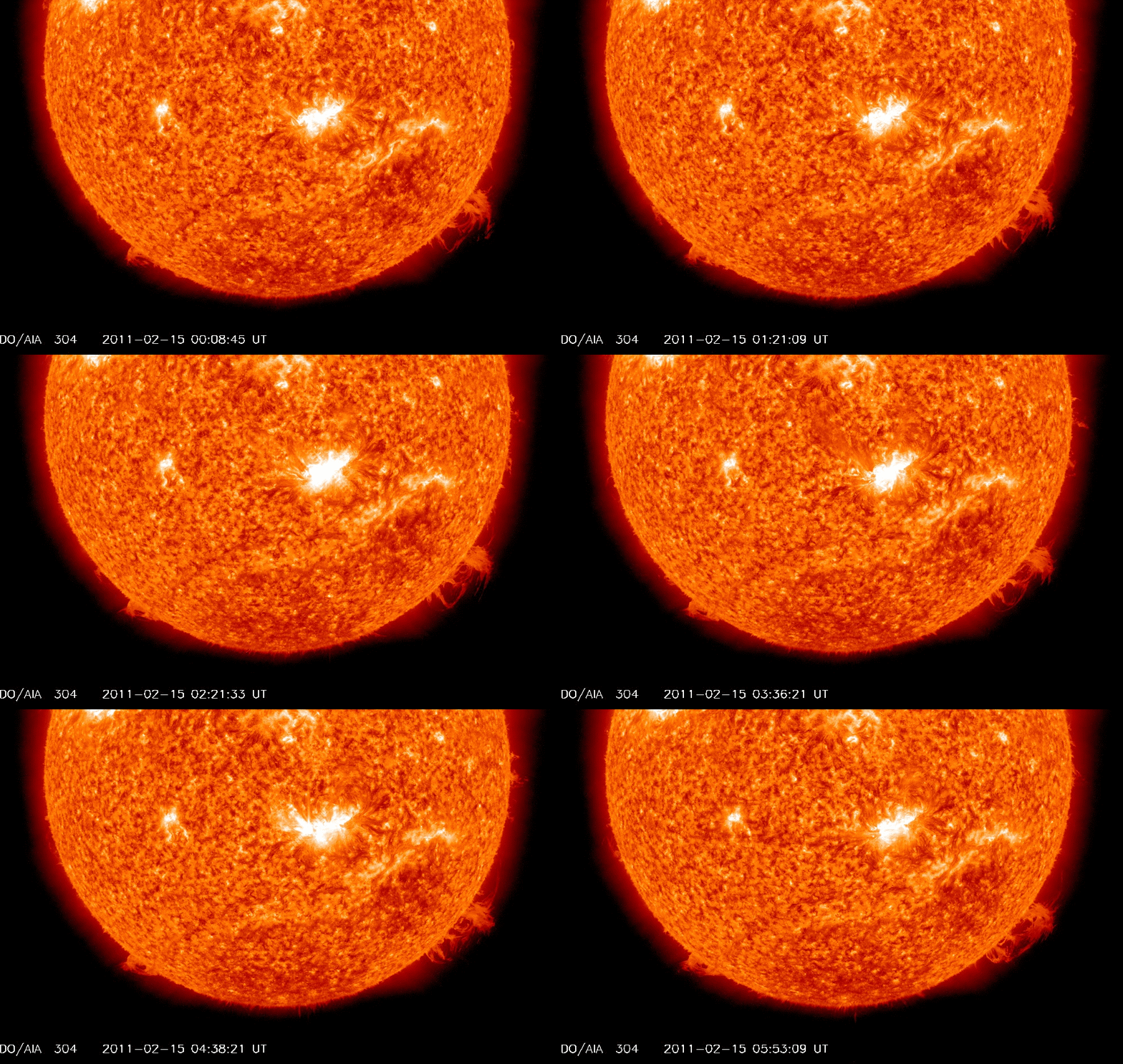
We're about 3 years into the current Solar Cycle and so far it's been less than stellar (pun intended), that is until now.
If the recent flare is any indication, we might see better-than-predicted activity from the sun this cycle.
The CME (Coronal Mass Ejection) should be hitting earth any time over the next 36 hours with beautiful aurora over the polar latitudes. And it may knock activity on the HF bands down to a standstill.
As Sunspot 1158 continues to grow, more Earth-directed flares could erupt and wreak havoc on the bands.
An couple of amazing animations of the flare can be found here and here.
This could very well be the kick-start that sun-watchers have been looking for that shows the activity on the sun is accelerating towards a peak in the activity, predicted to be in May, 2013.
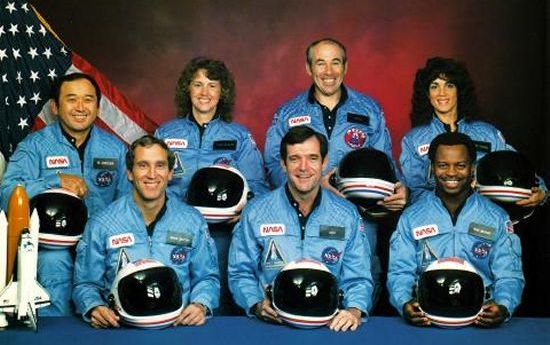
It's one of those questions anyone over college-age gets asked every so often about this time of year: Where were you when you heard about Challenger? You don't have to ask, you know which mission being asked.
STS-51L was one of those missions that, with the exception of the planned teacher in space, received little news coverage leading up to the launch. I myself forgot the shuttle was supposed to even go up that morning 25 years ago today, and I'm a self-proclaimed "NASA nerd".
I was a Sophomore in high school, and was on my way to pre-algebra class when I walked through the hall in front of the library and in passing heard a student talking to another mumble "...space shuttle blew up!".
I was hurrying to get to class and thought it had to be some sort of joke, and missed the punchline. While in my pre-algebra class my mind kept going back to that remark. Was there a launch today? What was the mission? Who was going up?
We would go to lunch after 30 minutes in class, so we dismissed for lunch, and as I was eating, a classmate came up to me and said "Did you hear? the space shuttle blew up!"
"...and?..." I replied, waiting for a punchline. Praying for one...
"No, seriously, it blew up, the TV's on in the library!"
I spent a couple of minutes telling him it couldn't be true, but he said to go up and see for myself, so I did. I rushed through lunch (I think it was another one of our many "pizza pig-out" weeks we had, where they crammed pizza down our gullets all 5 days until we were sick of it) and hurried up to the library.
The TV was on ABC and they began another of one of the hundreds of replays shown over and over that day. All the students were silent and transfixed on the small screen as the events played out, and Challenger lifted off, rolled, climbed, accelerated, then disappeared behind a fireball, the SRB's separating apart, spiraling and wandering aimlessly out over the Atlantic.
The shock of watching 7 lives end on national television was a powerful moment. Right before my eyes I'm seeing history, and not the history I wanted to witness. And then, they show it again. And again. And again. And again...
I got home from school and turned it on CNN, and watched it, repeatedly, as I tried, like much of America, to find out what in the hell could have caused it. All we had to use for our amateur forensics was the one feed shown on NASA TV as it occurred. The launch replays from all the different angles we often see were never aired (that I'm aware) until months later and the only other video they decided to show was Christa McAuliffe's parents watching from the press section as their daughter was killed in front of millions.
The crew of the space shuttle Challenger honored us by the manner in which they lived their lives. We will never forget them, nor the last time we saw them, this morning, as they prepared for their journey and waved goodbye and "slipped the surly bonds of earth" to "touch the face of God."
I recall a very somber time those next few days, months, and years as NASA struggled to reclaim the respect and credibility of its days of going to the Moon. I followed the investigations, the accusations, and the blame game passed from one agency within NASA to another. I relived some of those emotions once again when Columbia broke apart 17 years later.
My father was there that day at Kennedy Space Center. He was driving a busload of tourists to the Kennedy Space Center and this was his 2nd launch. He knew immediately something was wrong, but many people, having never seen a launch in person before, thought it was the normal SRB separation and were cheering. He remarked it as one of the more surreal experiences in his life.
There will never be another vehicle like the space shuttle. It was a piece of science fiction turned science fact, and as NASA prepares to sunset this program, we are left wondering what the next step for our manned space program will be.
Going into space is a risky business, and these 7 brave astronauts (and all astronauts who are in the program) know that anything that can go wrong, will go wrong if not addressed properly. As Challenger took off on that cold January morning, they knew the risks involved.
The crew of Challenger will always be remembered for their bravery, inspiration, and most importantly, their spirit to achieve, excel, and succeed.
On Wednesday, Jan. 19 at 11:30 a.m. EST, engineers at Marshall Space Flight Center in Huntsville, Ala., confirmed that the NanoSail-D nanosatellite ejected from Fast Affordable Scientific and Technology Satellite, FASTSAT.
The ejection event occurred spontaneously and was identified this morning when engineers at the center analyzed onboard FASTSAT telemetry. The ejection of NanoSail-D also has been confirmed by ground-based satellite tracking assets.
Amateur ham operators are asked to listen for the signal to verify NanoSail-D is operating. This information should be sent to the NanoSail-D dashboard at: http://nanosaild.engr.scu.edu/dashboard.htm. The NanoSail-D beacon signal can be found at 437.270 MHz.
Ever wonder just what the ISS hears when they try to contact stations on the ground? Commander Doug Wheelock (KF5BOC) treats us to a glimpse of the amateur radio station on board the International Space Station as he makes a pass over North America just before he returned to earth last week after spending 161 days aboard the ISS.
In the 20 minute YouTube video Wheelock introduces us to the NA1SS "shack" as well as a few of the US and Russian segments of the station before beginning his QSOs.
Some of the stations he worked this particular pass:
N6RSX
KD0EXV
N0KGM
N0WAR
N6RSX (again)
KF7IO? (he missed the suffix)
W0PD
W5SSV
As you'll hear, it's quite a pileup of noise as dozens of stations struggle to make contact with Doug. At one point he switches to what he referred as "Channel 5" which is a simplex frequency alternate he used to relieve the pileup he was getting on the primary frequency used over North America. I checked with a couple of web sites but no reference to a simplex frequency is mentioned.
If anyone knows what the "simplex" is he was using please let me know.
Skip to 10:30 for the NA1SS station and laptop used for them to monitor their location. 11:40 for the radio power-up.
So remember, the next time you try to contact the ISS and they don't hear you, chances are you're not the only station trying to talk to them.
Just a quick update that Lauren is still interested in learning amateur radio. She's got school and girl scouts and that takes up time. This weekend was especially hectic, and I'm sure next weekend will be just as crazy.
But the stuff we've covered so far she has done very well on. I gave her a sample exam and the first 10 questions she answered perfect. After the 10th question was material we haven't covered yet, but we're getting there.
As for all the other ham radio stuff, I have not been able to get on the air to do anything lately. I've done some "birdwatching" but winter makes opportunities fewer due to the fact the northern hemisphere is in more darkness. I saw the ISS last Thursday but it went into darkness as it was rising over the horizon. It was amazing to watch as it went right alongside Venus and Jupiter, and it was during a spacewalk, so in reality, I saw 4 satellites at the same time. Endeavour, the ISS, and two astronauts.
Before I go, I am wondering when the US hams will get 500 kHz to use? Canada just got them, and only a few US hams are "experimenting" in conjunction with the ARRL. Although I don't have 500 kHz equipment, I think it would be a great excuse to look for new equipment.
My brother and I are both into bird watching. The only difference is, his bird watching occurs in the daytime.
I've been spotting satellites in the sky for well over 25 years. Problem was, I didn't realize it until about the time I graduated high school.
I don't remember when I saw my first artificial satellite, but I do remember it was during a meteor shower while at my grandparents' home in "the sticks" of upper east Tennessee. The sky was clear, there were no city lights to obscure, and the Milky Way was as spectacular as you could imagine.
I spent many a night getting up late/early to catch a meteor shower, usually in the late fall or winter (around the time of the Leonids), and we'd trudge from the house to the nearby field some 100 yards away, where we'd hop on a flatbed hauler and and stare skyward, wrapped in sleeping bags, comforters, blankets, and thick jackets.
Every so often, amongst the skimmers, fireballs and bolides I would see what appeared to be an airplane. But I wouldn't hear any sounds, see any blinking lights, and it would occasionally disappear into thin air. None of us really knew what they were (my mom would assume an airplane too high to hear) and I'd call them "crazy stars". Hey, I was, what, 12, 13 years old at the time?
At that age I couldn't spot the Big Dipper, Little Dipper, Orion, Draco, Aries, Vega, etc. I knew the moon was up there and that was it. Heck, to me, the body of Orion looked like the Big Dipper, and the Pleiades were the little dipper. I thought this for years until I got into high school.
Only in the last few years have I been able to tell a few constellations here and there. It helps to know your constellations when looking for satellites.
I've seen several types of satellites, from the Space Shuttle to the Mir, from the ISS to spy satellites. There are a lot of them up there. There are thousands of objects in orbit, most are space debris, such as spent rocket motors, dead satellites, or in some cases items that shed from satellites. Of the thousands of objects in orbit, many are too small to be tracked.
So, how is it possible we can see a satellite in the middle of the night? Quite simply, it's dark on the ground, but up in space where the satellite is, the sun is still shining. It will reflect the sunlight off the body or the solar panels, or both, and those who are looking up can possibly see it cruising by. Usually when you see them, they are going into the orbital sunrise or sunset, where the satellite is going into or coming out of the dark side of the earth. Many satellites are polar orbiting, such as NOAA's weather satellites or reconnaissance satellites for the military.
Most of the satellites you can see are called Low-Earth-Orbiting satellites, or LEOs. They are usually between 100 and 500 miles above earth and circle the earth between 90 to 100 minutes. Normally they range in size from disco balls to that of a school bus. The largest (and brightest) man-made satellite is the International Space Station. We'll start with that one.
The ISS is about as bright as Venus when it moves across the sky. Even in the largest of cities, the ISS can still be seen. It takes little effort to view the spacecraft, just a clear sky and a viewing opportunity will be all you need. Sometimes the occupants may be on the station's ham radio, but it depends on the crew's time, and desire to talk.
So the big question is when and where? The best source for starters is the NASA website for novices. Input your country, then state, then city, and you'll get a listing of possible sightings over your city.
In the image shown, the passes for the ISS over my hometown are listed. The MAX ELEV is how high above the horizon (in degrees) the ISS is travelling over my location. 0 degrees is the horizon, and 90 degrees is overhead. The APPROACH and DEPARTURE listings tell you where to look in relation to North.
What you will see is an object that looks like a star or planet (again, as bright as Venus or Jupiter) but is slowly moving across the sky. No blinking lights (that's an airplane) and no sound. If it disappears, it's gone behind the dark side of the earth and out of the sunlight. This will happen after sunset. In the mornings the ISS may suddenly appear out of nowhere as it enters an orbital sunrise.
In the video above, you get an idea what you would be seeing, but a lot brighter than the picture gives justice.
Another web site I recommend for satellite watching is Heavens-Above.com. Heavens-Above has a large satellite database that you can reference. You can register, enter your location (by city, or even by your coordinates) and you can get pass information on various kinds of satellites.
Yet another website with a more in-depth scope of the satellites and various kinds of passes is CalSky. It takes a bit of getting used to, but it's very good at detailing more satellites and more passes of various kinds of "birds".
Real quick, how exactly do these web sites know when a satellite will pass over? A set of mathematical elements known as Keplarian elements are used. By using these elements, these web sites (or with some satellite tracking software) can predict with remarkable accuracy the location, distance, height, speed, and trajectory than an object is traveling around the earth. These elements are updated almost daily by NORAD, which tracks these orbiting objects constantly.
Okay, so I've started you out with the ISS, and given you some sites. Now I want to discuss what kinds of satellites you might see.
We've covered the ISS, but the Space Shuttle and the Soyuz and now the Chinese Shenzhou vehicles are also flying up there are manned space vehicles. I've see the Shuttle before, during, and after docking with the ISS and Mir. One morning a few years ago, just out of the blue, I woke up around 5:30 in the morning. I turned on the TV to NASA Television and found that the shuttle (launched the day before) was flying over Tennessee and about to enter an orbital sunrise, so I quickly rushed outside. No sooner than I look up do I see the Shuttle coming out of the dark straight overhead and zipping off to the Northeast on its way to rendezvous with the ISS some 24 hours later.
I have seen the Soyuz once or twice, the Shuttle countless times, and the ISS is a regular guest. I have yet to see the Shenzhou vehicles. Usually by the time the elements are published by NORAD and trickled down to the public sites, the Soyuz and Shenzhous have docked or landed.
Another type of satellite is the unmanned active space vehicles such as the Hubble Space Telescope (HST) or the NOAA weather satellites, or military reconnaissance satellites. Hubble is another popular object to look for in the skies, but it's primarily viewable in the lower lattitudes. The HST will never fly directly overhead of my location in Knoxville, (but I can still see it as it flies south of my location) but if you are in places like Florida, Georgia, Alabama, Texas, and Hawaii, you will see it fly directly overhead more often. Vehicles like the ISS are in higher inclination orbits so that they can cover more of the earth's land mass. Hubble doesn't need that kind of orbit (it's looking out towards space, not in towards the earth) and so its orbit is closer to the equator. Below is Hubble's orbit:
And this is the ISS:
Notice the steeper "sine wave" of the ISS orbit. As you can see, more of the earth's land is covered by the ISS. This allows more sighting opportunities in the higher lattitudes like Alaska and Canada and even Antarctica. Canada never sees HST.
However, those in the higher lattitudes aren't out of luck. The polar orbiting satellites are plentiful and are visible even from the poles.
The image above is of a polar orbiting satellite. While not completely vertical, you can see that the orbit is almost in synch with the solar terminator and is nearly in constant sunlight. This is advantageous to those looking for birds during the winter, when the increasing darkness decreases the opportunities to view the lower lattitude satellites such as HST.
Inactive space vehicles are satellites that have died or malfunctioned, or rocket parts and motors that were used to carry the working satellite into orbit and were separated from the working satellite and placed in a decaying orbit that will eventually cause it to burn up in the earth's atmosphere. Inactive satellites are basically space junk that are uncontrolled and their orbital track seldom changes.
Many of the inactive/junk satellites will actually be tumbling or spinning, and will flash as it passes overhead. Other satellites that are active may get brighter or dimmer as the sunlight reflection off the solar panels change. Zi Yuan 2 is an example of a tumbling satellite. Launched by the Chinese as a reconnaissance satellite, it is in a polar orbit that keeps it nearly in constant sunlight, and it will often pass overhead and vary in brightness from nearly invisible to extremely bright.
Another tumbler that caught my attention is the SL-16 Rocket Booster (R/B). I was looking for the ISS one night and saw this bird coming from the southwest, but thought it was an airplane. My attention was diverted to another satellite but this one kept in the corner of my eye until I finally focused on it and realized it was in fact a tumbling satellite, and spinning very rapidly. Definitely worth looking for.
The most prominent flares are from the Iridium satellites. These flares will get extremely bright, several times brighter than even the ISS. They will initially be almost invisible to the naked eye, then steadily increase in brightness until it peaks, then quickly fades. Below is an example of an Iridium flare:
Below is an example of a tumbling satellite:
It's hard to see the tumbler until halfway through the video. Sometimes Heaven's-Above and Calsky will not list tumbling satellites when doing a search on satellites that pass over your location, due to their varying brightness. But they are a great resource for locating Iridium flares, even in the daytime.
So, can you view satellites from anywhere? Pretty much. The ISS being the biggest object and the brightest, it can be seen from downtown Manhattan. Other satellites, however, require a bit of work. But even with my being on the fringes of the city, I can see even the dimmest of satellites using a clear sky and a pair of binoculars. More often than not (and comparatively speaking I'm still a novice) I see satellites that don't show up on the lists I create from these web sites. I will post to a mailing list I'm subscribed to and the users on that list will often pinpoint the satellite I was viewing.
A clear and dark sky is your best setting for spotting satellites. I've gone back to my grandparents' home on occasion, my mother-in-law has some land with no nearby lighting, and I've even gone up to Clingman's Dome in the Great Smoky Mountains National Park to spot many of the dimmer ones. If you can see the Milky Way, you are in an ideal location for "bird watching".
I hope this is a good starting point for you. There are plenty of resources online to help get you started in the hunt for satellites. Get started with the ISS, and go from there. There are many who have turned satellite watching into an art form. They even go after the geosynchronous satellites, especially during the periods when the sun is at the equatorial region, and the chances of catching a geosat flare are most likely to occur.
You don't have to be an expert, you don't even have to run pass predictions to step outside and look up for a few minutes after dark or before dawn. But it helps to know what you're looking for, and when and where. So step outside tonight and do a little "bird watching" of your own.