QRZ Logbook

        
Showing posts with label nasa. Show all posts

Thursday, August 29, 2019

Pluto's a planet to me, dammit!

Ever since Pluto was demoted to a "dwarf planet" in 2006, I've been disgruntled about it. Back in my day, there were NINE planets, and to me, it will always be a planet.

New Horizons' flyby of the PLANET PLUTO supports a lot of astronomers' feelings about its status. And now, NASA Administrator Jim Bridenstine agrees that it should be re-promoted to planet status.

"Just so you know, in my view, Pluto is a planet. You can write that the NASA Administrator declared Pluto a planet once again. I'm sticking by that, it's the way I learnt it, and I'm committed to it."
And there you have it! 

Of course the IAU has to get on board with it as well. However, after the controversial way that Pluto was demoted, it's still a long shot. On the last day of the IAU's conference in Prague in 2006, a vote was cast with approximately 10% of the 2700 attendees present regarding the criteria for how a planet is defined:
  1. is in orbit around the Sun,
  2. has sufficient mass to assume hydrostatic equilibrium (a nearly round shape), and
  3. has "cleared the neighborhood" around its orbit.
#3 has been the sticking point, and some claim that planets such as Earth and even Jupiter are not planets by definition as they regularly encounter asteroids that are orbits near theirs.

Some scientists are championing the cause to keep Pluto relegated to "dwarf planet" while others are in the opposite side. It's a battle debate that's bound to last for many years to come.

Whichever side you're on, you still have to admit, Pluto is a fascinating body in our Solar System.

Friday, August 16, 2019

NASA Image of the Day: Hubble’s Portrait of Star’s Gaseous Glow


August 16, 2019 - Although it looks more like an entity seen through a microscope than a telescope, this rounded object, named NGC 2022, is certainly not algae or tiny, blobby jellyfish. Instead, it is a vast orb of gas in space, cast off by an aging star. via NASA https://ift.tt/33DMs3i

Thursday, August 15, 2019

NASA Image of the Day: NASA and SpaceX: Dragon Crew Extraction Rehearsal


August 15, 2019 - On August 13, 2019, NASA astronauts Doug Hurley, left, and Bob Behnken continue to work with teams from NASA and SpaceX to rehearse crew extraction from SpaceX’s Crew Dragon. via NASA https://ift.tt/2z2gPSN

Saturday, August 11, 2012

Curiosity "UFO" ID'ed?

The very first picture from Curiosity on the Martian surface turned the internet upside-down because of an object that looked like an odd formation of some sort. However, the image was just a thumbnail, or a smaller sized image of the original to give viewers a glimpse of the original image, and the resolution was not very good due to the thumbnail's small size. 

Because time was critical due to the pass of Mars Odyssey overhead relaying the telemetry and data before it went out of range of the rover, the smaller thumbnails were programmed to be relayed back to Earth, and only 2 thumbnail-sized images were transmitted before Mars Odyssey went beyond Curiosity's new Martian horizon.

Kaboom!
However, later in the day when more images were sent from the rover's Hazcam, the formation disappeared. Almost instantly the internet was abuzz with hypothetical ideas as to what the phenomenon was, from dust cover debris to UFO's.

The leading theory, however, may be even cooler than E.T.

It is suspected that the object was a dust cloud caused by the crash-landing of the rover's "sky-crane" stage moments after dropping Curiosity onto the ground, and intentionally flying away to prevent it from colliding with the rover. It is believed that, as Curiosity was getting used to its new home and was snapping pictures through its Hazcams, it caught the sky crane slamming into the ground some 2000 feet away!

Once the higher-resolution image was downloaded to Earth, the image resembled more of a mushroom cloud and the direction of the camera coincided with where the sky-crane crashed according to images sent back from the orbiting Mars Reconnaissance Orbiter.

Now the big question is, will Curiosity take a detour to the site to see what the dust cloud might have uncovered?

Thursday, August 9, 2012

Incredible videos from Curiosity's descent

NASA
All eyes are on Mars this week as Curiosity made it's landing in one of the most complex maneuvers ever attempted on the red planet.

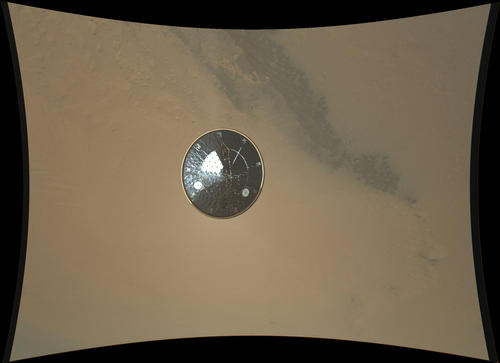
As curiosity descended it took video of its landing via the Mars Descent Imager, or MARDI. The video is grainy as the rover is currently sending thumbnail images (the high-res images will come in eventually, albeit slowly since they are so large and so many) to give a sample of what happened on it's way to the surface.

The concave black strips around the border are the result of the fish-eye lens that the camera was using to record the video. Fish-eye lenses allow a much larger field of view to be recorded. The view was inverted to flatten the background and present the video in a format more recognizable to viewers.


Along with the "good bye to the heat shield" video, MARDI also captured the landing. It's abbreviated, but NASA assures us a better video is on its way from the rover as soon as it can be sent.


Now that the high-gain antenna has been aligned with earth, we should be getting a lot more amazing pictures and videos in the upcoming days. I can't wait!

Tuesday, July 17, 2012

NASA gets interactive for Curiosity mission

The Mars Science Laboratory, AKA "Curiosity" is slated to land on Mars August 5. In preparation for the landing, NASA's come up with a slick interactive game for the Xbox 360 game console. 

Using the Kinect controller, you guide the Curiosity thru EDL (Entry, Descent, and Landing) as the rover makes its way to the Red Planet. I downloaded it tonight and ot to play a few rounds. The more accurate you are at each stage, the more points you are awarded. 

You first guide the vehicle through entry into the Martian atmosphere, and, using your body to keep the vehicle in the "center corridor". You'll go through pockets of turbulence and have to move the vehicle back to keep down the center line.


Next, you enter the descent phase, where you must time your movements to the pyrotechnics that deploy the parachute, eject the heat shield and finally remove the backshell, exposing the rover and leading to the final stage, landing.

In the landing stage you'll use your hands to guide the rover down to the target landing area. Accuracy and ease of landing (with the limited supply of fuel) will count as you put Curiosity down following its "7 minutes of terror".

The game also includes a video and some info on the overall mission. The opening screen contains a countdown timer to the actual landing of Curiosity on August 5th.

The game and video are narrated by Al Chen, who is the Flight Dynamics and Operations Lead for Curiosity. 

It's FREE to download (an Xbox Live membership is required, but you do not need to pay for use of the Live account) and available on the Xbox Live site.

And if you have a Twitter account, you can follow them @MarsCuriosity.

Monday, July 18, 2011

STS-135 launch (and spaceflight thoughts)

The week of the 4th of July I was in Florida visiting family and looking to attempt to watch Atlantis lift off from the Cape on the final Shuttle flight.

Two things:

1) I will NEVER drive through Orlando ever again if I can help it, and
2) It's sad that we will never have this opportunity to see such awesomeness ever again.

We were staying in Daytona Beach for a couple of days (we didn't dare try Cocoa Beach or Titusville) and I took the family down as well as my mother. We went mainly because she'd never seen a launch and wanted to catch it before NASA ended the shuttle program. Ironically, the day of the launch she felt ill and didn't want to make the trip down from Daytona. We arrived from Ft. Myers the day before and were pretty exhausted from the drive after suffering through Orlando during rush hour with a monsoonal rain to add to the misery. Two hours and 3 "alternate routes" through Orlando, and we arrived in Daytona about ready to stay without making an attempt to go to the Cape area.

And to boot, it was questionable whether they'd launch because of weather. a 30% chance of a launch was not good odds, but something told me that, with close to a million people watching around the space coast, I began to wonder if they'd forego some restrictions in order to finish up the program. With the shuttle program already a year behind on its scheduled shutdown, I thought for certain that they would be under pressure to finish while maintaining an acceptable limit of safety. After all, the last two times that NASA got complacent we lost two shuttles and 14 astronauts.

I didn't decide to make the trek south until about 2 hours until liftoff. We got on the road south on I-95 and I took an exit just north of Titusville. My plan was to simply get on the outskirts of the crowds, yet stay close enough to actually see the liftoff.

We rode US 1 to the Titusville city limit and checked the GPS for any nearby parks. But on the way we started seeing cars on the side of the road, so we figured the park was jammed.

As I turned around and went north, I spotted a parking lot near the hospital that was occupied with people watching the launch, but looked to have a few spaces left. When we got parked we had 30 minutes before liftoff. We walked around the area and then got back to the car and set up the camera.

As we got closer to the T-0, we could feel the anticipation grow. Then at 31 seconds, there was a halt due to a problem with the fuel arm that loads the liquid propellants into the external tank. We thought that was going to blow the launch for the day, but they were able to quickly resume the count after confirming that the arm was fully retracted. When the count hit zero, we waited for about 8-10 seconds before we saw it rise from the treeline and head into space.

Unfortunately the low clouds made it viewable for only 10-15 seconds before we lost it to cloud cover. We were a lot closer to the launch site than I thought, as we were looking towards an area further south than we actually were. The shuttle appeared further to our east and closer than I imagined. I had my video camera pointed to the southeast, but when I grabbed it to look east, I bumped the on/off button for the recording. When I looked at it later, all you see is a still shot of the view southeast, then a cut to the smoke trail heading off into the clouds. Fortunately my brother loaned us his digital camera as well as the video camera, so I managed to get off one good shot before it got into the clouds.

Almost immediately I grabbed the tripod and equipment and got into the car, the delayed sound of the shuttles SRBs roaring to life wafting over the crowd as we quickly made our way back to Daytona Beach. We got back to our room before 1PM. After being stuck in Orlando traffic, I was glad we didn't need to suffer through space coast traffic the day after.

As we drove back to Daytona, I then had the time to really ponder what we had witnessed and the impact on our future as a space power.

I'm not wanting to drag politics into the post, but you have to wonder why, after we built the majority of the International Space Station, and we footed most of the billions needed to put it in orbit, we now have to hitchhike with our partners in Russia, and then shell out millions for the rides. I'm curious how much money Russia paid NASA in order to ferry some of their cosmonauts on the shuttle.

Still, $56 million per person is a lot cheaper than what it would cost to launch another shuttle.

The reality is that the Space Shuttle, while cool, and an amazing display of American ingenuity technology and power, is almost 40 years old. It boggles my mind how stagnant the manned spaceflight program has been. In roughly 15 years, we went from Mercury, to Gemini, Apollo, then the Shuttle. Mercury was started in 1959. The shuttle program's origins go back to around 1969 as we landed on the moon. But from there, we have not launched anything other than the shuttles since 1981.

The shuttle was designed to make spaceflight "normal", and cheaper, more efficient, and almost as commonplace as getting on an airplane and flying from New York to London. And while the shuttle has made spaceflight a more achievable plateau than it was in the 60's, we have a long way to go before it's a mode of transportation that is as commonplace as air travel.

With the manned spaceflight program in full gear in the 60's to get to the moon, it would have appeared the the Space Shuttle was going to follow the same route, with Columbia being a "Generation 1" shuttle, and later shuttles being bigger, more advanced, and in some ways cosmetically different from one another. Other than subtle technology advances that made OV-105 (Endeavour) lighter than OV-102 (Columbia), there was no real change in the orbiters as far as concept, aerodynamic shape, etc.

I was hoping by now we'd have a shuttle with something like 9 main engines, a double-wide cargo bay, launched on a stack with 6 SRBs and a huge external tank 3x the size of the one the current fleet used. We never got to that point. I am sure THAT would have been impressive...

So now where does manned spaceflight go? We have a space station we can't get to, unless we hitch a ride with the Russians, and the only sign we're going to get back to a domestic manned program is either private industries like SpaceX or Congress appropriating more money towards the ARES program, using capsules to get into orbit rather than shuttles. And capsules seems rather regressive to me.

Sunday, June 5, 2011

Endeavour's final re-entry shown over the Yucatan

When Space Shuttle Endeavour returned home for the final time last week, it flew over the Yucatan Peninsula in southern Mexico before crossing the Florida Peninsula and landing at Kennedy Space Center on June 1.

It was captured and posted to Youtube. Video below or catch the full version here.

Friday, January 28, 2011

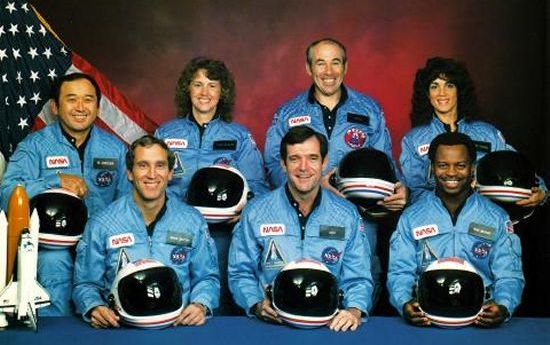
25 years after Challenger


It's one of those questions anyone over college-age gets asked every so often about this time of year: Where were you when you heard about Challenger? You don't have to ask, you know which mission being asked.

STS-51L was one of those missions that, with the exception of the planned teacher in space, received little news coverage leading up to the launch. I myself forgot the shuttle was supposed to even go up that morning 25 years ago today, and I'm a self-proclaimed "NASA nerd".

I was a Sophomore in high school, and was on my way to pre-algebra class when I walked through the hall in front of the library and in passing heard a student talking to another mumble "...space shuttle blew up!".

I was hurrying to get to class and thought it had to be some sort of joke, and missed the punchline. While in my pre-algebra class my mind kept going back to that remark. Was there a launch today? What was the mission? Who was going up?

We would go to lunch after 30 minutes in class, so we dismissed for lunch, and as I was eating, a classmate came up to me and said "Did you hear? the space shuttle blew up!"

"...and?..." I replied, waiting for a punchline. Praying for one...

"No, seriously, it blew up, the TV's on in the library!"

I spent a couple of minutes telling him it couldn't be true, but he said to go up and see for myself, so I did. I rushed through lunch (I think it was another one of our many "pizza pig-out" weeks we had, where they crammed pizza down our gullets all 5 days until we were sick of it) and hurried up to the library.

The TV was on ABC and they began another of one of the hundreds of replays shown over and over that day. All the students were silent and transfixed on the small screen as the events played out, and Challenger lifted off, rolled, climbed, accelerated, then disappeared behind a fireball, the SRB's separating apart, spiraling and wandering aimlessly out over the Atlantic.

The shock of watching 7 lives end on national television was a powerful moment. Right before my eyes I'm seeing history, and not the history I wanted to witness. And then, they show it again. And again. And again. And again...

I got home from school and turned it on CNN, and watched it, repeatedly, as I tried, like much of America, to find out what in the hell could have caused it. All we had to use for our amateur forensics was the one feed shown on NASA TV as it occurred. The launch replays from all the different angles we often see were never aired (that I'm aware) until months later and the only other video they decided to show was Christa McAuliffe's parents watching from the press section as their daughter was killed in front of millions.

That night, President Reagan addressed the nation (postponing the State of the Union address) and said all the right things we needed to hear:

The crew of the space shuttle Challenger honored us by the manner in which they lived their lives. We will never forget them, nor the last time we saw them, this morning, as they prepared for their journey and waved goodbye and "slipped the surly bonds of earth" to "touch the face of God."
I recall a very somber time those next few days, months, and years as NASA struggled to reclaim the respect and credibility of its days of going to the Moon. I followed the investigations, the accusations, and the blame game passed from one agency within NASA to another. I relived some of those emotions once again when Columbia broke apart 17 years later.

My father was there that day at Kennedy Space Center. He was driving a busload of tourists to the Kennedy Space Center and this was his 2nd launch. He knew immediately something was wrong, but many people, having never seen a launch in person before, thought it was the normal SRB separation and were cheering. He remarked it as one of the more surreal experiences in his life.

There will never be another vehicle like the space shuttle. It was a piece of science fiction turned science fact, and as NASA prepares to sunset this program, we are left wondering what the next step for our manned space program will be.

Going into space is a risky business, and these 7 brave astronauts (and all astronauts who are in the program) know that anything that can go wrong, will go wrong if not addressed properly. As Challenger took off on that cold January morning, they knew the risks involved.

The crew of Challenger will always be remembered for their bravery, inspiration, and most importantly, their spirit to achieve, excel, and succeed.

Tuesday, January 25, 2011

RS1S heads to the ISS

Hams around the world will be on the lookout for a new satellite to listen for in the weeks ahead.

The KEDR satellite (ArissSat-1)is aboard the Progress M-09M supply vehicle preparing to launch to the International Space Station (scheduled for January 27/28th) for release later in the year via a spacewalk.

Weighing in at 30kg (66lbs), the satellite was named after cosmonaut Yuri Gagarin's radio callsign on his historic flight as the first human in space, and is celebrating the 50th anniversary of that flight.

KEDR will transmit 25 greetings in 15 different languages and will transmit pictures back to earth as well as scientific data and telemetry. The frequency will be 145.950 MHz, callsign RS1S.

Stay tuned!

Thursday, January 20, 2011

NanoSail-D comes alive

From NASA:
On Wednesday, Jan. 19 at 11:30 a.m. EST, engineers at Marshall Space Flight Center in Huntsville, Ala., confirmed that the NanoSail-D nanosatellite ejected from Fast Affordable Scientific and Technology Satellite, FASTSAT.

The ejection event occurred spontaneously and was identified this morning when engineers at the center analyzed onboard FASTSAT telemetry. The ejection of NanoSail-D also has been confirmed by ground-based satellite tracking assets.

Amateur ham operators are asked to listen for the signal to verify NanoSail-D is operating. This information should be sent to the NanoSail-D dashboard at: http://nanosaild.engr.scu.edu/dashboard.htm. The NanoSail-D beacon signal can be found at 437.270 MHz.
More at the NASA web site or click here.

Stay tuned!