QRZ Logbook


Thursday, December 15, 2011

Amateur Radio balloon crosses the Atlantic

It's finally been done.

Several amateur radio groups, including one here in Knoxville I was a part of, have tried to send an amateur radio high-altitude balloon (ARHAB) across the Atlantic Ocean for several years, and now congratulations are in order to the California Near-Space Project (CNSP) and StratoFox for being able to accomplish what others have been unable to do. And they did it all the way from Silicon Valley, California!

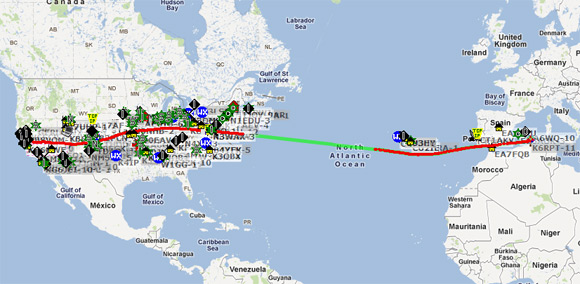
After 2 1/2 days aloft, on what they're saying was a goal to only go trans-continental, K6RPT-11 splashed down in the Mediterranean Sea, 6223 miles from where it was launched in San Jose, CA. It crossed the southern tip of Spain some 109000 feet about the town of Chipiona, north of Cadiz at 0538Z on December 14.

Path of K6RPT-11 from APRS.FI (credit theRegister)
It began to lose altitude about 4 hours later some 50 miles north of the Algerian coastline, the last packet received being about 14k' above the water as it plummeted to its watery demise.

It may never be recovered, but the payload nearly doubled the distance record (set by Spirit of Knoxville IV in 2008) and exceeded the duration record by a few hours. SNOX IV held that record for over a year prior to being bested by a group from Cornell.

While on Spirit of Knoxville, we had one payload (the 4th) that made it about 95% of the way across the Atlantic, stopping some 300 miles from the southwest tip of Ireland. Unfortunately the balloon's helium lost its lift from solar heating as night fell, and a weather system caught up to the payload, which is believed to have weighed the balloon down with water-ice and sent it to its demise in the Atlantic just shy of its goal.

On a personal note I am somewhat disappointed we at Spirit of Knoxville never got to make that push for the final 300 miles, but as with some grassroots efforts, things happen and real life gets in the way of a small-time project with big-time dreams.

Nevertheless, I watched anxiously as word spread that this payload was closing in on Spain and beyond, and stayed up late to watch it happen in real time on APRS.FI. It was bittersweet, but I was happy to see it officially occur.

Spirit of Knoxville's 3360 mile flight proved that it could be done. Had we launched from the coast of North Carolina, or further north, it might have happened. But then again, it wouldn't have been the Spirit of Knoxville, then, would it? Then again, the Spirit of St. Louis didn't take off from St. Louis, did it?

In any case, I'm happy for the CNSP team and everyone who worked hard to accomplish one goal, only to see it turn into so much more. Perhaps a circumnavigation of the globe is now the next big frontier?

Sunday, December 11, 2011

Rocky Beckner, K8DRB/ex WD8SBO SK

One of the main reasons I got seriously involved in ham radio was the aspect of emergency communications and community service that comes along with it. When I first got licensed I was doing bike races, 5k runs, and marathons for local track clubs.

Every Spring, the weather in East Tennessee can be some of the most complex in the country. One minute it's hot and sunny, the next it's cold and rainy. The thunderstorms in the region can rival a hot, muggy day in Tampa (the self-proclaimed "lightning capital of the world") and the occasional spurring of a tornado can make you think you're smack in the middle of "Tornado Alley" in the midwest.

I can recall a time when, as the weather got severe in these parts, there wouldn't be a SKYWARN net, just a gaggle of hams discussing what the weather's doing in their neck of the woods, or even better, "it ain't doin' nuthin' over here,"with subsequent discussion on their latest visit to the doctor...

Back in the early to mid-90's, that was the norm for these parts. It was especially frustrating for me, because I would often get in my '91 Chevy S-10 pickup truck and stupidly bravely chase these storms, and to not have a bona-fide way to report to the National Weather Service my observations (remember, this was before everyone and their mom had a cell phone). 

Then, along came Rocky Beckner.

He was living in Morristown at the time, having come down from his home state of Michigan, where he had helped with SKYWARN up there to get ham radio a permanent presence in the local weather office up there.

Whatever the reason he ended up here in East Tennessee (I've since forgotten) he made it a mission to get a ham station set up at the Morristown office. It wasn't just him, but he was a driving force in getting it done.

WX4MRX, circa 2000
The hamshack at the weather service was officially started in 1998. He was operating at the weather service about a year or two prior, often with his own equipment. The Lakeway Amateur Radio Club contributed some money and equipment and a government grant was given to the weather service office to secure the radios and cabling. Soon, Rocky was able to run a pretty slick operation from inside the weather service office. 

The station's initial callsign was initially KF4EKQ, which was quickly changed over to WX4MRX within a few weeks. 

Early on in the project, around 1994, Rocky came to know me well, and apparently so did some of the meteorologists who worked up there at the time. I can't count the number of times he would chastise me on the air (or off) for chasing these storms in these parts, sometimes at night, with little/no knowledge of weather myself. He couldn't STAND it when I was operating "stormchaser mobile". I do admit I was so full of piss & vinegar I didn't care what he (or any meteorologist) thought, I was having fun and doing daredevil stuff years which I'd been doing YEARS before "Twister" hit movie theaters (and blasphemed stormchasers everywhere in my opinion).

The current setup at WX4MRX
Then on May 18, 1995, there was an outbreak across the area that was part of a larger outbreak across Tennessee. This event changed how I respected weather and what I felt my "calling" was in ham radio. It had already been an active day weather-wise, and I was attending a RACK meeting but took my radio in and had it on the then-wide area repeater on English Mountain. Barely 15 minutes into the meeting I heard the then-used EBS tone and the announcement that a tornado warning had been issued for Anderson County, to the west of Knoxville. I stood up and let everyone in the meeting know, then booked it to the "chase vehicle". I headed north on I-75 towards Raccoon Valley Road, and I saw the cell that spawned the warning, but if there was a tornado, it was wrapped in rain. As I approached the Raccoon Valley Road exit, a golf-ball sized hailstone hit my windshield. It didn't crack, but I took the hint to get the hell off the road, because I was on a stretch of Interstate with no way of turning around, and little options if all hail broke loose. I quickly got off the Interstate at the exit and found shelter under a gas station awning right as the hailstorm hit. Baseball and softball sized ice rained down overhead, and fortunately the awning sheltered me. At one point I did hear the distinct "freight train" cliched noise, but never saw the tornado, nor did I see signs of it doing damage, so it may have only been a funnel cloud.

I drove home, at the time living in north Knoxville, and got my Radio Shack HTX-202 on a local repeater. All I heard was a bunch of hams hollering that there "wasn't a net" and yet no one seemed to want to take the reigns and do something about it. So I grabbed a pen and some paper and started calling one. I'd had some net control experience with some area ragchew nets and tech nets, but this was going to be a new experience. Overall I did as well as I could, before a tornado touched down about 1/4 mile from my house and knocked out power and caused some pandemonium in my neighborhood.

I learned a lot that night, that I was much better at calling a weather net rather than trying to chase the damned things. Rocky wasn't aware of the net because we weren't on the normal repeater where we'd hear the him transmitting from. But he'd heard about it, and soon after I started finding out more about SKYWARN and studying more about weather, tornadoes, wind, hail, and flooding.

Once Rocky and friends (not sure about Moose and Squirrel) got the hamshack in full operation it was not uncommon to hear him at all hours, any given day of the week, whenever the weather went bad.

We became well acquainted as fellow net control stations and he warmed up to me as a Net Control more than as a very amateur stormchaser, and he even invited me to operate WX4MRX at the NWS office following a lengthy rainstorm that caused major flooding in the area. When he left to go back home to Michigan due to his health, I knew I'd never see him again, unless we both ended up checking out the Hamvention in Dayton, which never happened.  We'd email each other every so often, and he gave me some words of encouragement (albeit brief, but his emails were not much on content) when there was a "meltdown" in 2006 that forced me out of SKYWARN for a couple of years.

I'd send an occasional email to him about things going on down here, but he wouldn't respond much, if at all. I knew his health was not the best, so I thought nothing of it. Then, last weekend while at the the weather service during SKYWARN Recognition Day, another ham who was there gave me the news that he'd passed away "a year or two ago", which shocked me. I figured someone would have told me. I guess I got that far out of the loop to get that bit of info...

He was a pioneer in SKYWARN getting the recognition it deserved with regards to the contribution of ham radio and how it could benefit the weather service here in East Tennessee. He was dedicated to both the hams and the meteorologists and these days I think few hams here truly realize or appreciate what he brought to the table.

He was not one to mince words with you, and would often tell you exactly what he thought. If you were wasting precious time asking him questions irrelevant to the weather situation, he had no reservations about letting you know it. Being diplomatic was not always in his repertoire, but then again, as he often told me, SKYWARN nets are not the time to win friends and influence people. 

I for one have missed his dedication, often being at the weather service pretty much 24/7, sometimes struggling with the health problems that eventually drove him back home to Michigan. While his presence has been replaced, he will not be forgotten by those of us who remember the times prior to WX4MRX being on the air. Ham radio has made weather spotting in this area more complete and has helped to bridge a needed gap in what the radar "sees" and what is on the ground. Rocky was a crucial part of that in its infancy. He will be missed.

Friday, December 2, 2011

Medical devices get FCC approval for 400 MHz

Medical devices designed to help paralyzed patients move won U.S. regulators’ approval to use a block of radio spectrum for transmitting wireless signals to incapacitated limbs.
The Federal Communications Commission adopted rules that give access needed by so-called advanced microstimulator devices that use implanted electrodes to stimulate muscles with the help of a wireless controller worn outside the body.
While the devices may be a medical breakthrough, using spectrum that amateur radio has (on a secondary basis) ranging from 413-457 MHz (amateur radio uses 420-450MHz) puts at risk the use that amateur radio employs for public safety and service on the 70cm band. Besides, there is plenty of spectrum available for these devices. Since UPS isn't using the spectrum they asked for from 220-222MHz, why not give it to these devices?

The ARRL has more detailed info, which you can read here.

Thursday, December 1, 2011

I'm still around

Yeah, I know, it's been awhile. Fact is, I haven't been on the radio but a handful of times in the last few months. In fact, the most I talked on the radio was this past Thanksgiving while on the way to my in-laws for dinner.

I got on the radio a couple of days prior to that while driving home from work, but one ham whose name I won't mention seemed to think I was intruding on *his* QSO and basically snubbed me. This was after I'd stepped out of my vehicle to get gas and in the middle of a QSO with others that he apparently butted into the conversation on.

It really annoys the hell out of me when people just treat me with no respect when I've done nothing wrong to them. If I have, at least have the balls to man up and tell me to my face what it is you don't like about me...what, did I insult your mother? Take your money? Rob your life savings? B.O.?

Oh well, no sense dwelling on it...in other news, SKYWARN Recognition Day is set for this coming Friday/Saturday and once again I plan to do some overnight operating at the Morristown NWS. So if you plan to operate Friday night/Saturday morning, listen for WX4MRX on the air, chances are you might be talking to me!

Saturday, October 22, 2011

Hams in Cinema

I just got back from watching the movie "The Big Year" starring Steve Martin, Jack Black, and Owen Wilson. The trio star as competing bird watchers trying to get the title of most birds seen in a single year.

But naturally, one scene got my attention. There was a scene where they were visiting Attu Island in Alaska. There was a lady operating the radio station/intercom and on a panel to the side of the desk in the background was two QSL cards. One was callsign VK2DG, which I recognized as an Australian callsign, having once worked a VK2 call from outside of Sydney as my first Aussie contact all those years ago.

I had to look it up once I got home and sure enough it was legit.

There was a second QSL card in the shot but I could not get it in time to see what the call was. They showed the cards in a later shot but the other card was obscured by the desk mic. I want to say it was CH6??? but I may be completely off. ITU has that as a Canadian prefix. If anyone else saw the movie (or plans to see it) please let me know.

It's a very entertaining movie, and I highly recommend going to see it, especially if you're a fan of these actors.

Sunday, September 25, 2011

FCC Upholds $17,000 Forfeiture Order to Tennessee Ham

Ham radio is one of the more diverse groups in any hobby. From janitors to jockeys, most anyone and everyone can be a ham operator. Among the ranks you will often find the most courteous and polite and respectful operators around.

And then, there's this guy...
In March 2009, the FCC issued a Notice of Apparent Liability for Forfeiture (NAL) in the amount of $17,000 to David Edward Perka, KA3PRB, of Lewisburg, Tennessee. The FCC alleges that Perka "willfully and repeatedly violat[ed] section 301 of the Communications Act of 1934, as amended, by operating without a license in the Maritime Radio Service and willfully violat[ed] Section 333 of the Act by maliciously interfering with the United States Coast Guard on the International Distress, Safety and Calling Channel in Annapolis, Maryland" Perka, who admitted to the findings, requested a reduction in the forfeiture amount, based on his inability to pay, but in a Forfeiture Order released by the FCC on September 21, 2011, the Commission refused to lower the amount.

Friday, September 16, 2011

Sunday, September 11, 2011

W2XOY recounts his 9/11 experience

Like many old enough to remember, we know where we were when we first heard about the horrible events of 9/11 as they unfolded.

Bill Continelli, W2XOY, one of the contributors to This Week in Amateur Radio (TWIAR) was in lower Manhattan on September 11, 2001. He was south of the World Trade Center and heard the 2nd plane as it flew over and slammed into Tower #2.

He gives his recollection of how he used his communications equipment to safely evacuate Manhattan on that horrible day.

Click here to listen to his story, recorded in 2001 (MP3)

Hearing Voices: 9/11 and the Ham Radio Renaissance

As the world remembers and pays tribute to the nearly 3000 victims of the September 11 terrorists attacks a decade ago, I thought I would reference this article from 2003 on how 9/11 brought a "renaissance" to ham radio:
...Sept. 11, 2001, marked a quiet renaissance in the world of amateur radio, after years of declining membership and relative obscurity. Over the past couple of decades, amateur radio operators have witnessed their beloved pastime lose much of its luster. In the early part of the 20th century, hams, as amateur radio operators are also known, were a rogue band of technology buffs who were quick to pick up on Guglielmo Marconi's experiments with then-new wireless technology. They for the most part defied government regulation of the airwaves until World War I, when the U.S. Navy shut down all non-military radio operations.
The full article can be found here.

Monday, August 29, 2011

6500

That's the number of cell towers that lost power or were damaged during Hurricane Irene.  44% of cell towers in Vermont alone were knocked out.

210,000 wired customers were out of service as of Monday afternoon, and 2 TV stations and 10 radio stations were also knocked off the air.

Meanwhile, ham radio's still chugging along for many in the northeast. Thoughts of amateur radio's decline and "ancient" form of communications continues to shine through despite the conveniences of modern technology, which isn't convenient when a natural disaster such as Hurricane Irene takes out the resources needed to communicate.

Saturday, August 13, 2011

What's the frequency, Kenneth???

Off and on I've been trying to find a way to listen to the meteor showers that frequently hit the Earth. The idea is that as a meteor hits the ionosphere, it scatters said ions and radio frequency signals that normally would just radiate into space are instead reflected back towards earth. Hams frequently use this method when making contacts via meteor scatter

There are web sites set up for people to listen to the NAVSPASUR (Air Force Space Surveillance System) transmitters on 216 MHz. I've not been able to hear the transmitters even though I live close to the facility in Alabama.

I've tried to listen to the meteors using a "poor man's" method of listening to TV signals from stations in other cities like Chattanooga and Bristol, TN. That idea went out the window when the FCC kicked TV stations off the analog frequencies in 2009. I've tried listening to FM radio stations using this method, but the dilemma I have is that, with Knoxville being such a big radio market, practically every available frequency from 88-108 MHz is taken locally.

So now I'm left trying to find any good radio frequency that would work for me to listen to meteors "pinging" the atmosphere. It needs to be outside the Knoxville area, constantly transmitting, and with a high enough power to be heard distinctly when the meteors pass overhead.

If anyone can assist with this quagmire, I'd be most appreciative.