QRZ Logbook


Sunday, October 10, 2010

TWIAR's web site redesigned

Some of you know I'm the "web designer" for the program This Week in Amateur Radio, or TWIAR. I'm admittedly behind the times when it comes to web design, and I'm thinking of going to school to learn more.

Over the summer, TWIAR took a bit of a hiatus as George Bowen, W2XBS (Executive Producer) was working odd hours at his employer, and he was committing himself to being better fit. When I visited him in August, he was definitely working out!

Being the worldwide media conglomerate that TWIAR is, we nickel & dime our way through bringing the service to the ham community. We aren't backed with big bucks like other services, but we've definitely been more innovative. We were the first ham radio service to bring our program via podcast. What a moment that was...

George called me up once day and said "we need to do a podcast". I responded "Great!! What the hell's a podcast?" Over the next 2-3 weeks I got a crash course in this new thing called "podcasting", and saw the potential.

At the time, the iPod craze was in full swing and podcasting was a way to provide news, opinions, etc, via RSS/XML feeds. Former MTV "VJ" Adam Curry is credited with coming up with the concept of podcasting.

TWIAR was just the repeater service version back then was averaging a few dozen downloads a week. I was paying for hosting on a shared hosting service for a few bucks a month and we had a 10 Gigabyte limit on our bandwidth per month. In other words, I couldn't go over 10 GB of data transfer pre month. This was no problem, as we were averaging about 4-5 Gigs of bandwidth.

After I set up RSS feeds for the podcast I posted an email, and sent links to a few podcasting sites that were out there.

And then...here came the masses...

I checked the stats one day on a whim and they skyrocketed after the first 3 weeks. We went from 3-4 GB average to right at the limit for the month!

And then, the next week, the site was pulled. We exceeded bandwidth.

I scrambled and got more temporarily allocated (and paid a hefty sum for it) and we went to a new plan that allowed 40GB of bandwidth. So we were pretty good...for about 3 weeks.

The next month, I closely monitored the stats of the site, and they just kept climbing. And even though I got an additional 30GB of bandwidth, they were quickly eaten up by the podcasting.

I begged George to find any way possible to limit the file sizes of TWIAR. They were 20-30 Mb files and that times 100 was just eating away at our bandwidth allocation.

His response: "I'm starting another ham podcast called TWIAR International!"

I scrambled and we were blessed to find an outlet to provide storage for our audio files. Radio NewYork International was a group that offered to host the files for us. We had a few bumps in the road with them, but we didn't realize just how big we became. Their web guy contacted George to let him know we were now averaging 100 gigabytes a WEEK of bandwidth! And this was 3 months into the podcasting phenomenon.

Then one day the web site just died. The folks at RNYi just shut the doors and threw away the key, apparently. The web site is gone but a blogger account exists for "Johnny Lightning", who I assume is keeping their dream alive.

We once again scrambled and Fred Moses stepped in to offer bandwidth, and we've been there to this day.

Other services quickly found out about the miracles of podcasting (either from our model or other means, I'm sure) and soon the internet was flooded with ham radio podcasts of all sorts, from the big names such as Amateur Radio Newsline to everyday hams just wanting to vent their frustrations, show off their new toys, or talk about whatever was on their mind. Even the ARRL finally got on board with their version.

I've redesigned the site several times over the years (one example is to the right), trying to at least LOOK like I know what I'm doing. We've expanded our reach to twitter, facebook, and continue to look for ways to send the service out to as many as possible, so that hams around the world know about TWIAR.

It's had its ups and downs, but despite the trials and tribulations, we've survived, sometimes barely.

Someday I might actually be able to do more than just the KISS method of web design. But then again, sometimes, that's what works the best. The last incarnation was okay, but not the best, and I never got to utilize what I wanted with it.

I finally found a template (after a search of several months) that I think will work best, and built TWIAR's site around the template being used (called "quatrain" or "quantrain", not sure which as it's spelled both ways). A small screengrab is at the top, but visit the site to get the full experience!

Hopefully it will be well received. We shall see.

Friday, October 8, 2010

Speaking of 220 MHz...

Continuing on from my previous post, while I'm on the subject of 220 MHz (1.25 meters), I welcome more 220 radios into ham radio. It seems like the 220 MHz market is thin, but there's an obvious reason. Very few countries have privileges on the 1.25 meter band; the US, Canada, and Mexico primarily here in Region 2, and no other countries in regions 1 or 3, except Somalia in Region 1. Because of this limitation, the big companies (Yaesu/Vertex, ICOM, Alinco, and Kenwood) don't deal much in the way of 220 simply because they cannot readily modify the equipment for other countries in order to sell the same model radios.

It's basic economics, really. Take a Kenwood TS-2000 HF/All-mode transceiver. This radio can be modified slightly (mainly in the power plug) in order for it to be sold in other countries like Japan, the UK, and Australia. Most of these countries have the same privileges for most of the bands that radio can transmit. Since they can sell these radios to several countries, they can manufacture more of them. Because they can manufacture more, they can buy parts in greater bulk, lowering the price of producing, thus lowering the price they can sell for a profit.

Radios with 220 capability will not be manufactured in larger quantities, so the parts cost more to order in less bulk, and increase the costs to manufacture. The higher the cost to produce, the higher the price in order to turn a profit.

It's a double-edged sword of sorts. There is a demand for more 220 radios, but the prices are higher than desired for many on a budget like myself. The prices are high because the manufacturing costs are higher for 220 than for 2m/440 dual-band radios. Unfortunately the threshold for the demand does not exceed the incentive to lower the prices to more competitive levels and invite more hams onto the band.

Yet, the band's inactivity results in a constant threat to that band being sold off to other services. It partially happened around 1988 when a portion of the band from 220-222 MHz was sold to UPS (though never used).

That's why I welcome the Wouxun radios. They offer use of the 220 MHz band at a great price and they hopefully will re-ignite interest in the band. 2 meters is already overcrowded in many parts of the country, and the 70cm band (440 MHz) is used, but has more limitations, namely in distance.

I'm hoping Wouxun will make a 220 MHz mono-band radio (HT and mobile). The prices they offer should be completely affordable and it might spark other companies to not only manufacture more 220 equipment, but also at an affordable price, same as 2 meters.

220 is a great band, with good propagation, signal quality, and the ability to continue use inside a building. Hopefully Wouxun will get the market for 1.25 meters in a renaissance of sorts, and we'll be able to drop the argument that no one is on that band.

Update to Irene Levy

Last May Irene Levy, KJ6CEY was arrested for causing deliberate interference on local police and fire frequencies in Hemet, CA.

In a followup, she pleaded guilty to 7 different charges, including making bomb threats and causing interference to public service bands.

She was given 3 years probation plus her jail time served. She was also ordered to undergo psychiatric counseling.

She was arrested after a weekend of transmitting on police and fire frequencies, attempting to disguise her voice as a male during the transmissions, and making a variety of noises and threats and references to officers of the department who had died. She continued to transmit right up until a few moments before officers knocked on her door, having triangulated her position with the help of investigators from 3 different police and fire departments using direction finding equipment.

It's unknown how (or if) this will affect her ham radio license. As of now, it is still listed as "active" in the FCC ULS database.

Thursday, October 7, 2010

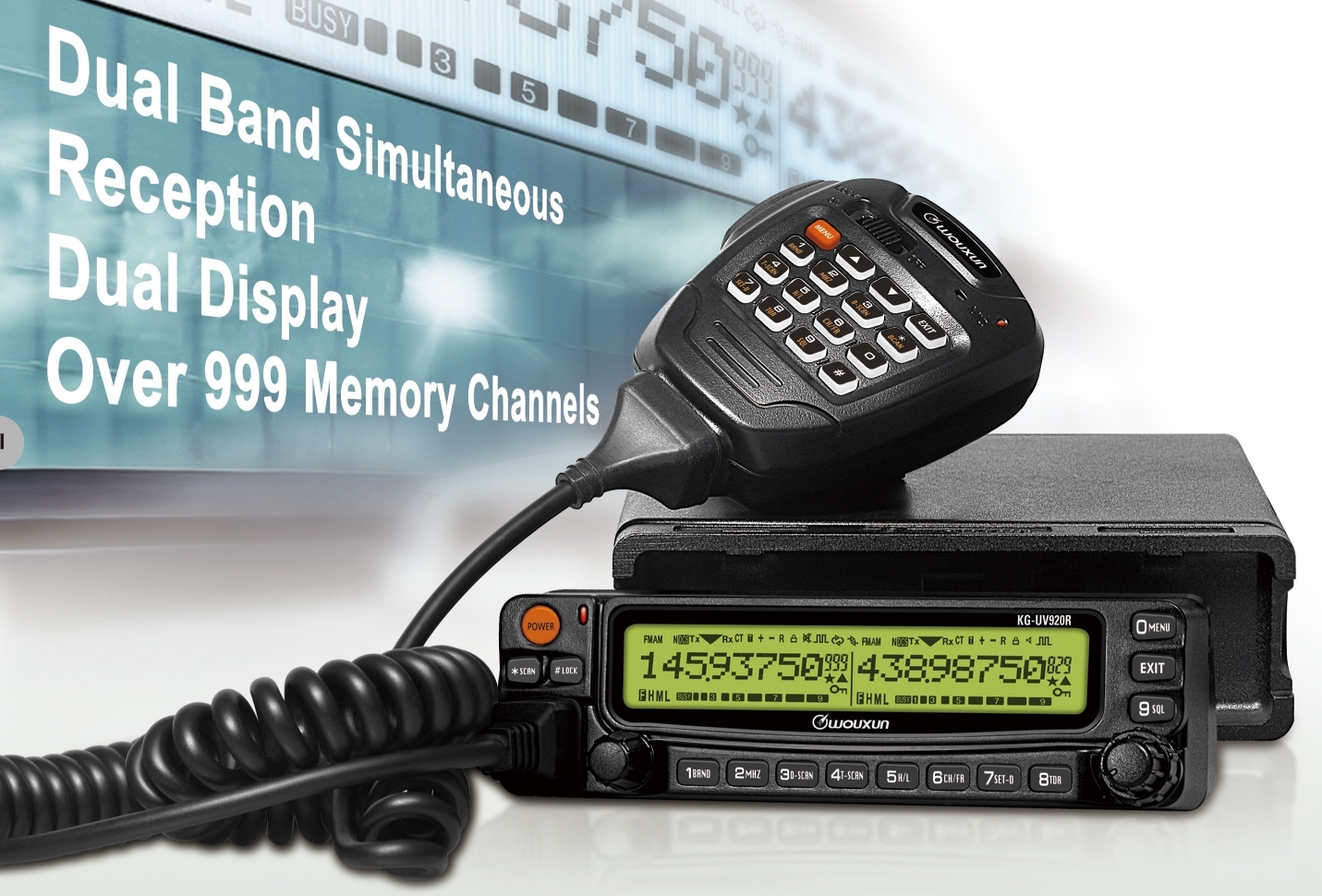
Wouxun to make a dual-band mobile?

It looks like the folks over at Wouxun are trying to get a dual-band mobile type-accepted by the FCC.

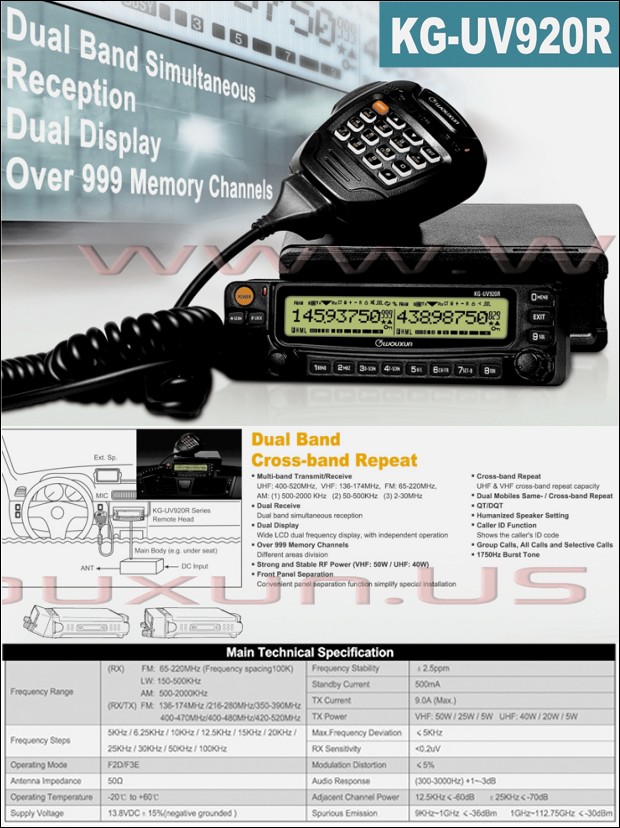
The 2m/440 KG-UV920R is not in production (yet) but a photo appears on the Wouxun homepage labeled "Coming Soon" and a note on the side of the image says that the company's head of US distribution (Ed Griffin) is in China until the end of the month (maybe to finalize the deal with this radio?).

A promotional flyer of the new rig with some preliminary specs can be found here.

Along with 2m/440, it looks like they may try to build a 2m/220 mobile radio as well!

I don't (yet) own one of these radios, but I'm saving my pennies to get one. Two radios, in fact. Maybe three. One for me, my wife, and daughter, the 2m/220 HTs.

I've been very interested in these radios since they debuted a few years ago. The low price is obviously very attractive, but my initial skepticism was that it was priced too low (as in, "you-get-what-you-pay-for") but the overall reviews have been for the most part positive regarding these radios, and the price is very hard to pass up, considering that the cost of a dual-band radio is the same (if not lower) than most single-band radios (especially 220MHz radios).

Keep your eyes on this company, folks. They may change the market on ham radios in a very good way.

Saturday, September 25, 2010

Boy Scouts rescued using ham radio

Sometimes a test of your emergency preparedness turns into a real-life emergency situation.

Such was the case with some boy scouts in Arizona who needed rescue after becoming lost while on a project to climb different peaks of the Pine Mountain Wilderness and signal one another with mirrors.

At some point during the expedition the team became stranded and one of the scouts fell ill as their water supply ran low. They relayed their predicament via ham radio to a Prescott resident who then called authorities.

After their rescue, none needed hospitalization.

It's good to see ham radio still has a purpose "when all else fails"!

Friday, September 17, 2010

5 tips for reducing radio club in-fighting, or why I don't belong to any local radio clubs

I've not been a club person for many years. In fact, I've steered away from clubs over the last several years because of one thing: politics. In fact, of the last 6 clubs I've been a member of:
  • I quit one in protest over an issue with the state ARES coordinator wanting to change policy demanding the requiring of training that cost money
  • I quit another in protest over a Field Day occurrence
  • I was thrown out of another club (who claimed I was never a member) after I tried to help organize Field Day activities that were not supposed to be club related, yet the President of the club decided he was going to make it a club event and sent me an email (and CC'ed everyone in the club) telling them that I was not a member and would do the world a favor if I went away
  • One club was dissolved after the membership dropped sharply
  • Two clubs simply went dormant due to lack of participation
Almost all of these clubs had one low common denominator: Politics.

I have been dabbling in various hobbies, clubs, and activities of all sorts and never have I seen more political mudslinging, underhandedness, and general douchebaggery than I have in an amateur radio club.

I realize not everyone's going to get along when it comes to being in a large club, but seriously, what do you have to gain from stealing someone else's thunder or makes them look bad? No one gets paid to be a club president (that I know of) and the only perk I've seen from it is that on maybe one occasion you might get thrust into the TV news' camera lenses and maybe some newsprint, and who cares who that person is, unless you're a glory hound (like some people I unfortunately know). I've been interviewed a couple of times for news stories, and it's not that spectacular, believe me. In fact I'm surprised my interview didn't end up a YouTube viral video.

KE5UTN wrote an interesting article on his blog about steps for reducing the politics of conflicts within an amateur radio club. It makes for recommended reading, especially for some of the clubs I've been associated with around here. Maybe more people would actually attend of some of these golden rules were abide by (I especially like #3).

And seriously, whoever "Robert" is, his rules of order suck!

Thursday, September 16, 2010

"New" web site address

You can now get to my blog by using the domain http://www.khaos.net.

This was a domain I registered a few years ago when it became available. The original intent didn't pan out but I kept the domain name anyway.

I wanted to start up a high-altitude ballooning group using an acronym and came up with "Knoxville High-Altitude Operation System" or "Observation" instead of "Operating". Somethinglikethat...

This was actually a couple of years before UTARC's guys started up their ARHAB efforts and I joined up with them instead.

Hmm, maybe now it can stand for "K4HSM's Ham (Amateur) Operator Service"?

k4hsm.blogspot.com still works as well.

Wednesday, September 15, 2010

Would you climb THIS tower?

Some of you out there can climb a tower 100-200 feet up, but what about going up 1,768 feet on a TV tower?

Just a warning, watching this video made my palms sweat, my feet sweat, my sweat was sweating, my body tensed up, and I'm sure my blood pressure skyrocketed.

I'm pretty sure that, in addition to the tool bag, he had to haul his BIG BRASS BALLS up to the top.


Tuesday, September 14, 2010

My 2m tape-measure antenna project

I've never been much of a "do-it-yourself" kind of person. Usually I buy whatever it is I need pre-fabricated, or have someone help me out (which basically employs my standing around getting tools and/or coffee for whomever is doing the actual work) after I buy the parts.

Take my 6m dipole for instance. I had it made for me by my friend Tim, KE4OTZ. Once I saw how simple it was, I sat there wondering why in the hell I didn't just do it myself...but that's the way I am, just too intimidated to try it thinking I'm going to set my equipment on fire if I do try to do it on my own. And chances are, I would...

When it comes to antennas, I just never felt like I was confident enough to do it properly. But last week I was shown a unique type of antenna that can be built with PVC tubing, tape measure tape, and hose clamps. And that made me think, to borrow a tired cliche, that if *I* could do it...

What was even more of an amazing coincidence was that when I talked to a ham friend of mine I work with (John, KD4DLU) he told me he made one of these himself and loved it. So, later that evening after work he and I met up and he showed it to me and let me borrow it for the weekend.

Within a few moments of looking at it, I knew this was an antenna I wanted to build, and I wanted to do it myself!

And not only did I do it myself, I did it fast, too. This could be constructed in less than 2 hours, and that's with a trip to the hardware store to get what you need.

So, last Sunday afternoon I went to the store and picked up the PVC connectors I needed, (I already had the right size PVC pipe from a previous project) along with the metal hose clamps and the tape measure. I bought the cheapest 25' roll they had, which was just under $5. I didn't need anything fancy, since the only thing I needed after all was the metal tape itself. And do make sure it is metal tape measure you are buying.

I got home and the first thing I did was to bring up the project's web page (written by Joe, WB2HOL) and got the measurements of the elements I would need. I extracted all 25+ feet of the tape, cut it using ordinary (but expendable) scissors and set the now-empty cartridge aside (you should hear the spring on one when it tries to reel in an empty roll of tape). I then cut the lengths I needed. In fact, I had so much tape measure left over I can actually make 2 of these antennas or add additional elements if I wanted more improved directionality of the yagi.

One note about the tape measure components is that they have sharp edges. I trimmed the edges off at the corners (see picture) and then applied electrical tape to the ends in order to prevent the sharp edges from cutting or stabbing me when handling it.

Next, I cut the PVC pipe into the proper lengths and then connected them together. I didn't need glue to hold the PVC fittings together, but it can be used if you prefer. I took the tape measure pieces for the reflector and director elements and connected them with the hose clamps. The bigger part of the project was getting the driven element parts connected to the array.

I had to use sandpaper to get the heavy paint off the tape measure components so that I could solder the coax and the hairpin match to them. Once I did that I warmed up the soldering iron.

While the soldering gun warmed up I searched for some wire for the "U"-shaped hairpin match, and eventually took some old wiring from an old ATX computer tower's power switch and stripped it to the required length for the hairpin match. Then, I took a string of coax from an old Radio Shack mag-mount antenna and cut about 12" off the end. I would later regret this, to be honest, as I should have cut a much longer length.

I then took some solder to the tape measure pieces before attaching them to the antenna structure. This works best so that when you attach the elements to the PVC pipe, you can then solder the coax and hairpin wire quickly without melting into the PVC underneath.

After I connected the driven element segments to the PVC, I wrapped electrical tape around the bend of the "U" shape in order to hold it in place against the PVC and then soldered the hairpin wire to the tape measure. It was very easy, almost too easy, really. In order to set the proper 3/4" distance between the leads, I took a scrap piece of tape measure cut to 3/4" and used it as a spacer. this was discarded once I had the correct distance between the two driven elements.

I then took the shielding off the RG-58 coax and then twisted it together, then tinned the shielding in advance and then soldered it to the tape measure mounted on the PVC. It was less than 3 seconds for the solder to melt enough for the wire to penetrate. Same with the center conductor. I even applied more solder afterward with no melting of the PVC pipe. The hairpin wire did not move when the solder melted around it as I applied the coax connector.

And just like that, I was done! I could not believe how easy it was, to be honest. I measured the SWR and it was 1.1 to 1.3 on 146.555 MHz. And I didn't have to adjust anything!

I plan to use it for a foxhunting project that the University of Tennessee Amateur Radio Club is putting together in October.

Again, I think I'm going to re-do the coax connector to make the cable much longer than the one I have on there now. Other than that I couldn't be more pleased with myself. In fact, I'm actually thinking of making one of these with more elements in order to narrow the beamwidth down even more, and use on a field day or mountaintop journey.

If you had to buy all the parts, you should not be out more than $25 at the most, I would think. Since I had the PVC pipe already, that trimmed the expense a tad. The most expensive part was the 10-pack of hose clamps, at just under $9. Zip ties or self-tapping screws can also work if you're on a tight budget. I recommend the hose clamps on the driven element at the very least in order to keep the element in place more securely.

Below are some additional pictures if you are so bold to try and take on such an intriguing endeavor. It's certainly an easy project that anyone can do and will not take all day or all your money to invest in the effort. It's a guaranteed confidence-builder.

Here are some additional pictures:

This is a shot of my measuring out one of the lengths for the two driven elements to be installed in the center.


Use sandpaper to strip the paint off the tape measure for the center radiators to ensure a good connection with the coax and the "U"-shaped hairpin match.


The hose clamps connected to the D1 driven element. Tie wraps can also be used or perhaps even electrical tape, but they will wear out over time. Self-tapping screws are also a possibility.


Preparing to mount onto the PVC fitting and solder the coax and hairpin match to the center elements.


The "U"-shaped hairpin match is soldered on. I used electrical tape to hold it against the PVC, which helped during soldering of both it and the coax. I took off the tape to show the match, but it can be left on to keep from getting it caught on anything.


To measure the correct 3/4 distance between the hairpin match wires on either side, I simply took a 3/4 inch piece of scrapped tape measure and used it as a spacer between the two leads. This does NOT get attached to the antenna, it is thrown away afterward.


Monday, September 13, 2010

Steve Bozak challenges citation and wins!

Earlier this year I mentioned a ham in New York (Steve Bozak, WB2IQU/HL9VX) who was cited for "talking on a cellular phone while driving" by a cop who apparently can't tell the difference between a ham radio and a cell phone.

Steve challenged the ruling and has won his argument.

The ruling is as follows:
The Vehicle and Traffic Law defines a "Mobile Telephone" as a "device used by subscribers and other users of wireless telephone service to access such service" (VTL §1225-c [1][a]). A "Wireless Telephone Service" is defined as "two-way real time voice tele-communications service that is interconnected to a public switched telephone network and is provided by a commercial mobile radio service, as such term is defined by 47 C.F.R. §20.3 (VTL §1225-c [1][b])(emphasis added). A review of 47 C.F.R.§20.3 reveals that Citizens Band Radio Service is defined under private mobile radio service not commercial mobile radio service. Therefore, the Court finds that the use of an amateur radio device does not fit the definition of a mobile telephone as defined under the Vehicle and Traffic Law and grants the defendant's motion to dismiss.
I sent the link to Steve via Facebook and it was news to him. He hadn't received word until I posted it!

Glad I was able to give him some great news...even if the law lumps ham radio and CB together...

Thursday, September 9, 2010

Why call for "emergency traffic"?

There are all sorts of nets on local repeaters, from SKYWARN nets to formal traffic nets to roundtable BS sessions.

I've called all sorts of nets since I got my ticket. One of the first net's I ever called was a technical net on English Mountain's 146.730 repeater in the mid-90s. From there I got to calling some of the nets on the Radio Amateur Club of Knoxville's (RACK) repeater, then I was calling nets for the local ARES/RACES group, then for yet another now-defunct radio club (a midnight "night owl net"), and all of this was at the same time!!! And then I began calling nets for SKYWARN.

One thing was always constant, with the exception of the SKYWARN nets, and that was all the other nets I was calling had the call for emergency traffic at the beginning of the net (also known as the preamble).

For example, this would be the beginning of a preamble used for a typical net on any given repeater in the area:
Calling the (NET NAME) net.
This is (YOUR NAME) in (LOCATION) and I'll be the net control for tonight's net.
This net meets every (DAY OF WEEK) at

Now, this is going to sound like me being a grammar nazi, but over the last few years I began to ponder the need for asking for emergency traffic. I mean, seriously, if there's an emergency, who's going to wait around until it's asked for? And when is an emergency ever scheduled for that particular time of the net???

And if there was a bona fide emergency, who's going to tell them "wait until emergency traffic is called for!"?

Again, seriously, if there's a legitimate emergency, you stop what you're doing (unless you're already calling an emergency net) and take that traffic first priority.

If I were still calling non-emergency nets (or really any nets for that matter, as I haven't called a SKYWARN net in any official capacity in about 4 years) I would say this for my preamble:
Calling the (NET NAME) net.
This is (YOUR NAME) in (LOCATION) and I'll be the net control for tonight's net.
This net meets every (DAY OF WEEK) at (TIME) on the (REPEATER NAME/FREQUENCY).

If there is any emergency traffic during this net, please alert the net control with your callsign and announce the word "Break" twice, at which time all net activity will be suspended in order to handle the emergency traffic.

That should suffice, don't you think?