QRZ Logbook

        
Showing posts with label license. Show all posts

Saturday, August 10, 2013

1965 Ham License Answers

Novice:
  1. Question #9: What method of frequency control is required to be used in the transmitter of a station licensed to the holder of a Novice Class License? The frequency must be crystal-controlled.
  2. Question #13: What is the maximum permissible percentage of modulation of an amateur radiotelephone station? 100%
  3. Question #17: What is the relationship between a fundamental frequency and its second harmonic; its third harmonic, etc.? The second harmonic is twice the frequency of the fundamental, the third harmonic is three times the fundamental frequency, and so on. A harmonic is always related to its fundamental frequency by an integral multiplier; i.e., 2, 3, 4, 5, 6, etc.
  4. Question #23: How is the actual power input to the tube or tubes supplying energy to the antenna of an amateur transmitter determined? The input power is determined by measuring the direct-current plate oltage and the d.c. plate current to the tubes in the final stage in the transmitter. The power input is equal to the plate voltage multiplied by the plate current in amperes.
  5. Question #27: What is meant by a "parasitic" oscillation? A parasitic oscillation is one not essential to the operation of the equipment and usually occurring on a frequency considerably removed from the operating frequency.
General:
  1. Question #1: Name the basic units of:
    • electrical resistance - ohm
    • inductance - henry
    • capacitance - farad
    • current - ampere
    • electromotive force or potential difference - volt (electromotive force is a fancy term for "voltage")
    • power - watt
    • energy - joule
    • quantity - coulomb
    • magneto-motive force - gilbert
    • frequency - cycles-per-second, or cycles (nowadays known as "hertz")
     
  2. Question #10: What is the principal reason for using a filter in a plate power-supply system? The principal reason for using a filter in a plate power-supply system is to smooth out the a.c. ripple component in the output and make it "pure d.c."
  3. Question #19: What undesirable effects may result from operation of an unneutralized triode r.f. amplifier in a transmitter? Self-oscillation may result, with consequent radiation on undesired frequencies, possibly outside an amateur band.
  4. Question #69: What is meant by a "doubler" stage? A vacuum-type circuit in which the output circuit is tuned to twice or doube the frequency of the input circuit.
  5. Question #71: What is the reciprocal of resistance? Conductance, measured in mhos ("ohms" spelled backwards)
  6. Question #106: What precaution should be taken to protect filter capacitors connected in series? Resistors having a value of approximately 100,000 ohms should be shunted across each capacitor to equalize the d.c. voltage drops and thus prevent breakdown of the individual capacitors.
Extra:
  1. Question #4: What factors determine the core losses in a transformer? Core losses are one of two types, hysteresis and eddy-current losses. Hysteresis losses vary with the type and volume of iron or steel used in the core and with the operating frequency and magnetic flux density. Eddy-current losses vary with the volume and resistance of the core material, the thickness of the laminations, and frequency and the flux density.
  2. Question #7: In a Class-C r.f. amplifier, what ratio of load impedance to dynamic plate impedance will give the greatest plate efficiency? The highest possible load impedance will give the greatest efficiency, since the ratio of the power in the load to power lost in the plate becomes larger as the ratio of load impedance is increased. However, under these conditions, the power output is relatively small.
  3. Question #12: During 100 percent sinusoidal amplitude modulation, what percentage of the average output power is in the sidebands? 33 1/3% The average power output would increase 50% with such modulation; i.e., a 100-watt unmodulated carrier output would rise to 150 watts. Sidebands carry the excess of 50 watts, which is 1/3 the total.
  4. Question #25: What are synchronizing pulses as used in television transmitters and receivers? Synchronizing pulses used in television transmitters and receivers are pulses of extremely short duration which ensure that trace lines across the face of the picture tube in the receiver are synchronized with the trace lines in the television camera.
  5. Question #34: What determines the operating frequency of a magnetron oscillator? Its dimensions and the electric and magnetic field intensities; also, the associated circuit constants.
  6. Question #46: If the conductors in a 2-wire r.f. transmission line are replaced by larger conductors, how is the surge impedance affected, assuming no change in the center-to-center spacing of the conductor? The surge impedance is lowered.
  7. Question #63: What is the purpose of the mosaic plate in a television camera? To what item of photographic equipment is it similar in function? To store an electrical image corresponding to the visual image focused upon it, for later scanning by an electron beam to translate the electrical image into a television signal. Its function is similar to that of the film in a photographic camera, which similarly stores the image for later development.
  8. Question #92: What are the "Baudot" and "Seven Unit" codes? How are they used? Both are used in teleprinter operation. Baudot used with synchronous printers, 7-unit with start-stop printers. Each transmitted character has assigned to it a fixed time interval divided into units, 5 for Baudot and 7 for 7-unit teletype. A particular character is distinguished by a unique combination of mark and space units in that particular codes being used in all cases.
  9. Question #120: What is the meaning of the term "frequency swing" in reference to frequency-modulation transmitters? The peak difference between the maximum and minimum values of the instantaneous frequency.
  10. Question #136: What is the ohms per volt of a voltmeter constructed of a 0-1 d.c. milliammeter and a suitable resistor which makes the full-scale reading of the meter 500 volts? 1000 ohms per volt.
  11. Question #181: What is meant by low-level modulation? That applied to an early or intermediate stage of a transmitter (instead of to the final amplifier) i.e., at a point where the power level is comparatively low.
  12. Question #204: State where antenna impedance is usually measured. At the point where the antenna is fed. The value so measured is frequently converted into an equivalent value at a current loop.
  13. Question #219: Define a "back-wave" and explain what causes it. A signal emitted during key-up conditions. In make-break keying, it may be caused by energy from unkeyed exciter stages leaking through a keyed amplifier (because of improper neutralizations, etc.) or by parasitic oscillation. In frequency-shift keying the "space" signal in the back-wave.

Friday, August 9, 2013

Could you pass the 1965 Ham License exam?

1965 ARRL FCC
License Manual
I was at an estate sale a couple of weeks back and came across a couple of books that got my attention, The Radio Amateur's License Manual and How to Become a Radio Amateur. Unfortunately I didn't get to find out the callsign of whoever it was that had the books.

The license manual covered all of the classes of licenses available at the time: Novice, Technician, General, Conditional (same as General but test taken by mail), Advanced (not available to new applicants), and Extra.


As I scoped out the book, I found some interesting rules that the FCC enforced at the time:
  • If you wanted to take the test or renew, you paid $4, and it was good for 5 years. If you changed your address, it was $2.
  • Callsigns must be transmitted at the beginning of each transmission, every 10 minutes, and at the end of each transmission (currently hams don't need to identify at the beginning).
  • Novices retained their callsigns for a year and must upgrade.
  • Hams violating FCC rules faced a $500 fine per day during which the offense occurs.
  • Logs were kept of each QSO and must show:
    •  Date & time of transmission  
    •  Signature of each operator
    •  Call of the station contacted
    • Power
    • Frequency
    • Emission type
    • Location
    • Message traffic handled
  • Hams had to notify the FCC Engineer-in-Charge if they intended to operate mobile longer than 48 hours.
  • If an applicant failed an exam, they had to wait 30 days to re-take the exam.
  • The book cost 50 cents, and included the FCC Part 97 rules and regulations.
The other manual
I bought
Some rules have obviously changed. 

What struck me even more was that many of the questions from the Novice/General/Extra questions were pretty tough. Even with my electronics education and background, it was amazing how intricate many of the questions were. Unlike today's question pools, the 1965 pool did not include multiple choice answers with the wrong answers included, but the exams were multiple choice. It also wanted the reader to draw out certain circuits.

So here are some sample questions in the Novice, General, and Extra class exam pool. See how many you can answer. I'll post the correct answers in 24 hours:

Novice:
  1. Question #9: What method of frequency control is required to be used in the transmitter of a station licensed to the holder of a Novice Class License?
  2. Question #13: What is the maximum permissible percentage of modulation of an amateur radiotelephone station?
  3. Question #17: What is the relationship between a fundamental frequency and its second harmonic; its third harmonic, etc.?
  4. Question #23: How is the actual power input to the tube or tubes supplying energy to the antenna of an amateur transmitter determined?
  5. Question #27: What is meant by a "parasitic" oscillation?
General:
  1. Question #1: Name the basic units of:
    • electrical resistance
    • inductance
    • capacitance
    • current
    • electromotive force or potential difference
    • power
    • energy
    • quantity
    • magneto-motive force
    • frequency
     
  2. Question #10: What is the principal reason for using a filter in a plate power-supply system?
  3. Question #19: What undesirable effects may result from operation of an unneutralized triode r.f. amplifier in a transmitter?
  4. Question #69: What is meant by a "doubler" stage?
  5. Question #71: What is the reciprocal of resistance?
  6. Question #106: What precaution should be taken to protect filter capacitors connected in series?
Extra:
  1. Question #4: What factors determine the core losses in a transformer?
  2. Question #7: In a Class-C r.f. amplifier, what ratio of load impedance to dynamic plate impedance will give the greatest plate efficiency?
  3. Question #12: During 100 percent sinusoidal amplitude modulation, what percentage of the average output power is in the sidebands?
  4. Question #25: What are synchronizing pulses as used in television transmitters and receivers?
  5. Question #34: What determines the operating frequency of a magnetron oscillator?
  6. Question #46: If the conductors in a 2-wire r.f. transmission line are replaced by larger conductors, how is the surge impedance affected, assuming no change in the center-to-center spacing of the conductor?
  7. Question #63: What is the purpose of the mosaic plate in a television camera? To what item of photographic equipment is it similar in function?
  8. Question #92: What are the "Baudot" and "Seven Unit" codes? How are they used?
  9. Question #120: What is the meaning of the term "frequency swing" in reference to frequency-modulation transmitters?
  10. Question #136: What is the ohms per volt of a voltmeter constructed of a 0-1 d.c. milliammeter and a suitable resistor which makes the full-scale reading of the meter 500 volts?
  11. Question #181: What is meant by low-level modulation?
  12. Question #204: State where antenna impedance is usually measured.
  13. Question #219: Define a "back-wave" and explain what causes it.

Thursday, May 2, 2013

My new ham radio "bling"

After my unexpected, less-than-friendly departure from the Pigeon Forge Titanic Special Event because of a lack of having my license upon my person, I made a photocopy and laminated it for my wallet (which soooooo many hams were soooooo polite to inform me of what a wallet-sized ham license looks like) so that this issue, should it ever occur again, will not prevent me from operating.

But I couldn't stop there. I needed to go deeper into being the smartass I can be.


I needed to make my license readily available so that I didn't have to go through the painstaking burden of reaching into my back pocket and pulling out the license. I needed something even more convenient.

Close up of my new necklace!
A coworker of mine has been making pendants using parts from a hobby store and clear acrylic, and one morning while we were talking about his latest creation (a OUIJA board) it dawned on me to have him attempt to do the same thing with my ham radio license. I obtained the parts needed, mainly the pendant, and he began work on the project. I sent him a scanned copy of my license and he was able to reduce it down to the dimensions of the pendant. 

Once he had it reduced, he took it to Walmart and had it printed on photo-quality paper. After snipping it down further, he positioned it and poured the acrylic atop it.

Quarter for scale
After a couple of days to set, he brought it in Wednesday morning me to look over. I couldn't be happier with it.

So now I not only have my official wallet-sized license to whip out on demand, I can also brandish this new piece of "bling" to amaze and impress. The wife and daughter like it and I'm going to have their licenses made into this as well. Amber, the little one, she wants one, too, and she's studying up already.

So next time before you ask me for my ham license, look around my neck for this new piece of hardware!

The next step? maybe something along the lines of Flavor Flav and his giant clock, perhaps?  YEEEEEEAAAAAHHH boyeeeeee!

And by the way, if you're interested in getting one of these using your license, let me know.

Sunday, April 14, 2013

How to lose friends and influence righteous indignation

I've been a ham going on 20 years.  Back when I got my license, there was no "internet" as we know it today. We did not surf the web, e-mail, blog, or Google. And cell phones? If you were a celebrity or a doctor, you got the privilege of owning one, which might have been a 20 pound battery with a handset strapped to the top of it. & frget txt msging LOL :)

Remember these things?
We also didn't get our ham radio licenses in just a few days. I waited nearly 10 weeks to get my license in the mail. Once I got it I finally knew what my callsign was (at the time KE4HSM) and got on the air, and got the ball rolling.

My, how times have changed. I mean, now we can do all those aforementioned things and then some and even do it in the palm of your hand. Heck, with electronic licensing, we don't have to wait around until the postman delivers our mail in order to get our callsign, we just check the FCC database and once it's in there, we're on the air! Am I Right?

So last Saturday night I made my annual pilgrimage to Titanic in Pigeon Forge, TN to assist in operating the ham radio special event to commemorate the anniversary of the sinking of the ship. I've operated there the last 2 years, brought my kids along and let them operate, and they both tagged along this year. It was late but they wanted to operate for a while then crash in the car while I stayed for a bit longer, that's how it's been done in the past. It's never been a problem.

My, how times have changed.

So we arrive and there's only one operator there and he's working the 80m station. We make small talk for a a couple of minutes and Amber grabs a headset from another radio and I turn it on and tune to 20m where I start to hear some chatter. Just as I start to fine tune the signal, Amber tugs at me and asks "where's your license?". 

I didn't understand the gist of her question until the operator said "You need your ham radio license to operate here".

I said I didn't have it on me (I checked my wallet to be sure) and he said I was not allowed to transmit without my license in hand. 

Now understand, I don't know this guy from Adam. In fact, I didn't catch his call because either I didn't hear it or he didn't tell me, even after I introduced my kids and myself, and I think it was the latter. He was using the special event club call (W4S) when he was on the air. So I don't know his realm of knowledge with all things ham radio, but he berates me for not having a license in my possession when I know for a fact one is no longer needed to be in possession in order to transmit on ham radio, one just has to have an active callsign. And here is this guy trying to school me on what an FCC ham radio license looks like. I advised him I didn't need one to operate a station thanks to electronic licensing, but he was having none of it.

I could have gotten belligerent with him but 1) I had the kids with me, and 2) I've learned to keep my mouth shut when it comes to speaking before thinking, especially when said thoughts are about what to do, where to do it, how to do it, and with whom to do it. I didn't say another word, other than telling the girls "let's go," and heading for the car.

Needless to say after 2+ hours and 80 miles of my life I won't get back, I'm pissed off. Royally. What good would it have been to argue my case, justifiably so, if it only creates a negative air and hostile tension between what's-his-face and myself? The kids are disappointed, I'm irate, and we are ready to have the day over with and done at this point.

When I get home I get on Facebook and let the guy in charge have it. His response was basically that due to events last year, there was a change in the rules and "it was in the notice". The specific rule in the notice says:
Non Members Must Present A Valid FCC License to operate the event stations !
Okay, fine. I honestly didn't read all of it. I didn't think I needed to because 1) I've done this event every year they've had it and nothing's changed except the location around the museum, and 2) it was buried at the tail end of the "notice" on the Facebook page, where few would catch it unless they were attentive. So screw me, right?

But basically this is a statement covering a lot of people. "Non-members" also includes the general public, as in non-hams. So what we have is a PUBLIC service club operating a PUBLIC event at a PUBLIC location not allowing the PUBLIC a chance to operate the equipment in order to make the PUBLIC demonstration hands-on. So what's the point of even having the damned thing if you prevent people from participating, maybe even getting some interested in ham radio and creating new licensees? Is this club going to instill this "rule" for Field Day, the biggest publicity event of the year?

But so be it, if this is how they want to operate, that's their prerogative. It's mine not to participate in the future with the event or this club, since obviously they feel "non-members" run such a serious risk to others. And this proves another example as to why I don't do clubs anymore.

Sometimes common sense fails miserably when trying to have a good time on the radio.

My, how times have changed, indeed. Now if you'll excuse me, I apparently need to make a photocopy of my license in the event some overbearing individuals need to see proof I know what the hell I'm doing.

Saturday, July 23, 2011

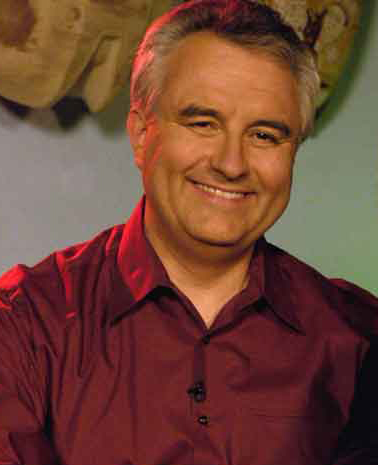
Leo Laporte, KJ6QGP (W6TWT)

Leo Laporte of TWiT and The Screen Savers fame is now KJ6QGP.

Leo's already embraced ham radio by partering with Bob Heil of Heil Sound who's doing a weekly podcast and starting up a ham radio social network.

So does this mean he'll be showing up at Dayton in the near future?

UPDATE: He has applied for and will be granted W6TWT

Monday, May 31, 2010

More hams in trouble with authorities

It seems that ham operators' run-ins with the law must come in waves, as yet ANOTHER ham is in trouble with police.

Although not as severe as Irene Levy (KJ6CEY) acted in California, this one is just as much a black eye on ham radio as her case is.

Authorities say that Keith Mutch (KB1RBI, pictured right) of Norwich, CT used a ham radio to report over the nearby Wal-Mart radio frequency that a man with a gun was outside the store threatening to shoot people, sending police into action.

Although there are no specific details, authorities were somehow able to determine that Mutch was responsible after Wal-mart employees advised none of their employees made the transmission.

Besides making a false report, he was also charged with reckless endangerment and breach of peace. He's currently held on $5000 bond awaiting a hearing on Tuesday, June 1.

And on the other side of the world in New Zealand, the Radio Spectrum Management agency (New Zealand's equivalent to the FCC) has charged Alan Potter, ZL3II (pictured, left) with running a station on 3100 watts of power, well over the 500W limit his license class was authorized for.

RSM was alerted after Potter posted a YouTube video of himself running his station at 3100 watts. The video has since been removed.

In addition to fines and court costs, Potter has to also forfeit his radio equipment.

Yet again another example that, if you're going to break the law, don't post the video to YouTube to show off!!!

Tuesday, December 22, 2009

My Christmas present to you: How to renew your ham license for FREE! *

If you've been licensed for over 10 years, chances are you've received notices from companies offering to renew your license for a "minimal fee".

Well, I'm about to save you some money, because you don't have to pay a dime if you do it yourself*.

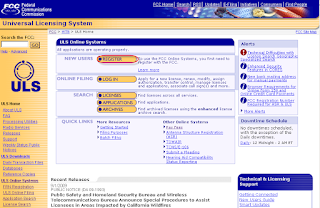
All you need to do is to go to the FCC's Universal License System (ULS) site and renew online.

A few "quick notes":
  • *If you have a vanity callsign (like I do) you will need to pay the vanity fee (currently $13.40 as of the posting of this article). This fee can also be paid online.
  • You cannot renew until it is 90 days before the date of expiration and up to 2 years after the expiry. If you wait to renew after the expiration date, you CANNOT transmit on amateur radio frequencies from the date of expiration until it appears in the ULS as renewed! If you wait until after the 2-year grace period, it cannot be renewed, you will need to take the Technician Class exam to get re-licensed.
  • This whole renewal process will NOT be instantaneous, it may take several days to process, so the sooner you fill out the renewal request during the 90-day window, the sooner it will get processed and you will not have to chance an interruption from using ham radio.
  • If filing online is still not for you, then you can still print and fill out the Form 605 and file via snail mail. That's free as well. Also, the ARRL will do it free for members, but Vanity calls are $13.40 + $5 for processing.
Find your FRN


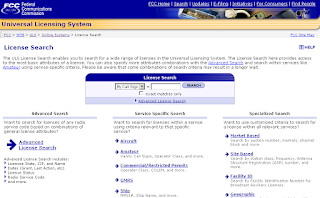
You will need to know your FRN (FCC Registration Number) in order to renew. Don't know it? Don't worry, all you need to do is look it up on the ULS search page.

To search for your FRN:
  1. Go to the ULS main page.
  2. Under the "Search" area, click "Licenses".
  3. In the search page enter your callsign.
  4. Locate your callsign. Under the "FRN" column (in the center) is your FRN that you will need to log in and renew your license. Write it down!
If you already know your FRN and password, go to the login page, sign on, and wait for me down below. Otherwise, continue on...

Chances are, you've never had to use ULS before, since either you've been a ham for less than 10 years, or renewed it before ULS online renewal was enacted, let someone else do it for you, or you got a new callsign (due to vanity request or license upgrade) and the 10-year term was reset upon the issuance of the new callsign. Therefore when you get back to the ULS sign-on page, click "Register".


When you get there, you will have 3 options, click "Update" in the middle.


Personal Security Question

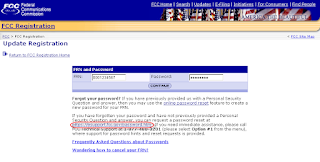
Now, if this is your first time using ULS, you probably have not set your Personal Security Question. If you have previously set up your Personal Security Question, skip to the next paragraph. If you have NOT set up a Personal Security Question, you will need to fill out an online request form and someone with the FCC will manually set this question and email you once complete. This may take a couple of days! To get to the request page, click the link that takes you to https://esupport.fcc.gov/password.htm.


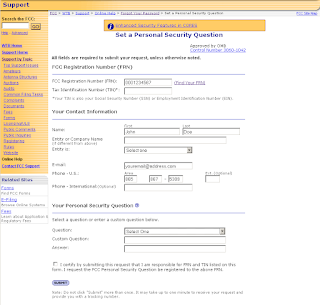
On the next page, click "Set your Personal Security Question" and the next page is where you fill out the Personal Security Question you want to set.


You will need your FRN, enter your contact info, and provide a current email address, then set whatever you want for your Personal Security Question. You can either choose a preset question from the dropdown menu, or set one up that you alone will know.

Again, someone contracted with the FCC will set the question and answer you chose so once again write it down!

Reset your password

Once you have received your email from the FCC that the Personal Security Question has been set up (or you already know it and skipped the previous paragraph) you will need to set your FRN password.
  • From the ULS main page, click "Login", then go to the link to contact tech support, then click the link to reset your password.
  • Enter your FRN (you did write it down, didn't you?).
  • Answer the Personal Security Question you set up.
  • Enter your new password (minimum 6 characters, combination of letters, numbers, and special characters (I highly recommend you do NOT use your callsign (if it was a 2X3).
  • Once your password is reset you may get a notification from the FCC advising that your password was reset.
Time to Log in to the ULS

Hopefully you haven't given up hope and are not shilling out $5-10 for someone else to renew your license at this point. We're almost there, I promise!

You've gone through setting up your Personal Security Question and/or password, so now it's time to log in.
  • From the ULS main page, click "Login".
  • Enter your FRN (again, you did write it down somewhere?) and password.
  • You should now be viewing your information (callsign, address, etc.):
  • On the menu to the left, you will see a link to renew your license so click the link.
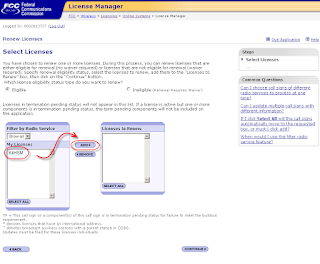
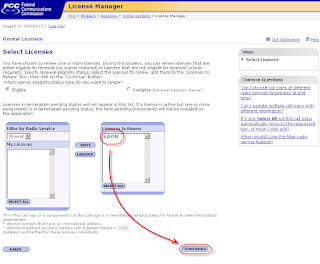
  • The next page will show your callsign in a box on the left (you should have "Eligible" selected above the box with your callsign). Click you callsign to highlight it, and the select the "Add" button in between. Scroll down to the bottom of the page and click "Continue".
  • Follow the remaining instructions to finish the registration and submit once you are ready.
If you have a Vanity call, you will be prompted to pay the fee associated with renewing a Vanity callsign once the renewal application has been successfully received. It will be in a "pending" mode until the Vanity fee is paid. I plan cover that process in a later posting.

And that, my friends, is what they're charging you for. So now, if all has gone through successfully, you will be placed in the queue for renewal. It shouldn't take more than a couple of business days to get updated in the ULS but give it up to 10 business days before attempting to contact the FCC for an update. Check the ULS for your callsign and note the expiration date should now read 10 years from now. You should also receive an email confirmation.

I admit for some this may be too much, but if you stuck with it this far, you hopefully saved a bit of money. If not, then you're not out an incredible amount of money if you let someone else do it for you. But still, why pay someone else to do a job that you should be able to do on your own for free?

I'd love to hear from anyone who followed these directions and get some feedback one way or the other. Also, if you could proved additional screenshots (especially if you have to renew your Vanity) I would appreciate it, as I never thought to grab screen captures while renewing mine, but then again, this idea didn't occur to me until after the fact. If you have a sequential callsign that's due for renewal, I can try to help if possible. My email is gregk4hsm at gmail dot com.