Last month I posted about a suspicious claim from Italian "scientists" that they had a machine that was producing 12,400 Watts of heat power out on 400 Watts on input.
The italian claim is off-base and without much merit, but now the US Navy has researchers in a lab claiming a breakthrough in nuclear energy-based cold fusion:
The scientists on Monday described what they called the first clear visual evidence that low-energy nuclear reaction (LENR), or cold fusion devices can produce neutrons, subatomic particles that scientists say are indicative of nuclear reactions.
Cold fusion is still skeptical to me, however, the US Navy is more of a respectable source than some questionable scientists who self-publish their hogwash.
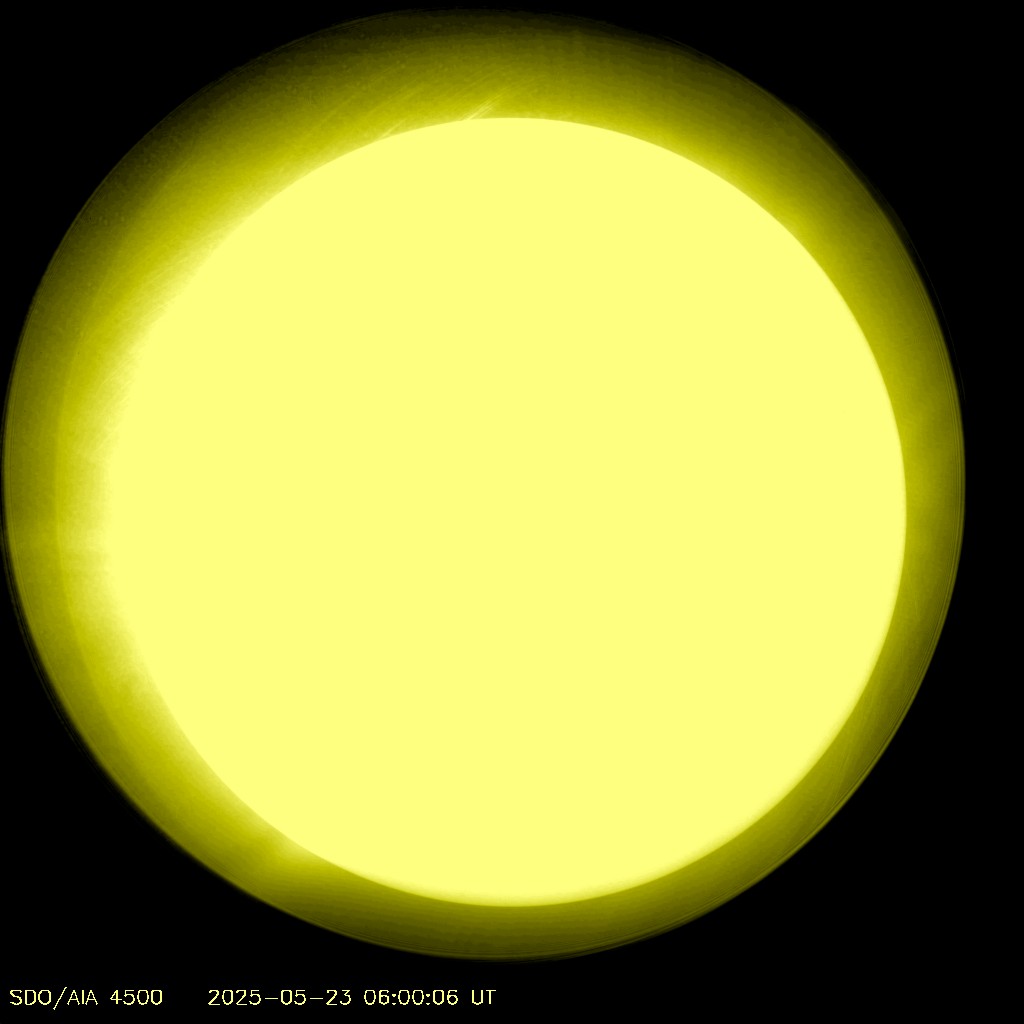
We're about 3 years into the current Solar Cycle and so far it's been less than stellar (pun intended), that is until now.
If the recent flare is any indication, we might see better-than-predicted activity from the sun this cycle.
The CME (Coronal Mass Ejection) should be hitting earth any time over the next 36 hours with beautiful aurora over the polar latitudes. And it may knock activity on the HF bands down to a standstill.
As Sunspot 1158 continues to grow, more Earth-directed flares could erupt and wreak havoc on the bands.
An couple of amazing animations of the flare can be found here and here.
This could very well be the kick-start that sun-watchers have been looking for that shows the activity on the sun is accelerating towards a peak in the activity, predicted to be in May, 2013.
They say things happen in threes, and tower fights are no exception.
Within a week, 3 articles appear online about homeowners fighting neighbors over towers in their backyards:
In Maryland, residents in Severna Park are up in arms over construction of an 80' tower despite owner Richard Hambly (W2GPS) obtaining all the necessary permits for the tower. Hambly, who designs GPS hardware and is a consultant on Satellite projects (someone who's quite familiar with radio interference issues) is facing complaints that neighbors have about the tower affecting property value and aesthetics and one complained that neighbors were not consulted beforehand. I didn't know hams needed their neighbors' blessings before putting up towers...
An appeal to rescind his permit was on February 9th.
In New York City, residents are complaining that a 30' tower was constructed illegally and is obstructing their view (as if there's much to see in NYC other than more buildings, judging by the slideshow).
Paul Isaacs, W2JGQ contends it was constructed legally but the city apparently revoked the permit.
Citing a work order stoppage, residents are demanding the tower be removed permanently.
And out in Arizona, Lee Winsor, K1VIK is in a dispute with neighbors over 2 towers he wants built (40 and 33 feet respectively) and is claiming his knowledge of ham radio and the need for antennas trumps that of the city planning staff and wants an engineering study performed. Casa Grande ordinance states that towers cannot exceed the height of the roof of the main structure on the property, which in this case is 16 feet.
68 residents signed a petition to have construction of the tower blocked.
It's one of those questions anyone over college-age gets asked every so often about this time of year: Where were you when you heard about Challenger? You don't have to ask, you know which mission being asked.
STS-51L was one of those missions that, with the exception of the planned teacher in space, received little news coverage leading up to the launch. I myself forgot the shuttle was supposed to even go up that morning 25 years ago today, and I'm a self-proclaimed "NASA nerd".
I was a Sophomore in high school, and was on my way to pre-algebra class when I walked through the hall in front of the library and in passing heard a student talking to another mumble "...space shuttle blew up!".
I was hurrying to get to class and thought it had to be some sort of joke, and missed the punchline. While in my pre-algebra class my mind kept going back to that remark. Was there a launch today? What was the mission? Who was going up?
We would go to lunch after 30 minutes in class, so we dismissed for lunch, and as I was eating, a classmate came up to me and said "Did you hear? the space shuttle blew up!"
"...and?..." I replied, waiting for a punchline. Praying for one...
"No, seriously, it blew up, the TV's on in the library!"
I spent a couple of minutes telling him it couldn't be true, but he said to go up and see for myself, so I did. I rushed through lunch (I think it was another one of our many "pizza pig-out" weeks we had, where they crammed pizza down our gullets all 5 days until we were sick of it) and hurried up to the library.
The TV was on ABC and they began another of one of the hundreds of replays shown over and over that day. All the students were silent and transfixed on the small screen as the events played out, and Challenger lifted off, rolled, climbed, accelerated, then disappeared behind a fireball, the SRB's separating apart, spiraling and wandering aimlessly out over the Atlantic.
The shock of watching 7 lives end on national television was a powerful moment. Right before my eyes I'm seeing history, and not the history I wanted to witness. And then, they show it again. And again. And again. And again...
I got home from school and turned it on CNN, and watched it, repeatedly, as I tried, like much of America, to find out what in the hell could have caused it. All we had to use for our amateur forensics was the one feed shown on NASA TV as it occurred. The launch replays from all the different angles we often see were never aired (that I'm aware) until months later and the only other video they decided to show was Christa McAuliffe's parents watching from the press section as their daughter was killed in front of millions.
The crew of the space shuttle Challenger honored us by the manner in which they lived their lives. We will never forget them, nor the last time we saw them, this morning, as they prepared for their journey and waved goodbye and "slipped the surly bonds of earth" to "touch the face of God."
I recall a very somber time those next few days, months, and years as NASA struggled to reclaim the respect and credibility of its days of going to the Moon. I followed the investigations, the accusations, and the blame game passed from one agency within NASA to another. I relived some of those emotions once again when Columbia broke apart 17 years later.
My father was there that day at Kennedy Space Center. He was driving a busload of tourists to the Kennedy Space Center and this was his 2nd launch. He knew immediately something was wrong, but many people, having never seen a launch in person before, thought it was the normal SRB separation and were cheering. He remarked it as one of the more surreal experiences in his life.
There will never be another vehicle like the space shuttle. It was a piece of science fiction turned science fact, and as NASA prepares to sunset this program, we are left wondering what the next step for our manned space program will be.
Going into space is a risky business, and these 7 brave astronauts (and all astronauts who are in the program) know that anything that can go wrong, will go wrong if not addressed properly. As Challenger took off on that cold January morning, they knew the risks involved.
The crew of Challenger will always be remembered for their bravery, inspiration, and most importantly, their spirit to achieve, excel, and succeed.
Weighing in at 30kg (66lbs), the satellite was named after cosmonaut Yuri Gagarin's radio callsign on his historic flight as the first human in space, and is celebrating the 50th anniversary of that flight.
KEDR will transmit 25 greetings in 15 different languages and will transmit pictures back to earth as well as scientific data and telemetry. The frequency will be 145.950 MHz, callsign RS1S.
(PhysOrg.com) -- Few areas of science are more controversial than cold fusion, the hypothetical near-room-temperature reaction in which two smaller nuclei join together to form a single larger nucleus while releasing large amounts of energy. In the 1980s, Stanley Pons and Martin Fleishmann claimed to have demonstrated cold fusion - which could potentially provide the world with a cheap, clean energy source - but their experiment could not be reproduced. Since then, all other claims of cold fusion have been illegitimate, and studies have shown that cold fusion is theoretically implausible, causing mainstream science to become highly speculative of the field in general.
Despite the intense skepticism, a small community of scientists is still investigating near-room-temperature fusion reactions. The latest news occurred last week, when Italian scientists Andrea Rossi and Sergio Focardi of the University of Bologna announced that they developed a cold fusion device capable of producing 12,400 W of heat power with an input of just 400 W. Last Friday, the scientists held a private invitation press conference in Bologna, attended by about 50 people, where they demonstrated what they claim is a nickel-hydrogen fusion reactor. Further, the scientists say that the reactor is well beyond the research phase; they plan to start shipping commercial devices within the next three months and start mass production by the end of 2011.
Like most the rest of the world, I call bullshit, and I know jack about physics. The paper they submitted on this reactor has been rejected by their peers, citing lack of proper theory on how the reaction works, but it was published in the Journal of Nuclear Physics. Never heard of it? That's because the scientists themselves fund and operate it!
They have applied for a patent, but it has been partially rejected, citing lack of evidence since it apparently is designed to defy the general laws of physics. I don't see why. After all, the Fushigi defies the laws of physics and they got a patent...
The YouTube video (I'll understand if you don't watch the whole 41 minutes, especially if you don't understand Italian) is vague at best on how it works. How appropriate it was in Bologna...
So there you have it, a reactor you can't see, no details on how it specifically works, a partially rejected patent for how the reactor is supposed to work, and the only "journal" to publish their findings is the one they own! So yeah, perhaps I'm a tad skeptical.
Maybe Wayne Green was right after all...hell, he's probably got his hand in this snake oil pitch...
On Wednesday, Jan. 19 at 11:30 a.m. EST, engineers at Marshall Space Flight Center in Huntsville, Ala., confirmed that the NanoSail-D nanosatellite ejected from Fast Affordable Scientific and Technology Satellite, FASTSAT.
The ejection event occurred spontaneously and was identified this morning when engineers at the center analyzed onboard FASTSAT telemetry. The ejection of NanoSail-D also has been confirmed by ground-based satellite tracking assets.
Amateur ham operators are asked to listen for the signal to verify NanoSail-D is operating. This information should be sent to the NanoSail-D dashboard at: http://nanosaild.engr.scu.edu/dashboard.htm. The NanoSail-D beacon signal can be found at 437.270 MHz.
This amazing USB stick has been a hot item of late. So hot, in fact, the last batch to go on sale (104) sold out in less than a minute.
It plugs into your computer (running Windows XP/Vista/7, OS X, and Kubuntu 10.10) and with the right program turns your computer into a software defined radio, capable of receiving whatever you want between 64MHz and 1.2GHz.
It's designed to be an educational tool for helping schools to pick up satellites using the dongle and a simple antenna. Hams around the world have been using them to receive voice/data/CW/whatever on all the bands from VHF on up.
Price is set currently at £125. Good luck picking one up. I've seen a Bag of Crap on Woot take slower time to sell out that these things.
If you missed out on the last run, there's one on eBay (ends Jan. 23) you can bid on, and as a bonus you get your callsign etched on FUNcube. Proceeds from the auction benefit the AMSAT-UK team.
You can check out this YouTube video of an "out-of-the-box" test listening to several AMSAT birds.
As I mentioned last week I got the Wouxun (pronounced "Oh-shing", close to the word "ocean") KG-UV2D handheld at the Morristown Hamfest last weekend. The radio is seeing a little bit of action, and needs some getting used to in order to properly operate it. After a week's worth of tinkering with it, here's my evaluation.
The KG-UV2D comes in 3 different versions, all using the same model number. On the 2 meter side, they all go from 136 MHz to 170 MHz. For the other band, there are three different frequency ranges. The one I have goes from 216-280 MHz covering the 1.25 (often referred to as "220") meter band. The others operate on the 70cm (often referred to as "440") band in 2 different ranges, one from 350-470 MHz, the other from 420-520 MHz. This review should cover most of what the 2m/440 radios have to offer as well concerning the functions of the radio.
Back to Basics!
First off, the relative simplicity of the radio is probably what will attract many hams (once they go past the super low price). Remember the Radio Shack HTX-202? That was a simple radio! Easy to use, clean keypad, not a lot of bells & whistles that some of today's HT's are overloaded with. It was a great first radio for may hams like myself, cutting their teeth in the post-apocalyptic no-code fallout back in the early 90's.
Don't get me wrong, it doesn't hurt to have too many gadgets on a radio to tinker with, but mess with the wrong setting, and you might have to do a hard reset of everything and start all over...
Wouxun was smart to not throw too much into these little radios. Put the essentials in (CTCSS/DCS tones, DTMF, Time-out timer, VOX) and throw in a few extras just to keep it interesting (FM radio, LED light, stopwatch, and alphanumeric memories).
RTFM (if you can)
One thing will be noticeable when you peruse the box and that is the owner's manual is not exactly, shall we say, proper use of the Queen's English...in fact, the "Engrish" is quite choppy at times. For example, the TOT function, what we call the "Time Out Timer", they dub it as the "Transmit Over Timer". There's quite a few others, but one thing I want to encourage is that, despite the rough translations, do not throw the manual away! It helped me figure out a few things I was doing wrong with the radio before getting on here shouting "this thing sucks" or something else...
I've talked with a few who went to the hamfest and got the radios (the 2/440 variety mainly) and a few were less than enthused with the radio. My first question to them was "did you read the manual?" and when they got done laughing, I reiterated "Seriously, read it!"
If you can overlook the grade-school-level translations of the Owner's Manual, reading the manual is not a large hurdle and you can get a better feel for this radio by reading it front-to-back. Right out of the box, you can figure out much of the functions with little confusion, but to get the full range of features, the manual is a must.
What happens in memory stays in memory
In one instance, I couldn't choose between high and low power via the keypad menu (more on that below). So if I wanted to shift from high to low, or vice versa, if I went through the menu options, and chose one or the other, the radio would beep three times, then reset back to the power setting it was on. As it turns out, I had to go to Menu 21 (the so-called "working mode") and set it to "FREQ" (a.k.a. VFO) before it would accept a change in power settings. If you are in the mode for the memories (CHFREQ, CH, or NAME) the power setting will not change. Whatever's plugged into the memory stays there.
Get your FREQ on
In "FREQ" mode you can direct-dial the frequency you want to listen to. You can scan to locate active frequencies if you are traveling. One of the things that is almost a must will be the need for the programming cable to quickly plug in frequencies that you plan to use. The cost will be around $20 give or take. I picked one up with the radio at the hamfest. You can program the radio manually, but the cable makes it easier by far.
Programming
While at the hamfest, I got a ham to go ahead and program my radio with whatever frequencies he had defaulted on his saved file. The software was easy to install (it runs off the executable, so no "install" necessary, just make sure you use the correct software for your operating system) and programming was not that complicated. It did not automatically shift the repeater inputs on the "TX Frequency[MHz]" column, so a knowledge of the repeater inputs (if applicable) is required.
Also note, if you program a frequency outside the transmitting range (such as NOAA weather radio on 162 MHz) leave the "TX Frequency[MHz]" column blank, otherwise you will get an error when trying to write to the radio. The error "Channel Message ## Out of range" appears, the "##" is the line number indicating which memory channel contains the invalid frequency.
The software also lets you program the TOT, frequency shift and offsets, the message you want to see when the radio is powered on, and several other features.
Selecting the COM port should be easy. On my computer, "COM3" was the only COM port available to choose. If your computer asks for more than one port, select the first one, and if the radio does not write, simply choose the "Communications Port" option and choose another COM port, then repeat until the radio upload commences. A progress bar across the bottom will move from left to right indication information is being written to the radio, and an LED light will blink on the radio.
The Good
I must say the light weight of the radio out of the box is nice. At just over 8 ounces you can almost forget you have it in your hand while walking.
I did have low audio on one repeater on 220MHz, but I determined it to be my location in the house, because when I moved to a different area (outside the house) my audio significantly increased.
I recorded myself using a local a couple of local repeaters here in Knoxville, one of which has 2 meters and 220 Mhz linked together, the other was a separate 2m repeater. The recording (which can be downloaded here, 39 seconds, 116kB MP3 file) is me first testing on the 2 meter repeater, then the 220 machine. I recorded off another radio plugged into the computer, so you will hear a buzzing noise which is NOT from my transmission, but from the radio with the carrier causing the noise. My 2m audio seems somewhat muffled on 2 meters as opposed to 220, which is why I tried it out on two different 2 meter machines.
I was told by a local ham about a mod on YouTube to increase the overall audio. I may give it a whirl soon with an update.
Voice prompts are a bonus as well. I like the feature of the voice telling me the battery voltage is low. It can also be fun to put it in Chinese to see what the different functions and channel numbers sound like.
The use of DCS and CTCSS is a good feature to have. Although I personally have not used DCS, some repeaters are employing this encode/decode method.
The dual receive on the same band is very helpful. You can monitor two 2m frequencies, two 220MHz frequencies, or one of each, or turn off the dual-receive and just monitor/use one channel. The FM radio feature also allows you to monitor your favorite repeater while listening to the local radio station of choice. Once the repeater keys up, it mutes the FM radio until the traffic has concluded.
The ability to store the FM broadcast radio frequencies into separate memory banks is also a bonus. I spent a majority of time listening to local radio stations while writing this article.
I've also programmed NOAA Weather radio into the memory so that I can take the HT with me to work and listen in if the weather gets bad.
The Bad
Just a personal preference for me, but I like a knob for adjusting the squelch. Having the radio determine the squelch via a menu setting can often lead to the radio becoming "deaf" when in the fringe areas of a repeater, or when trying to work a station on simplex. Perhaps an outside knob shielding the volume/power knob would be nice in a later version. You can temporarily kill the squelch by pressing and holding side key 2 (the lower button) but for me, I like to be able to use a physical knob to control the sensitivity of the receiver.
Next, the options for choosing high/low power, reverse (input), and repeater shift are options I would have preferred to be on the keypad or the side buttons. The menu process can be complicated just to change power level or choose a repeater shift. The lower side button (side key 2) only has two options, one for the monitoring (dropping squelch) of a frequency, or the built-in flashlight.
Side key 1 has four options to select from when programming the radio (FM radio, SOS help, scan, or lamp), so perhaps the side key 2 menu in a later model should be programmed to have the option of high/low power, reverse (input), and repeater shift. Better yet, I've always been keen on having the power button be it's own button, or a push-button switch like on the HTX-202's case. The important features (power, reverse, and repeater shift) should be a one-button function, or two steps using the "MENU" button first.
The VFO knob across the top got sticky on part of the turn when spinning it. It starts smooth (notching as you turn) and then it becomes increasingly harder to turn, as if it were tightening against something. Then as you continue to turn, the friction will ease up. I got some info (thanks, Rusty!) regarding the sticking tuning knob and was told that the plastic in the knob's base may have residue that makes turning the knob inconsistent with regards to the friction. I'm hesitant to crack the radio open right after I get it (and void that warranty!) so for now I'll live with it.
The stickers that ID the antennas (one for 216-239 MHz for the ham bands, the other antenna for 240-280MHz which is allocated for mobile, mobile satellite and fixed) are not held on very well. I simply took some scotch tape, cut it to the necessary width and length, and wrapped it around the labels to help keep them in place. See image to the left to see the scotch tape on the antenna's label.
Also, the "Wouxun" label on the front of the radio kept trying to peel off. A tiny swipe of super glue has resolved that problem.
The Ugly
The one thing I'm stumped on is why the need for a "Roger beep", and more importantly, why put it on the keypad and not something more useful such as repeater shift, MEM/VFO, or high/low power? Unless roger beeps are big in China, it's not useful here.
The owner's manual also needs to be "translated". After all we get these radios from a US distributor, so perhaps one should take the time to go through and clean it up?
The Rest
The KG-UV2D also features an "SOS" transmit for use in an emergency where it will sound an alarm for about 10 seconds and repeat this alarm approximately every 5 minutes. The SOS feature might be useful for foxhunting.
Here is a demo of the SOS feature I recorded:
It's best to use a programming cable when entering the memories you want for the radio. Using the keypad can take hours as opposed to just a few moments of programming the software, and just a few seconds of upload time to the radio.
The audio on the 2m side seems to need a tad more improvement, but, as shown by the audio recording, I was perfectly readable. Still, better audio quality makes for a better overall experience with any radio.
The Bottom Line
I do like this radio. On a scale of 1 to 10, I will give this radio somewhere between a 7 or 8. You will get your money's worth and then some with this radio. You can't beat the price of this radio, that's for sure! It's lightweight design will make it nice to carry around at a hamfest. When compared to other HT's, it's got enough features to compete, yet at the same time has a level of simplicity that makes it attractive to hams who might be intimidated by those HTs that have everything but the kitchen sink tossed in to the radio. It's not perfect, but then again, is there such as thing as a perfect radio? Some of the features a ham like myself would use more often should be easier to access, but once you get used to the radio, it should not be an obstacle. If you are looking for a good quality radio that will get you on the 1.25 meter band, this will suit your needs perfectly. If 220 is not active in your area, go with the 2m/440 version.
Wouxun is getting noticed with these radios, judging by the interest at the hamfest I attended. Perhaps this will open the market up for more 220 radios by the heavyweights like ICOM, Yaesu/Vertex and Kenwood, whose 220 product lines are all rather thin or even non-existent. It might get the competition to lower their prices on their current models (and/or future ones) in order to compete, not just the 220 market, but the 440 MHz dual-band radios as well. There are things that could be better on the radio overall, but this is certainly not a "knockoff" by any stretch, and does the job for those who may want a cost-effective means of getting on 220 or 440.
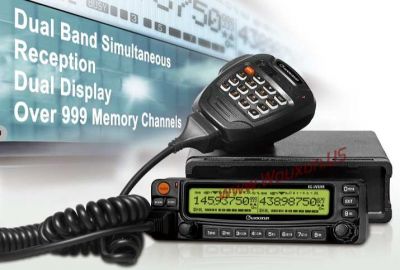
A visit to the Wouxun (pronounced "O-shing", close to the word "ocean") web site while checking out specs on my new KG-UV2D HT showed that they were taking reservations for people wanting to buy the 2m/440 dual-band mobile as soon as it's available.
You can put in for a reservation to have the chance to get in on the new radios once they are available, no obligation to buy once the price has been announced in case you don't like the price.